1090 – At the same time that one motley crew of illiterate peasants seizing control of a wilderness island at the edge of the known world at the Battle of Hastings was heralded as a great feat, the Seljuq Turks in a whirlwind advance seized control of the most civilized and wealthy territories of what is known today as Iran, Turkmenistan, and northern Afghanistan, and kept on going.
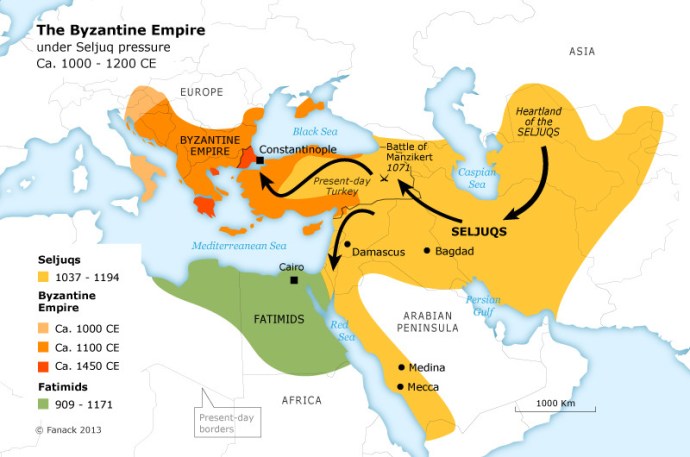
The Great Seljuk empire was made up of an astoundingly diverse range of linguistic and ethnic groups, and religions including Muslims, Christians, Jews, and Zoroastrians in a loose political confederation meeting mutual interests. Like OPEC.
True to the endless battle for control of the land east of Eden, Rome’s East Thema / Eastern Administrative Division at Constantinople battled for control of the area against the Arab Islamic Caliphates in eight major Crusades between 1096 and 1291. Later historians – NOT documents at that time – designated the region controlled by Rome the Byzantine Empire, after the original Greek name of Byzantium, changed by Roman Emperor into his name of Constantinople. Whether or not intentionally, this deflects attention from Rome’s continuous control in this regions. The more reality-grounded sailors called this territory The Levant which meant ‘the rising’ or ‘to rise’ referring to how the land rose up out on the horizon of the sea when sailing towards it, and this appellation has stuck to this day.
The First Crusade was proclaimed by Pope Urban II, whose position as head of the Catholic Church had strengthened through wars on the frontiers of Western Christendom to direct armed force in the name of religious causes. Over time, the crusading movement expanded to include campaigns against pagans, Christian dissidents, and other enemies of the papacy into the 18th century.
The Massacre of Jerusalem was a mass slaughter of thousands of Muslims and Jews by the sieging Crusaders in mid-July 1099. Historians and eyewitness crusader accounts emphasize that the massacre was especially brutal, even by the standards of ancient and medieval warfare, a “juxtaposition of extreme violence and anguished faith. Eyewitnesses described it as “more of a slaughter than a fight”, “the slaughter was so great that our men waded in blood up to their ankles”, and at “the porch of Solomon men rode in blood up to their knees and bridle reins… the blood flowed so forcefully and deeply that it carried the severed limbs and heads down the avenues of the city.”The death toll in the temple alone reached 10,000″ and “none of them were left alive; neither women nor children were spared.” Crusaders brutalized the bodies of dead Muslims, “eviscerating them from the head to the kidneys and cutting them lengthwise from left to right,” and many were decapitated, hit with arrows, and burned alive. The Crusaders then ran amok through the streets of the city, stabbing everyone they encountered – Muslim, Jew and Orthodox Christian alike. From a population which had numbered 40,000 the few remaining were sold into slavery. Such a massacre in the city has seldom been paralleled in the history of war. 22
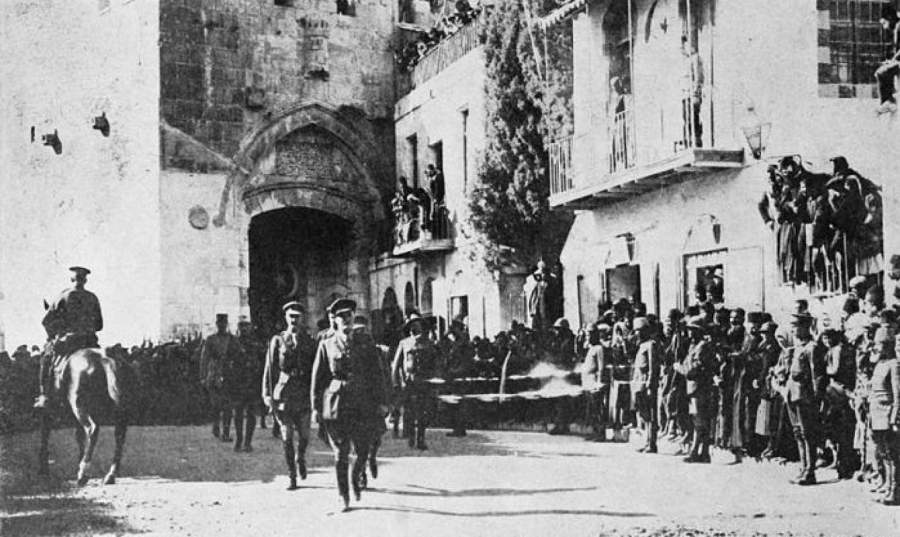
In 1187 Salah Al-Din Al-Ayyubi—known in the West as ‘Saladin’—recovered Jerusalem. In contrast to the Crusaders’ slaughter, he granted amnesty and free passage not only to the resident Catholics but also to the defeated Christian soldiers, as long as they were able to pay a paltry ransom for themselves. He allowed the native Christians to remain and Jews who had been expelled from Jerusalem by the Crusaders to resettle in the city. Salah Al-Din also restored the rights of pilgrimage to several eastern Christian denominations who were condemned as heretics under Rome’s Theodosian Code.
This fits a prophecy from Isaiah 41:25
- “I have raised up one from the north / , and he shall come:
- from the rising of the sun [east] shall he [another] call upon my name: and HE shall come…as the potter treadeth clay [crushing the northern king].

As
In 638 Sophronius, the Patriarch of Jerusalem, peacefully surrendered the city and the welfare of the Christian community to the Second Caliph Omar bin Al- Khattab in person. In an age when conquest was often characterised by intolerance and violence towards a conquered community, the terms of surrender of Jerusalem, which is known as the Pact of Omar, were generous and humane:
In the Name of God, the Compassionate, the Merciful.
This is what the servant of God, Omar bin Al-Khattab, the Commander of the Faithful, has offered the people of Jerusalem: their security, granting them protection for their selves, their money, their churches, their children, their lowly and their innocent, and the remainder of their people. Their churches are not to be taken, nor are they to be destroyed, nor are they to be degraded or belittled, neither are their crosses or their money, and they are not to be forced to change their religion, nor is any one of them to be harmed.
We can’t miss that he is a Savior. Within a few years the Muslims had also conquered parts of Egypt to the South and Asia Minor and Armenia to the North.
But is he an Antichrist?
Continue reading “155) Tracking The King Of The South From Seljuk Turks To The Ottoman Empire”