1090 – At the same time that one motley crew of illiterate peasants seizing control of a wilderness island at the edge of the known world at the Battle of Hastings was heralded as a great feat, the Seljuq Turks in a whirlwind advance seized control of the most civilized and wealthy territories of what is known today as Iran, Turkmenistan, and northern Afghanistan, and kept on going.

The Great Seljuk empire was made up of an astoundingly diverse range of linguistic and ethnic groups, and religions including Muslims, Christians, Jews, and Zoroastrians in a loose political confederation meeting mutual interests. Like OPEC.
True to the endless battle for control of the land east of Eden, Rome’s East Thema / Eastern Administrative Division at Constantinople battled for control of the area against the Arab Islamic Caliphates in eight major Crusades between 1096 and 1291. Later historians – NOT documents at that time – designated the region controlled by Rome the Byzantine Empire, after the original Greek name of Byzantium, changed by Roman Emperor into his name of Constantinople. Whether or not intentionally, this deflects attention from Rome’s continuous control in this regions. The more reality-grounded sailors called this territory The Levant which meant ‘the rising’ or ‘to rise’ referring to how the land rose up out on the horizon of the sea when sailing towards it, and this appellation has stuck to this day.
The First Crusade was proclaimed by Pope Urban II, whose position as head of the Catholic Church had strengthened through wars on the frontiers of Western Christendom to direct armed force in the name of religious causes. Over time, the crusading movement expanded to include campaigns against pagans, Christian dissidents, and other enemies of the papacy into the 18th century.
The Massacre of Jerusalem was a mass slaughter of thousands of Muslims and Jews by the sieging Crusaders in mid-July 1099. Historians and eyewitness crusader accounts emphasize that the massacre was especially brutal, even by the standards of ancient and medieval warfare, a “juxtaposition of extreme violence and anguished faith. Eyewitnesses described it as “more of a slaughter than a fight”, “the slaughter was so great that our men waded in blood up to their ankles”, and at “the porch of Solomon men rode in blood up to their knees and bridle reins… the blood flowed so forcefully and deeply that it carried the severed limbs and heads down the avenues of the city.”The death toll in the temple alone reached 10,000″ and “none of them were left alive; neither women nor children were spared.” Crusaders brutalized the bodies of dead Muslims, “eviscerating them from the head to the kidneys and cutting them lengthwise from left to right,” and many were decapitated, hit with arrows, and burned alive. The Crusaders then ran amok through the streets of the city, stabbing everyone they encountered – Muslim, Jew and Orthodox Christian alike. From a population which had numbered 40,000 the few remaining were sold into slavery. Such a massacre in the city has seldom been paralleled in the history of war. 22
In 1187 Salah Al-Din Al-Ayyubi—known in the West as ‘Saladin’—recovered Jerusalem. In contrast to the Crusaders’ slaughter, he granted amnesty and free passage not only to the resident Catholics but also to the defeated Christian soldiers, as long as they were able to pay a paltry ransom for themselves. He allowed the native Christians to remain and Jews who had been expelled from Jerusalem by the Crusaders to resettle in the city. Salah Al-Din also restored the rights of pilgrimage to several eastern Christian denominations who were condemned as heretics under Rome’s Theodosian Code.
This fits a prophecy from Isaiah 41:25
- “I have raised up one from the north / , and he shall come:
- from the rising of the sun [east] shall he [another] call upon my name: and HE shall come…as the potter treadeth clay [crushing the northern king].

As
In 638 Sophronius, the Patriarch of Jerusalem, peacefully surrendered the city and the welfare of the Christian community to the Second Caliph Omar bin Al- Khattab in person. In an age when conquest was often characterised by intolerance and violence towards a conquered community, the terms of surrender of Jerusalem, which is known as the Pact of Omar, were generous and humane:
In the Name of God, the Compassionate, the Merciful.
This is what the servant of God, Omar bin Al-Khattab, the Commander of the Faithful, has offered the people of Jerusalem: their security, granting them protection for their selves, their money, their churches, their children, their lowly and their innocent, and the remainder of their people. Their churches are not to be taken, nor are they to be destroyed, nor are they to be degraded or belittled, neither are their crosses or their money, and they are not to be forced to change their religion, nor is any one of them to be harmed.
We can’t miss that he is a Savior. Within a few years the Muslims had also conquered parts of Egypt to the South and Asia Minor and Armenia to the North.
But is he an Antichrist?
This is not a religious question so much as it is a political question. For Antichrist, religion is a means to a political end.
When we compare a map of the classical Roman Empire with the same territory during the Middle Ages it is easy to see the Moslem takeover of the south-eastern half of the classical Roman Empire, with the north-western Christian half shrunken down within the boundaries of the Mediterranean Sea.

By the Middle Ages we can confidently assign an Islamic identity to Daniel’s king of the south and a Christian identity to the king of the north. The Islamic ruler is absolutely the equivalent of the Christian ruler with the element of religion serving to whip up national support for war between:
- the Christian ruler of the north: European Roman Catholics and their Protestant offspring as well as the Eastern Orthodox Churches much more set in the ancient cultural traditions, and
- the Muslim ruler of the south.
A change in religion from
- Classical Pagan Rome to
- Roman Catholic under Constantine to
- Eastern Orthodox after the Great Schism
- to Islam
didn’t change the identity of the Fourth Empire any more than changing demographics in Texas changes its American identity. Based on Daniel, the essential identifier of the Fourth Empire is not religion per se, but political control of Jerusalem.
Seljuq, also spelled Seljuk, ruling military family of the…Turkic tribes that invaded southwestern Asia in the 11th century and eventually founded an empire that included Mesopotamia, Syria, Palestine, and most of Iran. Their advance marked the beginning of Turkic power in the Middle East.
Salah ad-Din Yusuf / Joseph ibn Ayyub / son of Job, known in the Western world as Saladin, played a major role is shaping the middle east of the 12th and 13th centuries...
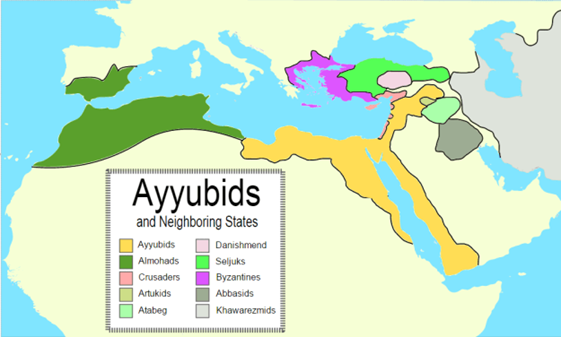
At the young age of 32 years Saladin had taken control of the Egyptian Sultanate and formed his own Dynasty, the Ayyubids (named for his father).
Understanding that there are repeating cycles of history within the long stretch of history, the following simply focuses on obvious examples, beginning at Daniel 11:9 onward.
“So the king of the south shall come into his kingdom, and [then] shall return into his own land.”
In 1081 Rome’s eastern-most territory of Anatolia / Turkey was conquered by the Seljuk Turk Empire. As with the names of the other political entities incorporated into the Turkish Empire, the name remained Rome and its ruler – as conqueror – claimed the title of the Sultan of Rum / Rome.
At the death of the Seljuk ruler in Anatolia, Saladin took the opportunity to expand into Syria as sole master of the Middle East. At the height of his power, he ruled a unified Muslim region stretching from Egypt to Arabia. He was successful at uniting the Muslim sects against their common enemy, the Christians, and wresting Jerusalem from the Christians in September of 1187. Back from the Third Crusade Richard the Lionheart would describe him in glowing terms. “His military genius and treatment of Christian prisoners has Saladin as one of the finest knights of his generation, the true embodiment of chivalry.”
“But his sons shall be stirred up, and shall assemble a multitude of great forces: and one shall certainly come, and overflow, and pass through: then shall he return, and be stirred up, even to his fortress.
At Saladin’s death in 1193, like Alexander he divided his empire among his relations. His sons were “stirred up” by a power struggle in which Saladin’s brother, al-˓Adil with “a multitude of great forces” emerged triumphant by 1202 and “stirred up” reorganized Saladin’s inheritance in favor of his own family / fortress. With so much stirring of the pot the Ayyubid dynasty faded away and completely disappeared in one lifetime.
And the king of the south shall be moved with choler, and shall come forth and fight with…the king of the north: and he [the king of the north] shall set forth a great multitude; but the multitude shall be given into his [the king of the south’s] hand. And when he [the king of the south] hath taken away the multitude, his heart shall be lifted up; and he [the king of the south, the Ottoman emperor] shall cast down many ten thousands:”
The first period of Ottoman history was characterized by almost continuous territorial expansion, during which Ottoman dominion spread out from a small northwestern Anatolian principality to cover most of southeastern Europe and Anatolia. The political, economic, and social institutions of the classical Islamic empires were amalgamated with those inherited from Byzantium and the great Turkish empires of Central Asia and were reestablished in new forms that were to characterize the area into modern times.
In 1453 Mehmet II “the Conqueror”, took Constantinople, the gateway to Europe, and Islam surged into Christendom.
Like conquerors before him, with the taking of the capitol city Mehmet II also claimed the European title Kayser-i Rûm, i.e. Caesar of Rome / Emperor.
All subsequent Sultans of the Ottoman Empire kept Kayser-i Rum as one of their many titles.
During the 15th century the Ottoman Empire, based in in Anatolia / Asia Minor / Turkey, grew to be one of the most powerful states in the world, encompassing portions of Rome’s Eastern territory, AKA the Middle East now occupied by Iraq, Syria, Israel, and Egypt; North Africa as far west as Algeria; and large parts of the Arabian Peninsula. as well as a significant chunk of Rome’s Western territory including present-day Hungary, the Balkan region, Greece, and parts of Ukraine; up to the very gates of Vienna, which was until 1806 the seat of the Holy Roman Empire and then the capital of the Austro-Hungarian Empire.
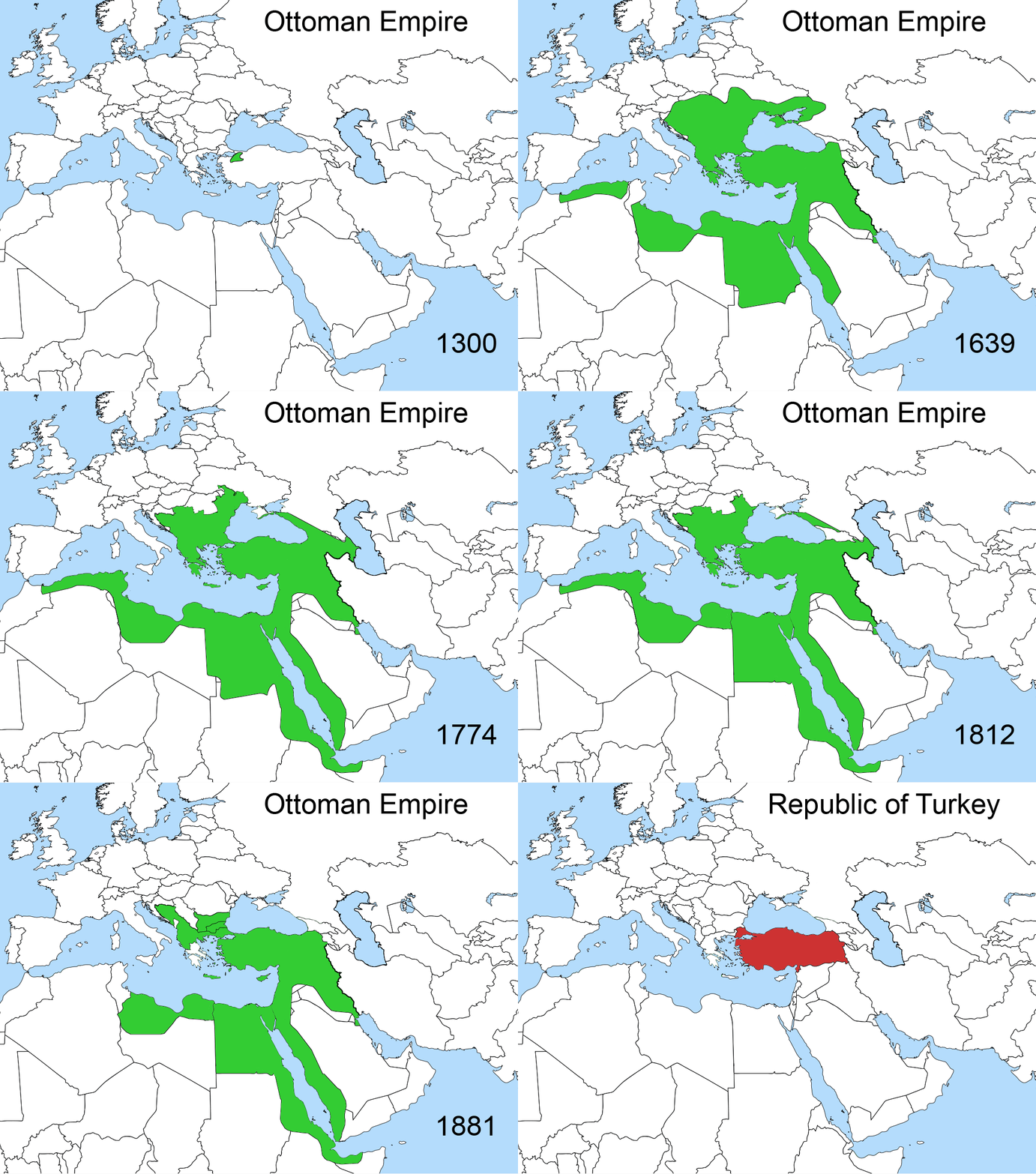
At its peak in the 1500s, the Ottoman Empire was one of the biggest military and economic powers in the world, controlling… territory that stretched from the Danube [in the northern king’s domain] to the Nile [in the southern king’s domain], with a powerful military, lucrative commerce, and impressive achievements in fields ranging from architecture to astronomy.

Sultan Süleyman I the Magnificent (1520–66) rivaled the power and prestige of his European counterparts Francis I of France and Charles V of England, and the Ottoman army was the foremost military power in Europe, which fortunately for Europe, was preoccupied with their Eastern nations.
“but he [the Muslim king of the south] shall not be strengthened by it.”