The establishment of the modern Republic of Turkey marked the formal end of the Ottoman Empire and the beginning of a new secular, national state led by Mustafa Kemal Atatürk who won the Turkish War of Independence (1919–1922).
Given its crucial geographical position straddling East and West, and political connections remaining from its 1,000 year old empire status, the United States promptly established diplomatic relations with the new Republic of Turkey in
To curry favor with their new ally, the U.S. and other European nations kept their navy ships at sea while the Moslem Turks asserted themselves by massacring 300,000 Christian inhabitants of Smyrna by sword and fire.
As Trifkovic observes… “The moral disarmament of contemporary post-Christian Europe is now nearly universal.”
Turkish foreign policy was wholly based on close relations with the West, particularly the friendship of the United States due to Turkey’s fear of its enormous northern neighbour, the Soviet Union, from its dependence on U.S. military and economic aid, and from its desire to be accepted as a secular, democratic, Western state. Turkey sent troops to fight in the Korean War and joined the North Atlantic Treaty Organization (NATO; 1952) and the Central Treaty Organization (1955).
“the king of the north shall return, and shall set forth a multitude greater than the former, and shall certainly come after certain years with a great army and with much riches.”
The British and the French competed for hegemony with each other in the New World Order by carving out influence in the Middle East and North Africa.
- And in those times there shall many [an alliance of nations] stand up against the king of the south:
- also the robbers of thy people shall exalt themselves to establish the vision [of once again becoming masters of the holy site of Jerusalem]
Among Muslims, the Temple Mount is called Haram al-Sharif (the Noble Sanctuary). They believe it was here that the Prophet Muhammad ascended to the “Divine Presence” on the back of a winged horse—the Miraculous Night Journey, commemorated by one of Islam’s architectural triumphs, the Dome of the Rock shrine. A territorial prize occupied or conquered by a long succession of peoples—including Jebusites, Israelites, Babylonians, Greeks, Persians, Romans, Byzantines, early Muslims, Crusaders, Mamluks, Ottomans and the British—the Temple Mount has seen more momentous historical events than perhaps any other 35 acres in the world.
“And a mighty king [of the north / European shall stand up, that shall rule with great dominion, and do according to his will.
And the king of the south [leader of an alliance of Moslem nations] shall be strong, and one of his [king of the north’s] princes; BUT! his [king of the south’s] sons / followers shall be stirred up, and shall assemble a multitude of great forces: And the king of the south shall be moved with choler, and shall come forth and fight with…the king of the north: and he [king of the south] shall set forth a great multitude;”
On 22–26 July 1952…Egypt’s Gamal Abdel Nasser overthrew [British supported] King Farouk, whom the military blamed for Egypt’s poor performance in the 1948 war with Israel…and declared Egypt a republic on 18 June 1953.
Nasser evolved into a charismatic leader, not only of Egypt but of the Arab world, promoting and implementing “Arab socialism.” In 1958 Egypt joined with the Republic of Syria and annexed the Palestine Government-ruled Gaza Strip to form the United Arab Republic. Although Syria seceded only three years later, Egypt clung to the hope and glory as the UAR for another ten years.
Nasser ruled as an autocrat but remained extremely popular within Egypt and throughout the Arab world because of his willingness to stand up to the Western powers and to Israel. Nasser helped establish the Non-Aligned Movement of developing countries with India and Yugoslavia in September 1961, and continued to be a leading force in the movement until his death. His foreign and military policies were central in provoking the Six-Day War in 1967.
but [yet] the multitude shall be given into his [the king of the north’s] hand. For the king of the north shall return, and shall set forth a multitude greater than the former,
With Western Power’s assistance, the Israelis won the Six-Day War.
and [the king of the north] shall certainly come after certain years with a great army and with much riches. he shall stir up his power and his courage against the king of the south with a great army; and the king of the south shall be stirred up to battle with a very great and mighty army; but he shall not stand: for they shall forecast devices against him.
After Nasser’s death…Vice President Anwar el-Sadat, was elected President of Egypt and the new king of the south.
Sadat engaged in a diplomatic offensive and by the fall of 1973 had support for a war of more than a hundred states, including most of the countries of the Arab League, Non-Aligned Movement, and Organization of African Unity. Syria agreed to join Egypt in attacking Israel.
“through his riches he shall stir up all [his Eastern allies] against the realm of Grecia / Europe, and the king of the south shall be stirred up to battle with a very great and mighty army; but he shall not stand: for they shall forecast devices against him.”
In October 1973, Egypt’s armed forces achieved initial successes as it advanced to the end of the range of safe coverage of its own air force, but after moving his forces deeper into Sinai without air cover, the Egyptian army suffered huge losses.
“Yea, they that feed of the portion of his meat shall destroy him, and his army shall overflow: and many shall fall down slain.” (Daniel 11:26)
On 6 October 1981, Sadat was assassinated during the annual victory parade held in Cairo to celebrate Egypt’s crossing of the Suez Canal. Over three hundred Islamic radicals were indicted in the trial of assassin Khalid Al-Islambuli, including future al-Qaeda leader Ayman al-Zawahiri, Omar Abdel-Rahman, and Abd al-Hamid Kishk.
“And both of these kings’ hearts” (Daniel 11:27)
OBVIOUSLY the narrative has moved on to a new set of Northern and Southern Kings.
shall be to do mischief, and they shall speak lies at one table; but it shall not prosper: for yet the end [of the world] shall be at the time appointed.”
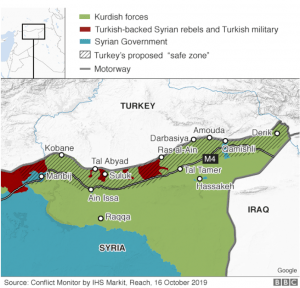
When Turkey’s southern border with Syria was threatened by the rise of militants of the Islamic State in Iraq and the Levant (ISIL or ISIS depending on translation) as well as emboldened Kurdish separatists, from Libya to Nagorno-Karabakh, the Turkish leader has used armed force to advance Turkey’s objectives.
“At the time appointed [not a surprise war but the routine reinforcement of alliances] he [northern king] shall return, and come toward the south;
but it shall not be as the former, or as the latter. For the ships [signifying military power in general] of Chittim / Cyprus shall come against him:” (Daniel 11:29-30)
Cyprus is located only 80 km from the Anatolian coast…Its location makes the island an ideal base for both protecting Turkey and controlling the Eastern Mediterranean area and the Middle East…Thus, Cyprus plays a manifold role in the foreign and military policies of Turkey.
Cracks in Turkey’s relationship with the West emerged when the West failed to intervene in Cyprus on Turkey’s behalf after an attempted coup in 1974. Consequently Turkey broadened its relations, forming a friendship agreement with the Soviet Union in 1978. Cyprus and sovereignty disputes in the Aegean Sea remain major impediments to Turkey’s relations.
Turkey began proactively supporting the democratic movements taking hold across the Middle East during the Arab Spring. Turkey’s control of the headwaters of the Tigris and Euphrates gives it considerable influence over Arab politics. The whole Euphrates River dam system gives Turkey the ability to cut off the supply of water to Syria and Iraq and alternately, the capacity to pump water as far as the water-starved West Bank in Palestine. Control over this essential resource will make Turkey a greater power in the Arab Middle East in the 21st century than it was in the 20th.
“Turkey has realised the greatest natural gas discovery in its history, “Erdogan told his nation that this gas find is a gift from Allah. “My Lord has opened the door to unprecedented wealth for us,” he said.
In 2022, Russian President Putin proposed creating a Russian “gas hub” in Turkey that would help it reroute exports, after European countries curbed imports over the Ukraine war. Turkey is negotiating the proposal and could leverage its extensive gas infrastructure. Turkey’s diplomacy and control of the straits connecting the Black Sea to world markets put it at the centre of an agreement between Russia, Ukraine and the United Nations.
Simply, it is clear that Turkey has realised their neo-Ottoman ambitions.