900 – Simeon I of Bulgaria entitled himself Caesar / Tsar of the Bulgarians after turning Bulgaria into the most powerful state in contemporary Eastern and Southeast Europe, deemed its Golden Age. This title was passed down to subsequent Bulgarian heads of state until the monarchy was abolished in 1946. During the inevitable battles for domination the Byzantines, Magyars and Serbs citizens in the Greek-controlled side of the Roman Empire, while called by later Latins the ‘Byzantine Empire’, continued to refer to themselves as Roman citizens and to their empire as the Roman Empire or Romania.
962 – Otto I was crowned Römisch-Deutscher Kaiser / Caesar.
1157 – German Frederick I Barbarossa added the word “Holy” to his “Roman Empire”, in response to the Great Schism of 1054 between Greek Constantinople and Latin Rome that created the Roman Catholic Church vs the Greek Orthodox Church, reflecting his jostling for power as one of the two “co-regents” to become the “first among equals” in the Principate.
1453 – Ivan III, the Grand Prince of Moscow, became the only Orthodox monarch in the world when the Ottoman Turks conquered first, Constantinople, then the Balkans, leaving Moscow as the ‘third Rome’. His claim was strengthened in 1472 when he married the niece of the last Byzantine emperor, Zoe, then Sophia, Palaiologina.
1547 – Ivan IV was crowned Tsar / Caesar of Russia when the nephew of the last Byzantine emperor Andreas Palaiologos, brother of Sophia Palaiologina (Russian language indicates male and female genders on last names) failed to win support from any Western European king for a crusade to win back “his” throne at Constantinople.
1502 – King Ferdinand, married to Queen Isabella / Jezebel, became a legal Emperor of Rome at the death of Andreas Palaiologos, who had bequeathed his Caesarean inheritance to the greatest powerhouse at that time.  Although he never used the title, actions spoke louder than words, as he and his consort had already expanded their dominion into the New World by funding Christopher Columbus’ voyages. (Map shows Spanish Empire in red and Portuguese in blue during the union of their empires 1581-1640.)
1516 – Ferdinand’s grandson, Charles I (1516–56) inherits the throne of the Holy Roman Empire with the Spanish dominions, the Netherlands, Austria and southern Germany, heading one of the most powerful dynasties in the history of Western civilization. The Habsburgs continuously occupied the throne of the Holy Roman Empire from 1440 until their extinction in the male line in 1740, reincorporated through the female Habsburg line joined in marriage to a male from Lorraine as the Habsburg-Lorraines from 1765 until dissolved in 1806 by Napoleon’s empire.
1806 –  Napoleon Bonaparte, while modestly calling himself Emperor of France, identified himself as Emperor of Rome by having himself crowned with a replica of Charlemagne’s Roman Emperor crown and a Roman laurel wreath. He also conferred on his son the title King of Rome, which, like the official designation of the heir to the throne of England ,”Prince of Wales,” is the official designation of the heir to the Emperor of the Roman Empire.
1815 – After being frozen out of his bid to incorporate the Eastern sector of the Roman empire, Napoleon also lost the western half to the British at the Battle of Waterloo.
1861 – the first oil well was drilled in Scotland, and the North Sea Bed, discovered in the 1880s, propels the UK into becoming a major industrial power.
1867 – Austria-Hungary evolves from the Habsburg monarch as a military and diplomatic union of two states under a single monarch with the dual titles of Emperor of Austria and the Apostolic King of Hungary. One of Europe’s major powers, and the second-largest country in Europe in area (after Russia) and the third-most populous (after Russia and the German Empire), and among the 10 most populous countries worldwide. The Empire built up the fourth-largest machine-building industry in the world.
1913 – the British Empire had become the foremost global power and was by far the largest empire in history, controlling 23% of the world’s population and covering 24% of the Earth’s total land area.

1871 – Wilhelm I, King of the largest state of Prussia in confederation with 25 Germany states, was granted the title of German Emperor / Deutscher Kaiser, by the nobility, with Berlin as its capital, forming the Second Reich, (Charlemagne’s being the First). During its 47 years of existence, the German Empire became an industrial, technological, and scientific giant, building the longest railway network of Europe and the world’s strongest army, and a navy second only to Britain‘s Royal Navy.
1879 – the German Empire consolidated the Dual Alliance with Austria-Hungary, followed by the Triple Alliance with Italy in 1882. Claiming much of the leftover territory that was not yet conquered by Europeans in the Scramble for Africa, it built the third-largest colonial empire at the time, after the British and the French. German colonial policy in the 1880s was social imperialism, a device that allowed the government to distract public attention from domestic problems and preserve the existing social and political order.
1897 – The German empire embarked on Weltpolitik (“world politics”), imperialist foreign policy to transform Germany into a global power.
1914 – The heir to the Austro-Hungarian throne is assassinated by a Bosnian Serb, prompting the Russian Empire to ally with Serbia. In early August, Germany declared war on Russia and France; the United Kingdom entered the war after Germany invaded Belgium. Germany’s strategy in 1914 was to quickly defeat France, but its advance was halted in September, and the Western Front solidified into a near-continuous line of fortified trenches. The Eastern Front was more dynamic, but neither side gained a decisive advantage, despite costly offensives. The Ottoman Empire joined the Central Powers in November, which was followed by a failed Allied campaign at Gallipoli. Japan and Italy also joined the Allies.
The financial crisis of 1914, triggered by the outbreak of World War I, saw the liquidation of about $3 billion in European-held American securities, marking a turning point that shifted the U.S. from a debtor to a creditor nation. As global stock markets reeled, Treasury Secretary William McAdoo closed the New York Stock Exchange on July 31, 1914, to prevent further economic collapse and protect the gold supply. With the Federal Reserve still in its infancy, McAdoo took emergency measures—including gold distributions, paper currency expansion, and intervention in New York City’s finances—to stabilize the banking system and prevent a repeat of the 1907 panic. The crisis underscored the fragility of international finance and the emerging power of the United States on the global economic stage.
Jarmulovsky Bank was ordered closed and riots broke out as thousands of immigrant depositors lost their savings which they

. Which lost to the British.
“So the king of the north shall come, and cast up a mount, and take the most fenced cities: and the arms of the south shall not withstand…and he shall stand in the glorious land [Palestine], which by his hand shall be consumed.”
This can only be Field Marshal Edmund Allenby, a British army officer who commanded the Allied Forces in Palestine from June 1917 until the end of the First World War.
When Allenby captured Jerusalem his entry was a carefully stage-managed event, filmed for the world’s cinema audiences to aid the Allied propaganda cause.
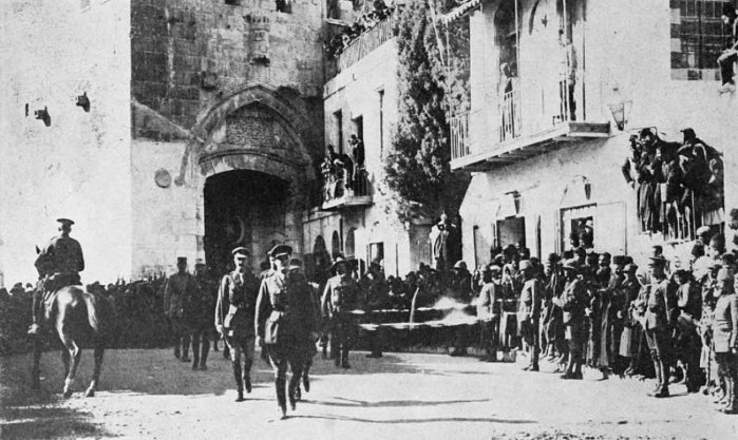
“He shall also set his face to enter with the strength of his whole kingdom, and upright / equitable / equal to him ones with him; thus shall he do:” (Daniel 11)
Gen. Edmund Allenby, chief British commander in the Middle East during World War I noted that “Lawrence of Arabia” was first among equals: “There is no other man I know,” he asserted, “who could have achieved what Lawrence did.” Today, T.E. Lawrence remains one of the most iconic figures of the early 20th century with over 70 biographies. His wartime memoir, Seven Pillars of Wisdom has been translated into more than a dozen languages and remains in print nearly a full century after its first publication.
Not to be left in the dust, Russian President Vladimir Putin has been inspired by the tsars that represented not just earthly power, but within the framework of Russian Christian Orthodox religion also embodied the eschatological purpose of Russia as the ‘Third Rome’. In 2018, soon after Vladimir Putin was inaugurated again as President of the Russian Federation bombastic music started to echo through the halls of the Grand Kremlin Palace in Moscow. Canons fired their salutes outside as the orchestra played Glory. While the choir at Putin’s inauguration was accompanying the well-known music with different lyrics, the music certainly brought to mind the original lyrics from the final act of the nineteenth-century opera A Life for the Tsar, euphoric Russians are singing for their newly coronated sovereign on the Red Square.
Hail, hail, our Russian tsar!The God-given sovereign tsar!May your royal line immortalize,Through which the Russian people thrive.3