170) Messianic Judaism Segregates Gentiles

From Acts 14:

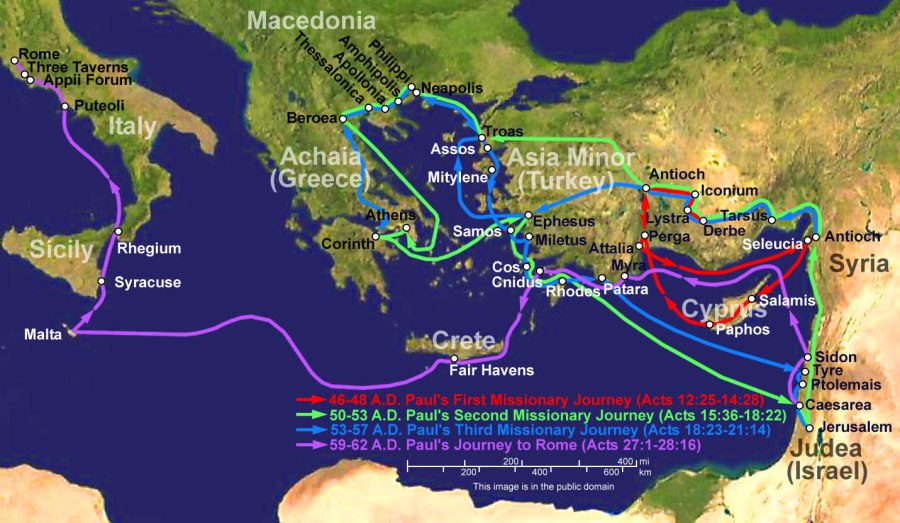
“[During Paul’s missionary journey in Asia Minor / modern Turkey]

  • in Iconium…a great multitude both of the Jews and also of the Greeks believed…
  • Lystra
  • and Derbe…
  • and unto the region that lieth round about…
  • returned again to Lystra, and to Iconium,
  • and Antioch in Pisidia…
  • Perga…
  • Attalia

And thence sailed [back] to Antioch [in Syria], from whence they had been recommended to the grace of God for the work which they fulfilled.

And when they…had gathered the church together, they rehearsed all that God had done with them, and how he had opened the door of faith unto the Gentiles…

From Acts 15:

And certain men which came down from Judaea taught the brethren, and said, Except ye be circumcised after the manner of Moses, ye cannot be saved. When therefore Paul and Barnabas had no small dissension and disputation with them, they determined that Paul and Barnabas…should go up to Jerusalem unto the apostles and elders about this question…

And when there had been much disputing, Peter rose up, and said unto them, Men and brethren, ye know how that a good while ago God made choice among us, that the Gentiles by my mouth should hear the word of the gospel, and believe…

James [High Melchizedek of Messianic Judaism] answered… “Simeon / Peter hath declared how God at the first did visit the Gentiles  / Europeans, to take out of them a people for his name.” (Acts 15)

What a snub to Paul! Peter led one Gentile to salvation in the Jewish Christ, while Paul endured years of suffering that surely established his commitment to leading multitudes of Gentiles to convert from paganism to YHVH’s Savior.

Continue reading “170) Messianic Judaism Segregates Gentiles”

SECTION XXXIV: YHVH Does His Own New Thing

The title is a play on the post “A New Thing” in which false gods hybridized their spirits with humans to create a new breed of offspring to serve them. Apply this to what the apostle Paul announces.


Thus saith the LORD, your redeemer, the Holy One of Israel…Behold, I will do a new thing…This people have I formed for myself. They shall shew forth my praise.

    • but thou hast not called upon me, O Jacob;
    • but thou hast been weary of me, O Israel…
    • Thy first fathers / top authorities hath sinned, and thy teachers have transgressed against me.” (Isaiah 43)

“For it is written, I will destroy the wisdom of the wise and will bring to nothing the understanding of the prudent. Where is the wise? where is the scribe? where is the disputer of this world? hath not God made foolish the wisdom of this world? For after that in the wisdom of God the world by wisdom knew not God, it pleased God by the foolishness of preaching to save them that believe. For the Jews require a sign, and the Greeks seek after wisdom: But we preach Christ crucified, unto the Jews a stumblingblock, and unto the Greeks foolishness; But unto them which are called, both Jews and Greeks, Christ the power of God, and the wisdom of God.” (I Corinthians 1:10-24)

“Paul went in with us unto James; and all the elders were present…and said unto him, Thou seest, brother, how many thousands of Jews there are which believe; and they are all zealous of the law:” (Acts 21:19)

“there were in the church that was at Antioch certain prophets and teachers…the Holy Ghost said, Separate me Barnabas and Saul for the work whereunto I have called them…when they were at Salamis, they preached the word of God in the synagogues of the Jews.

Then all the multitude kept silence, and gave audience to Barnabas and Paul, declaring what miracles and wonders God had wrought among the Gentiles by them. And after they had held their peace, James answered, saying,

Men and brethren…the Gentiles are turned to God:” (Act 15:12-19)

“in YHVH’s Chosen Savior / Christ Jesus neither circumcision availeth any thing, nor uncircumcision, but a new creature. And as many as walk according to this rule, peace be on them, and mercy, and upon the Israel of God.” (Galatians 6:15-16)

“Wherefore remember, that ye being in time past Gentiles…without Messiah / Christ, being aliens from the commonwealth of Israel, and strangers from the covenants of promise, having no hope, and without God in the world: But now in Messiah Yeshua / Christ Jesus ye who sometimes were far off are made nigh by the blood of Messiah / Christ…that he might reconcile both unto God in one body by the cross, having slain the enmity thereby…For

    1. through him we both have access
    2. by one Spirit
    3. unto the Father.

Now therefore ye are no more strangers and foreigners, but fellowcitizens with the saints, and of the household of God…keep the unity of the Spirit in the bond of peace. There is one body, and one Spirit, even as ye are called in one hope of your calling; One Lord, one faith, one baptism, One God and Father of all, who is above all, and through all, and in you all.” (Ephesians 2:11-19, 4:3-6)


“Paul, an apostle of Jesus Christ by the will of God, to the saints / Upright Ones / Jeshurun which are at Ephesus…

  • According as he hath chosen / messiahed us in him before the foundation of the world,
  • that we should be holy and without blame before him in love:
  • Having predestinated us unto the adoption of children by Jesus Christ to himself…wherein he hath made us accepted in the beloved.” (Ephesians 1:1-6)

And as always, Paul got his doctrine from existing scripture.

Continue reading “SECTION XXXIV: YHVH Does His Own New Thing”

171) The Chosen Vessel In The Hebrew Commonwealth Is Still Jewish

During the Hellenistic and Roman period thousands of Jews voluntarily migrated from Israel. Face it, there just wasn’t enough land to support the exponentially expanding population. The practice of meeting weekly for worship at local synagogues and abstinence from pagan daily practices prevented absorption into local communities. Instead, a Jewish diaspora developed – a scattered population maintaining its unique identity, dispersed across North Africa, the Middle East, the Mediterranean, and Europe and all territories secured by Roman influence.

This geographic dispersion created commercially valuable networks. Merchants could rely on correspondence, introductions, family relationships, community institutions, reputation, literacy, and repeated transactions to establish relationships across great distances.

These networks helped solve one of entrepreneurship’s oldest problems. Trust. Normally, trust is local. Jewish merchant networks could sometimes transform: “Nobody here knows me.” into: “Someone here knows someone who knows me.”

Perfect for spreading the good news that the Savior of the world had fulfilled his mandate to, not just the nation of Israel, but to the world-wide Hebrew Commonwealth. And at this stage in history, the Jews were the only ones with the biblical literacy to understand YHVHism / Monotheism, and YHVH’s Savior’s fulfillment of millennia of prophetic scripture to the world that “God so loved the world that he gave his only begotten son, that whosoever believeth in him should not perish, but have everlasting life” (John 3:16)

The problem, as documented in the apostolic record – and history –  is that the existing leadership of the “chosen people” were highly protective of this special identity. They were twisting Moses’ words that “the LORD thy God hath chosen thee to be a special people unto himself” (Deuteronomy 7:6) as an exclusive relationship, rather than, as clearly stated in context, an appointment as Melchizedeks / priests and kings in leadership over the general population of God’s people. 

“And Moses went up unto God, and the LORD called unto him out of the mountain, saying, Thus shalt thou say to the house of Jacob, and tell the children of Israel…”if ye will obey my voice indeed, and keep my covenant, then ye shall be a peculiar treasure unto me above all people: for all the earth is mine: And ye shall be unto me a kingdom of priests, and an holy nation.” (Exodus 19:3-6)

Enter the “chosen vessel” unto me to bear my name before [first in order of importance] the Gentiles, and [their] kings, and [last in order of his calling] the children of Israel” (Acts 9:15)

Continue reading “171) The Chosen Vessel In The Hebrew Commonwealth Is Still Jewish”

172) A(nother) Jewish Melchizedek Like Moses

Although Messianic Judaism and Christianity acknowledge that Jesus Christ is identified by his likeness to Moses, any others’ likeness is downplayed as being nothing more than “types” of Christ. We are discarding our own identity in Christ if don’t recognize Moses’ successors’ relationship to the Promised Redeemer.

Yes, Deuteronomy 34:10-12 documents “And there arose not a prophet since in Israel like unto Moses…” but that is time-stamped to the historical era during which it was written –

The full biblical – not Jewish or Christian – criteria for recognizing the Melchizedekian successors to Moses include the essentials of the same attributes. 

Continue reading “172) A(nother) Jewish Melchizedek Like Moses”

173) The Gospel According To Paul

“Now to him that is of power to stablish you (according to my gospel, and the preaching of Jesus Christ), God only wise, be glory through Jesus Christ…“I certify you, brethren, that the gospel which was preached of me is…by the revelation of Jesus Christ.” (Romans 16:25-17, Galatians 1:12)

What Paul calls “my gospel” is NOT something new to him, but the same preached by Jesus Christ.” (Romans 16:25).

“Think not that I am come to destroy the law, or the prophets: I am not come to destroy, but to fulfil…Till heaven and earth pass, one jot or one tittle shall in no wise pass from the law, till all be fulfilled. Whosoever therefore shall break one of these least commandments, and shall teach men so, he shall be called the least in the kingdom of heaven.” (Matthew 5:17-19)

Continue reading “173) The Gospel According To Paul”

174) The First Principles Of The Oracles Of God

“The Endless is a movie that plays with our perceptions of time, space, and reality, and sketches the outlines of unimaginable / endless terror…Things become unmoored from scientifically verifiable truth…There are so many strange moments and images, most of them tossed-off…effectiveness comes from comparing what we’re told would happen against what actually does happen.“

And this is where the Word of God telling us in advance of what will happen before it actually does happen is of paramount importance.

The Bible is not a guidebook to a lifestyle, it is a guide to life itself. Only those who develop wisdom and understanding from studying the subject recognize and know how to respond with life sustaining action when confronted by death-dealing forces.

“What advantage then hath the Jew? or what profit is there of circumcision? Much every way: chiefly, because that unto them were committed the oracles of God…when for the time ye ought to be teachers, ye have need that one teach you again which be the first principles of the oracles of God.” (Romans 3:1-2, Hebrews 5:12)

So let’s review some of the first principles of the oracles of God, 90 of which are expressed documented just in the book of Genesis as “God said“. Seems to be that’s key. Then roughly half that number are documented in the book of Exodus with the establishment of the nation of Israel.

So it makes sense to back up to Genesis to ensure we’ve captured the very “first” principles of the oracles of God, where we discover that before there was a nation of Israel, Abraham is called – as much into being as anything else in Creation – “the father / authorizer of who belongs in the family with all its provisions”.

“What shall we say then that Abraham our father, as pertaining to the flesh, hath found?…what saith the scripture? Abraham believed God, and it was counted unto him for righteousness… faith was reckoned to Abraham for righteousness…the promise, that he should be the heir of the world, was…through the righteousness of faith…of Abraham; who is the father of us all.” (Romans 4)

Continue reading “174) The First Principles Of The Oracles Of God”

175) The Hebrew Torah Authenticates All Subsequent Word From God

A biblical canon or canon of scripture is a set of texts (or “books”) which a particular Jewish or Christian religious community regards as authoritative scripture. The English word canon comes from the Greek κανών, meaning “rule” or “measuring stick”.

  • The books of Moses, consisting of Genesis – Deuteronomy, were preserved over the years by the priests.
  • The Psalms of David and other song leaders and wisdom writings of Solomon were authenticated as consistent with the Torah by the priests at the time they were written and likewise safeguarded.
  • The historical records were written and safeguarded by official scribes (which, interestingly are making a comeback in the medical field where meticulous accuracy is of paramount importance).
  • For whatever reasons, there are other historical writings, in particular Jasher and Enoch, that, while referenced in the Bible and included in the first edition of the King James Bible in 1611, aren’t included in later editions.

Most of all, the concepts of justice, righteousness and freedom are articulated by the Prophets in hundreds of prophecies of judgment for failing to follow these precepts that came true, especially for rejecting the law of the LORD / Creator.

Continue reading “175) The Hebrew Torah Authenticates All Subsequent Word From God”

176) Christ Is The End Of What Law?

From Romans 10:

“Christ is the end of the law for righteousness to every one that believeth.”

There we have it. End of Judaism, beginning of easy believe Christianity.

Or is it?

  • For Christ / The Messiah / Anointed Lamb of God which taketh away the sin of the world” (John 1:25, 29) is the end of the law requiring a substitute animal blood sacrifice  
  • for [establishing God’s] righteousness to every one that believeth…
    • For the scripture saith…there is no difference between the Jew and the Greek: for the same Lord over all is rich unto all that call upon him. For whosoever shall call upon the name of the Lord shall be saved.” 

“For Moses describeth the righteousness which is of the law, That the man which doeth those things shall live by them. But the righteousness which is of faith speaketh on this wise, Say not in thine heart, Who shall…bring Christ down from above:) Or, Who shall…bring up Christ again from the dead.)”

Paul didn’t make up this scenario. Clearly, many Jews were rejecting the claims of Jesus the Christ being the only begotten son of God, proven by his resurrection from the dead, and therefore denying YHVH himself, and their need to be saved from their sin.

Back up a  verse to get the entire argument in view.

“going about to establish their own righteousness, [Israel] have not submitted themselves unto the righteousness of God.”

Continue reading “176) Christ Is The End Of What Law?”

177) From Faith To Faith

“Going my way?” What a loaded question. It’s…delivered to Will with rakish charm by Hannibal…Is Will going Hannibal’s way? Is he finally becoming like Hannibal…or is he sacrificing himself to save the world…? And in the end, is there a difference?…

Will bends Hannibal to his will by saying the words he wants to hear: “I need you, Hannibal. Please…”  a truly glorious fight sequence…their blood-soaked embrace was payoff galore…with Hannibal getting everything he has ever wanted…and in that moment I think he was perfectly content to die.

Shocking to equate God’s plan of salvation with a ghastly TV show? What I find really shocking is just how tepid the Christian church experience has become. Including and especially identifying with Jesus Christ, with whom salvation is achieved by identifying with him in his blood sacrifice.

“I am crucified with Christ: nevertheless I live; yet not I, but Christ liveth in me: and the life which I now live in the flesh I live by the faith of the Son of God, who loved me, and gave himself for me. I do not frustrate the grace of God: for if righteousness come by the law, then Christ is dead in vain…

For I am not ashamed of the gospel of Christ: for it is the power of God unto salvation to every one that believeth; to the Jew first, and also to the Greek. For therein is the righteousness of God revealed from faith to faith: as it is written, The just shall live by faith.” (Galatians 2:20-21, Romans 1:16-17)

Hebrews chapter 11 tracks the righteousness of God revealed

  • from faith in the promised Savior through substituting animal deaths
  • to faith in the Savior who died in our place
  • as the same faith in the yet-to-come resurrection of our mortal bodies.

NOT some faith of Judaism changed to different faith of Christianity.

Continue reading “177) From Faith To Faith”

SECTION XXXV: Paul Did Not Found Christianity

It is highly significant that, while encouraging Gentiles to identify with God’s people without full conversion to Judaism, Paul himself never relinquished his elite Jewish Pharisee identity.

  • “I also am [present tense] an Israelite, of the seed of Abraham, of the tribe of Benjamin.” (Romans 11:1)
  • “Circumcised the eighth day, of the stock of Israel, of the tribe of Benjamin, an Hebrew of the Hebrews; as touching the law, a Pharisee;” (Philippians 3:4-5)
  • “among mine own nation at Jerusalem, know all the Jews; if they would testify, that after the most straitest sect of our religion I lived a Pharisee.
  • And now I stand and am judged for the hope of the promise made of God, unto our fathers: Unto which promise our twelve tribes, instantly serving God day and night, hope to come.” (Acts 26)

Paul’s ostracism by the Jews proves that no Gentile Christian church was established during the Acts of the Apostles. There was only a Jewish Messianic sect that was fiercely opposed by mainstream Judaism, especially Paul’s claim that the HEBREW scriptures allowed non-practicing Gentiles into their assembly.

  1. Acts 9: in Damascus: And straightway he preached Christ in the synagogues…And the Jews took counsel to kill him:
  2. Act 9: in Jerusalem: And when Saul was come…he disputed against the Greeks [philosophically adulterated sect of liberal Jews: but they went about to slay him. 
  3. Acts 14: in Iconium…there was an assault made both of the Gentiles, and also of the Jews with their rulers, to use despitefully / torture, and to stone them.
  4. Acts 14: they fled unto Lystra and Derbe…And there came thither certain Jews from Antioch and Iconium, who persuaded the people, and having stoned Paul, drew him out of the city, supposing he had been dead.

Paul himself never claimed to found a new religion. He states multiple times that he was a follower of Jesus of Nazareth because Jesus was the fulfillment of Judaism’s Old Testament prophecy.

“Ananias the high priest descended with the elders, and with a certain orator named Tertullus, who informed the governor against Paul…we have found this man a pestilent fellow…a ringleader of the [Jewish] sect of the Nazarenes…

Then Paul…answered, after the way which they call heresy, so worship I the God of my fathers, believing [present tense!] all things which are written in the law and in the prophets: And have hope toward God, which they themselves also allow, that there shall be a resurrection of the dead, both of the just and unjust…I came to bring alms to my nation, and offerings…certain Jews from Asia found me purified in the temple…” (Acts 24:1-18)

Paul clearly articulates that the law of Moses, which did not institute but rather affirmed the earlier practice of the identifying mark of circumcision, was never an element of salvation for the Jews but a code of righteous conduct for a select leadership who are already in a faith-based relationship with the LORD God.

“For what saith the scripture? Abraham believed God, and it was counted unto him for righteousness…And he received the sign of circumcision, a seal of the righteousness of the faith which he had yet being uncircumcised…being fully persuaded that, what he [God] had promised, he was able also to perform. And therefore it was imputed to him for righteousness.

Now it was not written for his sake alone, that it was imputed to him; But for us also, to whom it shall be imputed, if we believe on him that raised up Jesus / YHVH’s Savior our Lord from the dead; Who was delivered for our offences, and was raised again for our justification.” (Romans 4:1-25)

Continue reading “SECTION XXXV: Paul Did Not Found Christianity”