135) The Levites Turn A Curse Into A Blessing

“And the LORD said unto Moses, Go, get thee down; for thy people, which thou broughtest out of the land of Egypt, have corrupted themselves / joined themselves with hyperdimensionals; They have turned aside quickly out of the way which I commanded them: they have made them a molten calf, and have worshipped it, and have sacrificed thereunto, and said, These be thy gods, O Israel, which have brought thee up out of the land of Egypt… 

Put some life into God’s verbatim report! He is outraged and spitting it out! You can best believe Moses was mirroring God’s response when he stormed down the mountain.

And Moses turned, and went down from the mount, And it came to pass, as soon as he came nigh unto the camp, that he saw the calf, and the dancing…Moses’ anger waxed hot, and he cast the tables out of his hands, and brake them beneath the mount. 

Basically, Moses destroyed the covenant between these people and YHVH before they were completely wiped out under the terms of the covenant.

Continue reading “135) The Levites Turn A Curse Into A Blessing”

136) Who On Earth Is Jes(h)urun?

Continue reading “136) Who On Earth Is Jes(h)urun?”

SECTION XXIV: Melchizedek Is A Man Of War

Knowing the parts of a story are essential for getting your book right.

  1. Characters What do your characters want? Their desire can be simple or complex, tangible or concept…If your character doesn’t want something, they won’t be compelled to act.
  2. Setting – when and where your story takes place.
  3. Plot – the actual story–what happens, when, how, why, and what’s the result?
  4. Conflict – For a story to be interesting, there needs to be conflict. The conflict could lend to the overall plot, a subplot, conflict between characters, or even a smaller conflict that is resolved within that scene.
    • Does the scene add to the overall plot?
    • Does the scene advance internal or inter-character relationships?
    • Does the scene add to a subplot?
    • Does the scene answer or bring about any plot-crucial questions?
  5. Resolution – By the end of your story, all of your conflicts should have a resolution.
  6. Theme – your story’s main takeaway. Your story can one theme or several. The theme(s) of your story helps to focus the narrative and answers the question: What’s the point? What have your characters learned? How are they changed, and what will they affect now that they are different? Some examples of themes include:
    • Forgiveness
    • Death – overcoming it, processing it, fearing it
    • Love
    • Empowerment
    • Good versus bad

These themes are exactly the themes in the Bible, which is why so much literature pulls or plays on quotes from the Bible.

As detailed in Genesis 1, the plot of of the Bible is mankind retaking dominion over creation, resulting in war between the Seed of the Woman and his hosts and the Seed of the Serpent and his hosts.

The re-establishment of humanity’s dominion over the earth is not a smooth transition of power that just happens by asking God to do it for us. It is an ongoing battle in which God’s people are expected to join the fight to save others once they have themselves have found salvation.

Continue reading “SECTION XXIV: Melchizedek Is A Man Of War”
137) Taking Dominion Against Genocide

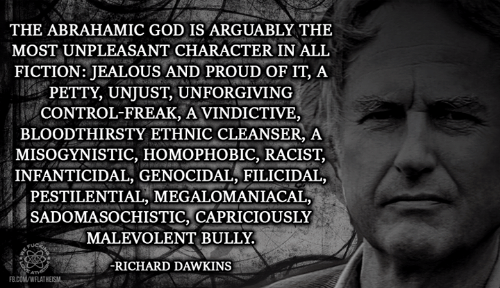
As an emeritus fellow at Oxford university Richard Dawkins can’t be that uneducated on a topic on which he promotes such hatred, so this must be gross propaganda.

Richard Dawkins enjoys the freedom of speech in a country that won the right to do so by going on the offensive against the Nazi and Japanese regimes which were slaughtering millions of people.

sleeping-giant-800-x-400_text-800x400-1

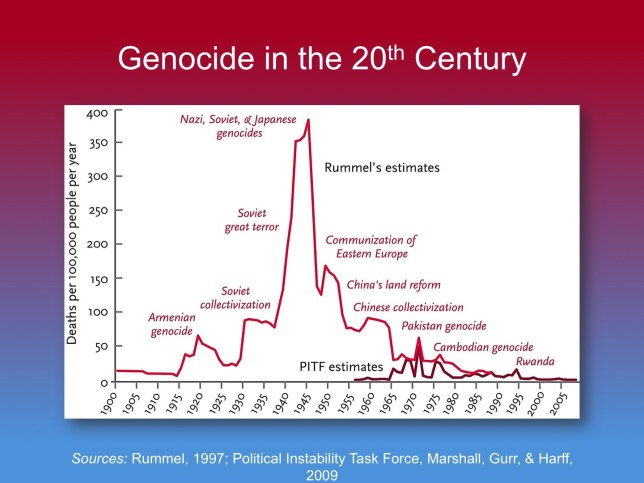
Success in WWII has led to a massive reduction in genocide worldwide.

genocide_since_1900

Continue reading “137) Taking Dominion Against Genocide”

138) Melchizedeks In The Running

After Moses the Levite dies he is succeeded by Joshua the Ephrathite who leads the newly constituted nation of Israel into the Promised land. He is succeeded by a variety of tribal leaders within the scattering and burgeoning twelve tribes.

“And Joshua the son of Nun, the servant of the LORD, died, being an hundred and ten years old…And also all that generation were gathered unto their fathers: and there arose another generation after them, which knew not the LORD, nor yet the works which he had done for Israel.

Ironically, the social peace brought about by following God’s ways, which by natural law allows prosperity, by human nature relaxes one’s reliance on God, promotes a prideful conviction of achievement by one’s one efforts with a sense of entitlement and results in a cycle of domestic violence on a grand scale.

If you’ve ever poured your life into improving someone else’s only to have them put you down, you’ll understand how God feels.

Continue reading “138) Melchizedeks In The Running”

139) The Man Who Wouldn’t Be King

  • Saul chose him three thousand men of Israel…
  • And the Philistines gathered themselves together to fight with Israel, thirty thousand chariots,
  • and six thousand horsemen,
  • and people as the sand which is on the sea shore in multitude: and they came up…

then the people did hide themselves in caves, and in thickets, and in rocks, and in high places, and in pits… (I Sam 13:1-6) 

Except for one intrepid teenager.

Continue reading “139) The Man Who Wouldn’t Be King”

140) Judah’s First Melchizedek. Finally.

“And Jacob [the current Melchizedek] called unto his sons, and said,

  1. Gather / אָסַף yourselves together [in purity and unity, removing any discord]
    1. that I may tell you that which shall befall you in the last days / end of space-time
  2. Gather /  קָבַץ yourselves together [a different word, meaning bring together what was scattered] Prophetically this is noted by James, brother of Jesus, writing to “the twelve tribes which are scattered abroad” (James 1:1)
    1. and hear / pay attention to this message ye sons of Jacob; and hearken/ respond obediently unto Isra-el / The Prince of El your father.

“Judah, THOU art he whom thy brethren shall praise: The sceptre shall not depart from Judah, nor a lawgiver from between his feet [obviously bequeathing the role of Melchizedek to Judah and his heirs]”

A bump in the road getting to Judah becoming Melchizedek:

Continue reading “140) Judah’s First Melchizedek. Finally.”

141) The Sacral King David

Besides Shem, King David has the only other Old Testament explicit declaration of filling the position of Melchizedek, in a psalm written by and about himself. This is quoted in application to Jesus Christ by the author of the letter to the Hebrews, but the context of David’s psalm is the blessing God conferred on David himself. Jesus Christ never herded sheep, nor yet has become the ruler of the nation of Israel.

“Thus saith the LORD of hosts / armies, I took thee from the sheepcote, from following the sheep, to be

  • ruler over my people, over Israel:
  • And I was with thee whithersoever thou wentest,
  • and have cut off all thine enemies out of thy sight,
  • and have made thee a great name, like unto the name of the great men that are in the earth.
  • Moreover I will appoint a place for my people Israel, and will plant them, that they may dwell in a place of their own, and move no more; neither shall the children of wickedness afflict them any more, as beforetime…
  • Also the LORD telleth thee that he will make thee an house. And when thy days be fulfilled, and thou shalt sleep with thy fathers, I will set up thy seed after thee, which shall proceed out of thy bowels, and I will establish his kingdom….and I will stablish the throne of his kingdom for ever.
  • I will be his father, and he shall be my son. If he commit iniquity, I will chasten him with the rod of men, and with the stripes of the children of men: But my mercy shall not depart away from him, as I took it from Saul, whom I put away before thee.
  • And thine house and thy kingdom shall be established for ever before thee: thy throne shall be established for ever.

Continue reading “141) The Sacral King David”

142) Righteousness Is Fulfilling All God’s Will

“the LORD hath sought him a man after his own heart, and the LORD hath commanded him to be captain over his people [instead of Saul], because thou hast not kept that which the LORD commanded thee.” (I Samuel 13:14)

What commandment is this?  It cannot be any one of the commandments given to the nation of Israel at Mount Sinai, which include Thou shalt not kill” and Thou shalt not commit adultery, both of which David transgressed.

” I have found David the son of Jesse, a man after mine own heart, which shall fulfil all my will.” (Acts 13:22),

And what is YHVH’s Prime Directive Will? For man to take dominion!

And that is what David did, most essentially, like Adam, in dealing with sin.

Continue reading “142) Righteousness Is Fulfilling All God’s Will”