
After Shem and Abram, King David has the only other Old Testament explicit declaration of filling the position of Melchizedek, consistent with the first documented mention of Melchizedek by name honoring Abram for the “slaughter of the kings”. He brings peace the only way possible when evil rules – by fighting back.
The LORD hath sworn, and will not repent, Thou art a priest for ever after the order of Melchizedek [through his genetics and epigenetics passed down through his seed]
- The LORD at thy right hand shall strike through kings in the day of his wrath.
- He shall judge among the heathen,
- he shall fill the places with the dead bodies;
- he shall wound the heads over many countries.” (Psalm 110)
“I have found David my servant; with my holy oil have I anointed him: With whom my hand shall be established: mine arm also shall strengthen him…my faithfulness and my mercy shall be with him: and in my name shall his horn be exalted…
He shall cry unto me, Thou art my father, my God, and the rock of my salvation. Also I will make him my firstborn / heir, higher than the kings of the earth…His seed also will I make to endure for ever, and his throne as the days of heaven. ” (Psalm 89:20-37)
The following excerpt from James M. Gibbs, Ph.D.’s doctoral dissertation on the meaning of “son of God” is very enlightening.
When the king is spoken of as Yahweh’s son (as in Ps 2.7, a favourite text with NT writers), it is in terms of adoption by God for obedient service rather than in terms of divinization…we never find in Israel any expression of a ‘metaphysical’ conception of the king’s divinity and his relation to Yahweh. It is clear that the king is regarded as Yahweh’s son by adoption,
When, in Ps. 2.7, Yahweh says to the king on the day of his anointing and installation, ‘You are My son; I have begotten you today’, He is using the ordinary formula of adoption…. Yahweh has ‘called’ and ‘chosen’ the king, made him His son, anointed and endowed him with His spirit…
The king performs the will of Yahweh, and through him Yahweh’s blessing to land and people is transmitted; he represents Yahweh before the people…In this he was seen as the chief priest of the people…”
As did all the Anti-Christ kings in that era, all the pagan gods adopted their human rulers as their sons as well as appointed them their representative priest-kings.
Take David’s heir to the throne of Judah, Ahaz. When he rejected the God of Israel he became both the son and the priest of the pagan god.
“Ahaz sent messengers to Tiglathpileser king of Assyria, saying, I am thy servant and thy son…And king Ahaz went to Damascus to meet Tiglathpileser king of Assyria, and saw an altar…And Urijah the priest built an altar according to all that king Ahaz had sent from Damascus…and the king approached to the altar, and offered thereon.“ (II Kings 16:1-16)
King David’s position in the higher level Melchizedekian order is evident in the record that he, like Moses, exercised authority over the Aaronic priesthood and was the anointed ruler over not just Israel, but the whole earth.
- “And David…prepared a place for the ark of God, and pitched for it a tent [functioning exactly like Moses]…
- And David called for…the priests, and for the Levites…And said unto them…sanctify yourselves, both ye and your brethren, that ye may bring up the ark of the LORD God of Israel unto the place that I have prepared for it…
- And when David had made an end of offering the burnt offerings and the peace offerings, he blessed the people in the name of [as the representative of] the LORD.
- And he appointed certain of the Levites to minister before the ark of the Lord, and to record, and to thank and praise the LORD God of Israel…
Further proof of David’s Melchizedekian role is found in other psalms in which there isn’t anything that can’t be attributed to David’s personal experiences. Surely that is how the audience of his day understood them.
“the LORD hath said unto me, Thou art my Son; this day have I begotten / permanently adopted as mine. Ask of me, and I shall give thee the heathen for thine inheritance, and the uttermost parts of the earth for thy possession…Be wise now therefore, O ye kings: be instructed, ye judges of the earth. Serve the LORD with fear, and rejoice with trembling.
Kiss the Son [of God, the ruler], lest he be angry, and ye perish from the way, when his wrath is kindled but a little. Blessed are all they that put their trust in him.” (Psalm 2)
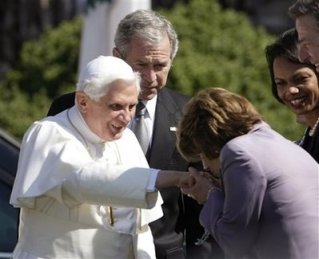 Kissing the Son / vicar of God is a common expression of publicly submitting to a ruler’s authority.
“And the LORD said unto [Elijah]…I have left me seven thousand in Israel, all the knees which have not bowed unto Baal, and every mouth which hath not kissed him.“ (I Ki 19:13-18)
“Then Samuel took a vial of oil, and poured it upon his head, and kissed him, and said, Is it not because the LORD hath anointed thee to be captain over his inheritance?” (I Sam 10:1)
A rare example of Melchizedek’s inheritance being dominion over the whole occurred under King David’s influence.
“And Hiram king of Tyre [one of Lucifer’s positions, remember?] sent his servants unto Solomon; for he had heard that they had anointed him king in the room of his father: for Hiram was ever a lover of David.” (I Kings 5:1)
The consistency with which the concept “love” is portrayed throughout the Bible in 442 passages provides a reliable interpretation in every single instance. Hiram’s “love” for David must be interpreted to mean the same thing as Jonathan’s “love” for David: “Jonathan loved him as his own soul [identified as being one with himself].” (I Samuel 18:1-4)
“And Solomon sent to Hiram, saying, Thou knowest how that David my father could not build an house unto the name of the LORD his God for the wars which were about him on every side…the LORD spake unto David my father, saying, Thy son…shall build an house unto my name. Now therefore command thou that they hew me cedar trees out of Lebanon; and my servants shall be with thy servants…
when Hiram heard the words of Solomon, that he rejoiced greatly…So Hiram gave Solomon cedar trees and fir trees according to all his desire…and there was peace between Hiram and Solomon; and they two made a league together.” (I Kings 5:2-7)
So it comes as no surprise that at the same time that Solomon was building the temple in Jerusalem per David’s blueprints, coordinated with supplies and skilled workmen provided by Hiram, that Hiram was building his own temple in Tyre.
Herodotus visited the temple 500 years later and described its impressive entrance as having two columns, just like those at Solomon’s temple. Outside the god’s temple, at a specially constructed altar, worship involved prayers, burning incense, the pouring of libations, and making offerings to the god of animal sacrifices, foodstuffs, and precious goods. Women, foreigners, and pigs were not allowed in the sacred precinct, which also functioned as the city’s treasury.
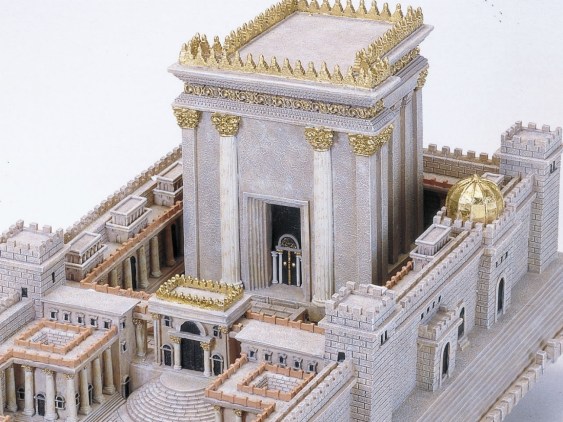
So Hiram not only copied the form but also the function of the new temple as these practices are fully consistent with Israel’s prescribed worship of YHVH. In every sacral kingdom, making a league required submitting to the acknowledged true king – the god of the nation. indicating that Hiram led his nation in a religious conversion to monotheism, exactly as happened in Egypt under Pharaoh Akhenaten.
Since, as the capitol of Phoenicia’s Mediterranean colonies, Tyre required every new colony to build a temple to its god, Israel could have had a foreign mission’s program long before the Apostle Paul, most importantly at Carthage where Rome wrested control of the Mediterranean from Phoenicia and catapulting into empire status.
However, by Herodotus’ time worship had shifted back to Melqart, the local title for the general identity of Baal / Lord found in several passages of the Bible, for example, when describing the sins of King Ahab in I Kings 16:31-2.
Interestingly, in the 9th-century BCE, i.e. during Ahab’s lifetime, a stele dedicated by Bar-Hadad [Aramaic] / son of the God of War [English] / Benhadad [Hebrew] with an inscription to Melqart was installed in Syria.
Tragically, Israel’s rulers lost not only their witness but their spiritual power as their own worship of YHVH corrupted into worship of the false gods of their neighbors, and the Solomonic temple at Tyre changed its god to Melqart.
About this same time in history, Nebuchadnezzar covered his new Ishtar Gate at Babylon with images of the same cloned seed of Satan, the anti-christ, the snake-dragon / mushussu, called Marduk in Babylonian.
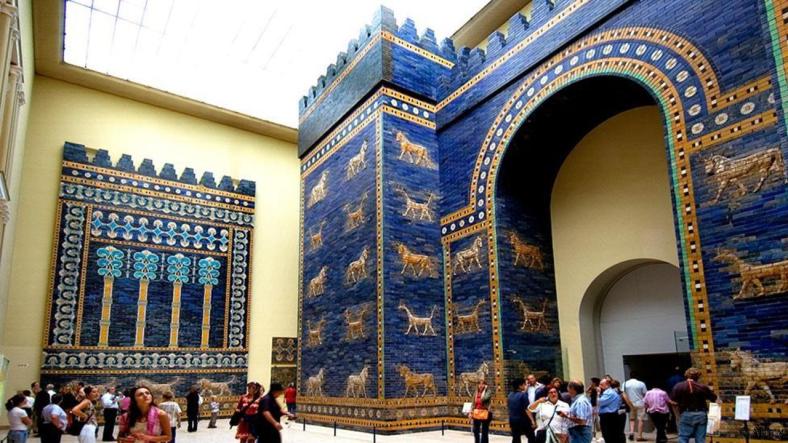
The Ishtar gate of Babylon was moved to the Pergamum “Where Satan Dwelleth” – Museum in Berlin during Hitler’s combined occult and rocket fueled acceleration to the heights of power. Given the hyper dimensional quality of spirit beings / aliens, no doubt some kind of hyperdimensional portal is required for establishing contact with spirits either in the cosmic space or on earth.
In marked contrast to this Christian nation’s reverence and preservation of paganism, the rise of Islam’s Da’esh (ISIS) and its expansion across Syria and Iraq were characterized by the ideological purity of the seventh-century the Quran and Sunna (words and acts) of the Prophet Muhammad and his companions, emphasizing an imperative to combat polytheism, idolatry, unbelief, and all attempts to associate other beings or things with God.
- (ISIS) released a video showing the fiery destruction of the Temple of Baal-shamin at the Syrian site of Palmyra.
- A United Nation agency says satellite images confirm explosions reported at another Palmyra temple which has largely been destroyed.
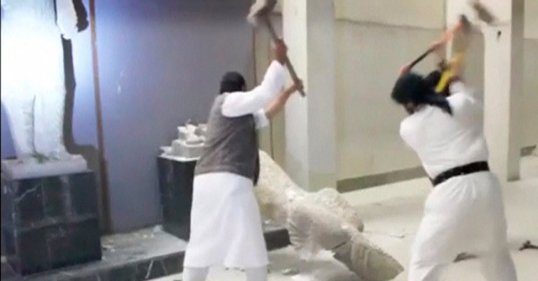
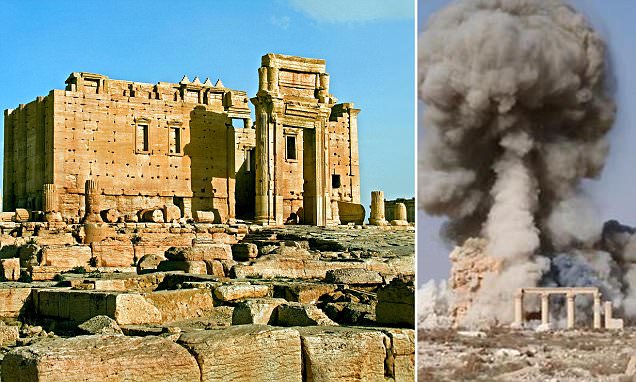
Call me a terrorist if you will, but isn’t the destruction of this heritage of carnage exactly what YHVH calls his people to do?
“These are the statutes and judgments, which ye shall observe to do in the land, which the Lord God of thy fathers giveth thee to possess it, all the days that ye live upon the earth. Ye shall utterly destroy all the places, wherein the nations which ye shall possess served their gods, upon the high mountains, and upon the hills, and under every green tree: And ye shall overthrow their altars, and break their pillars, and burn their groves with fire; and ye shall hew down the graven images of their gods, and destroy the names of them out of that place.” (Deuteronomy 12:1-3)