When Noah blunders into a catastrophic failure of leadership, although accidentally, nonetheless he transfers his Melchizedekian role to Shem, who is then known as “the father / authority of all the children / disciples of Eber” (Genesis 10:21). These are not his namesake Semites, who are defined by their common languages Hebrew, Aramaic, Akkadian, Ugaritic, Phoenician, and others. In the same way Abraham is defined as “the father / authority of all them that believe“, i.e. his followers, disciples, Melchizedek Shem’s begotten children are his spiritual heirs.
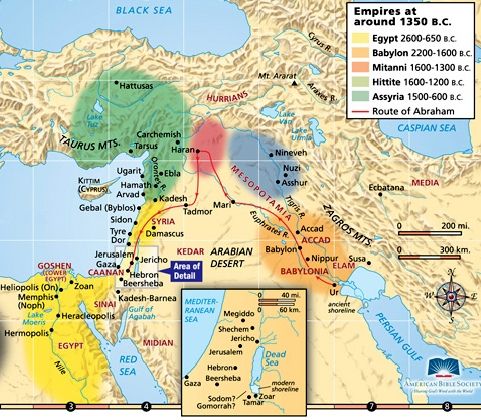
Cultural historians confirm the biblical account that righteous Shem’s great-grandson Eber is the namesake founder of the [H]ebre[w]s of whom Abraham “our father” is the first person identified as such.
“Shem, Arphaxad, Shelah, Eber, Peleg, Reu, Serug, Nahor, Terah, Abram; the same is Abraham.” (I Chronicles 1:24-17)
There is a logical reason why Eber is barely mentioned in the Bible despite his key role.
That would be his key role. Eber’s name / defining characteristic means “regions beyond”. Consistent with the biblical account, secular anthropology also states that “Little is known about the oldest eras of ancient Hebrew civilization because the culture was nomadic. Like Paul, Eber was constantly traveling to spread the gospel to the migrating heathen nations.
“For the [Old Testament] scripture saith, Whosoever believeth on him shall not be ashamed…the same Lord over all is rich unto all that call upon him….Have they not heard? Yes, verily, their sound went into all the earth, and their words unto the ends of the world.”
Continue reading “SECTION XXII: Covenantal Monotheism Available In All Nations Of The World”