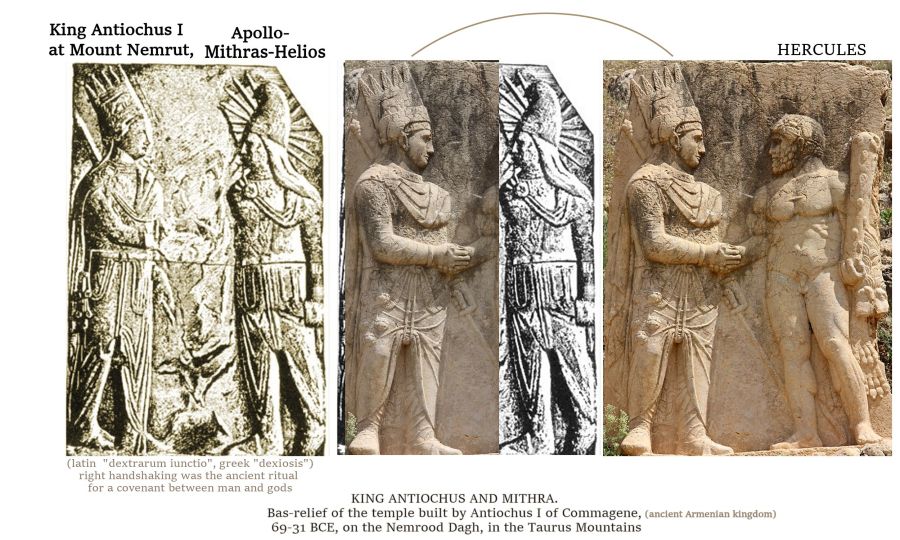
Every nation appeals to a Supreme Authority to govern through a code of laws.
The 1993 Constitution of the atheist Russian Federation [of states] is frankly based on a contract with the people: “We, the multinational people…adopt the Constitution Of the Russian Federation”.
As does the 1776 American Constitution. “We the People…do ordain and establish this Constitution.
This contrasts sharply with nations based on a spiritual covenant. Take Iran’s Constitution, for example.
“The Islamic Republic is a system based on the faith in One God (“There is no god but God”), the exclusive attribution of sovereignty and the legislation of law to Him, and the necessity of surrender to His commands;
- divine inspiration and its foundational role in the articulation of the laws;
- resurrection and its constructive role in explanation of laws;
- the justice of God in creation and legislation…”
Human nature is such that powerful rulers, whether a theo-cracy – rule by the gods, or aristo-cracy – rule by the aristocrats, over powerless masses inevitably overrides the contractual agreements. And aren’t we seeing this in 2026 in America.
The Greeks recognized this problem when they replaced their kings with new forms of government. First came Demo–cracy – People Power. In Athens, all male citizens were eligible to participate in the city’s governing assembly. Obviously, this only works in small city states, and most of all, worked because anyone who didn’t fit in was eliminated by ostracism – a legal procedure by which any citizen could be expelled from the city-state of Athens for ten years. Execution was also used to keep the status quo from being disrupted by new ideas, Socrates being a famous example.
Socrates’ student Plato conceived The Republic, from Latin rēs (“thing”) + pūblica (“public”), literally “the public thing”, defining the novel plan of rule of the people by using representatives in an organized political system famously implemented by Rome (hence the Latinized name) and subsequent Western nations including the United States of America. Plato also emphasizes the rights of the people through detailed expositions of political and ethical justice.
The ideal Republic comprises three social classes: rulers, guardians / military and producers, who do not take part in governmental decisions. There is no place for persons who do not benefit the state.
In Plato’s Republic, the three parts of the platonic conception of individuals’ souls corresponding to the three classes of society, must be Good and Just for this macro system to work.
- ruled by reason that desires truth and goodness
- guarded by a spirit preoccupied with honour and values
- production / appetite curbed by restraints on food, drink, and sex.
This is basic Humanism, the belief that humans have the innate power to overcome the essential hormonal and neurological drives of the human body and soul, in total opposition to the laws – unalterable physical reality created by God.
Hammurabi’s and Moses’ codes both explicitly state that their purpose is to bring about the rule of righteousness in the land to prevent injustice.
And here is where the Law of Moses absolutely did not plagiarize the Code of Hammurabi. The difference between the two codes – and this is huge – lies in the contractual nature of Hammurabi’s Law vs the covenantal nature of the Mosaic Law.
- Hammurabi’s Laws assign socially approved / disallowed behaviors and punishments.
- The Mosaic Law deals with the cause of destructive behavior, not just its effects, and prevents, not just punishes, social damage through empowering personal and national holiness.
“the law is holy, and the commandment holy, and just, and good…but I am carnal [flesh, hormonal and neurotransmitter-driven]…what I would, that do I not; but what I hate, that do I…to will is present with me; but how to perform that which is good I find not….
O wretched man that I am! who shall deliver me from the body of this death…?God…That the righteousness of the law might be fulfilled in us, who walk not after the flesh, but…[mind] the things of the Spirit [of God in us].” (Romans 7, 8:3-5)
- The Code of Hammurabi protects only the free men class – the middle and higher social classes of Babylon. The lower classes, the wardu (slaves) and the mushkenu (free person of low estate) have no such protection. Taking the life of your own slave was no-one’s business but your own, and taking the life of another man’s slave might only bring a fine.
- The law of Moses protects the disenfranchised members of society, regardless of their place or rank in society.
Hammurabi or the Supreme Court of the United States or any other leadership forum can’t simply arbitrarily call into existence the rightness or wrongness of actions. It’s simply a matter of defying laws of human nature as much as laws of physics. Either situation will inevitably cause destruction.
“After nearly thirty years, the data suggest that abortion has been anything but good for the United States.” The economic consequences alone are that abortion (the modern clinically approved manner of child sacrifice)
- reduced the size of the economy,
- undercut one main cause of the American economy’s current dynamism: innovation,
- reduced the standard of living of the average America household
- is single-handedly responsible for anticipated imbalances in the Social Security retirement system,
- is perhaps the single largest American economic event of the past century, more significant than the Great Depression or the Second World War.
“the analysis warns that if it continues unchecked, legal abortion will progressively erode both America’s relative economic importance and her average absolute standard of living.”
Another example of the impossibility of reversing a law of nature by decree is the massive numbers of innocent deaths by AIDS caused by unlimited political support of homosexuality. See relevant post for details.
The Mosaic law provides a far better quality of life for its subjects than any contract nation.
- There is one day out of seven free from labor as opposed to the Egyptian, Roman and French Renaissance Republics’ one day out of ten,
- as well as one full year’s vacation out of seven,
- redistribution of resources to those unable to provide for themselves via a low ~22% income tax,
- and periodic elimination of debt.
- ensuring equal distribution of resources to all subjects, with no wealthy elite gaining power over the impoverished.
The presumption here is not that loans are made to exploit commercial opportunity, but rather to avert disaster. Indeed the Mosaic law encourages such lending: “If there is a poor man among your brothers in any of the towns of the land that the LORD your God is giving you, do not be hardhearted or tightfisted toward your poor brother. Rather be openhanded and freely lend him what he needs.” (Deut. 15: 7-8, NIV)
Compare the assurances of debt relief in the Mosaic Covenant with the Mesopotamian reactionary debt release practices during crises.
In Hammurabi’s time…The peasantry was provided with land…tools, draught animals, livestock, and water for irrigation, so that they could grow food…they had to pay to the State as rent…When the harvest was poor, they accumulated debts. If peasants were unable to pay off their debts, they could also find themselves reduced to the condition of serfs or slaves…after 1400 BC; inequality increased and intensified. Land was taken over by big private land-owners and debt enslavement became commonplace. The ensuing centuries…have evidence of violent social struggles between creditors and debtors.”
Contrast with the oversight and restrictions placed on leaders in God’s kingdom.
“Now the sons of Eli [chief priest and judge over the kingdom of Israel] were sons of Belial; they knew not the LORD. And there came a man of God unto Eli and said unto him… Wherefore… honourest thy sons above me, …thy two sons, on Hophni and Phinehas; in one day they shall die both of them.” (I Samuel 2:12-36)
“And Samuel said to Saul, Thou hast done foolishly: thou hast not kept the commandment of the LORD thy God, which he commanded thee: for now would the Lord have established thy kingdom upon Israel for ever. But now thy kingdom shall not continue:” (I Samuel 13:13-14, Acts 13:22)
There is a sharp contrast between
- contractual laws simply cursing the unrighteousness
- and covenantal blessings giving second chances,
- the contractual goal for longevity of the king and prosperity for the nation’s elite class through exploitation of the working class
- and the covenantal goal for equality and elevation of all through eternal unity with Almighty God.
To determine the type of any nation, we only need to measure the morality of the ruler and the welfare of the people in action, not words. What are America’s in 2027?