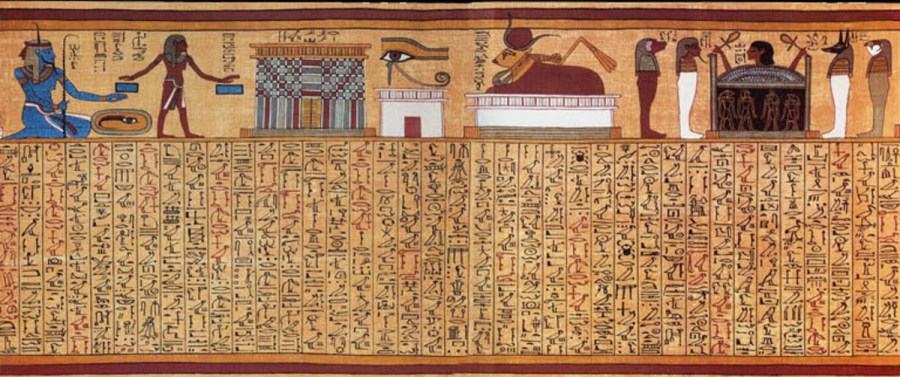
Egyptian Book of the Dead or The Egyptian Book of Living & Dying was a guidebook to assist the deceased in the afterlife and comprised a collection of hymns, spells and instructions to allow the deceased to pass through obstacles in the afterlife. The work has similarities with ‘The Tibetan Book of Living and Dying’ and the Mesoamerican Popol Vuh.
These mimic the books by which the dead are judged by the Hebrew God.
“And I saw a great white throne, and him that sat on it,..
- and the books were opened…and the dead were judged out of those things which were written in the books, according to their works, and they were judged every man according to their works. –
- “Every man’s work shall be made manifest…fire shall try every man’s work of what sort it is. If any man’s work abide which he hath built thereupon, he shall receive a reward. If any man’s work shall be burned, he shall suffer loss: but he himself shall be saved; yet so as by fire.” (I Corinthians 3:12-14)
- and another book was opened, which is the book of life
- And whosoever was not found written in the book of life was cast into the lake of fire. (Revelation 20:11-15)
In order to make sense of this book of life, we need to stay on track with the standard literary format of any book – reference back to the beginning of the story to understand the ending.
The first mention of a book recording life is found at the beginning of the history of human life, where it is stated to be a book listing the names of some of Adam’s offspring.
“This is the book of the generations of Adam.” (Genesis 5)
Adam, whose life was breathed into him by God, then passed to Eve through a cloned stem cell from Adam’s bone, was then passed through the Women’s mitochondria in her ova.
“And Adam called his wife’s name Eve; because she was the mother of all living.” (Genesis 3:20)
A straightforward interpretation of this passage is that all human beings start out written in the book of life.
“While the child was yet alive, I fasted and wept: for I said, Who can tell whether God will be gracious to me, that the child may live? But now he is dead, wherefore should I fast? can I bring him back again? I shall [only] go to him.” (II Samuel 12:22-2)
We can conclude from this that all children younger than the age of accountability, regardless of infant baptism into a faith or belonging to a faith-less family, are found written in the book of life and enjoy eternal life.
But the Bible states flat-out that it is possible for adults to be blotted out of this book.
Continue reading “94) The Book Of The Dead vs The Book Of Life”