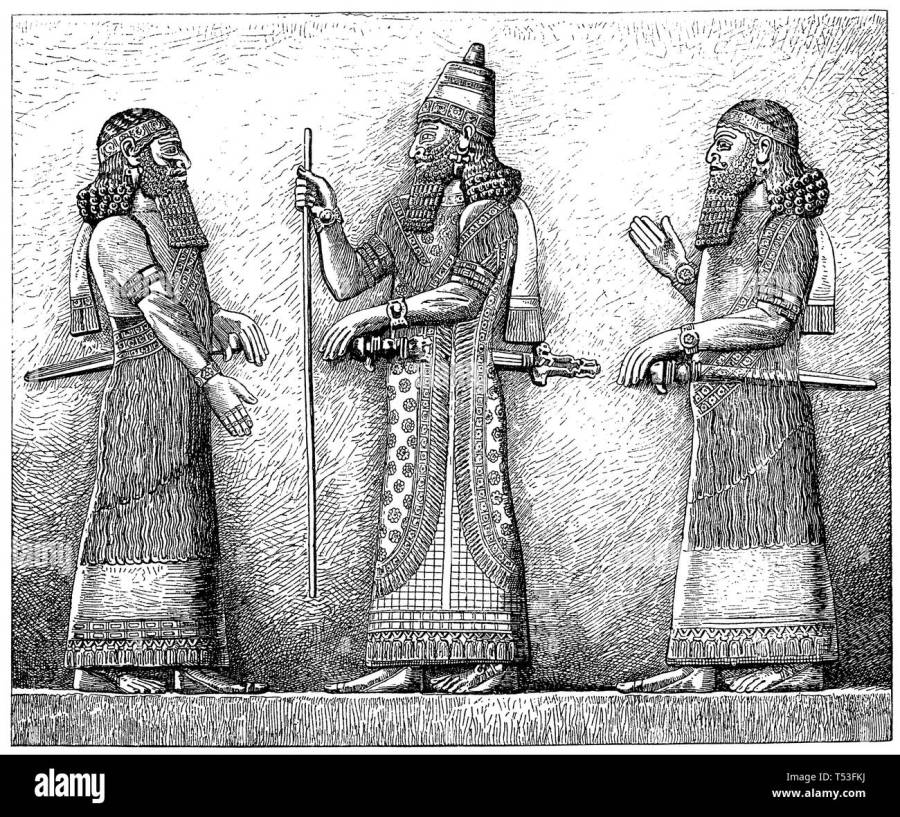
Closely following in his ancestor Cain’s steps as adversary to the order of Melchizedek, Arphaxad / Gilgamesh gave himself yet another title – Sharru-ukin / true king.
The definition of true in this context is not as the opposite to false but “rightul because fully fulfilled, ideal, belonging to the same natural group, legitimate guaranteed“. Sargon was conducting a political campaign to win essential support from elites with resources. Think Donald Trump’s being voted into absolute world-wide power in the American democratic system.
His biggest rival was, of course, Noah’s party, the YHVHists whose proven success by their family’s survival, with livestock, of the world-wide flood that had wiped out every other living creature should have been a massive obstacle to defeating him. However, the biggest drawback to Melchizedek’s Monotheism is its insistence on “One Way, a strait [as in the Strait of Hormuz] gate, and narrow is the way, which leadeth unto life.” (Matthew 7:14), which Antichrists play to their advantage with “All Roads Lead To Rome”, i.e. many different ways of reaching the same goal.
As detailed in a previous post, the spirits of the drowned hybrids survived the flood as demons desperately seeking re-incorporation. It should be understood without having to be stated that promises of “friends with benefits” were being made to the many entrepreneurs in the Mesopotamian version of the Wild West Gold Rush.
What Sargon was asserting as “true” king is that he, not Noah with YHVH, nor any of his pagan rivals with their devil-may-care spirits, was imbued with greater power from on high like the pre-flood Supermen whose exploits inspired awe. And from all appearances, Sargon was the exception to the rule.
Unlike his rivals who identified themselves as sons / heirs of pre-flood gods and heroes / hybrids like Hercules, Sargon identified his paternity as purely human. But what a man! Famed world-wide for surviving the flood by the grace of YHVH who bequeathed dominion over the whole world to him as Adam’s / Enlil’s heir, which he passed on to Shem who Sargon was able to defeat and take possession of all his spiritual, i.e. empowering artifacts, thereby seizing – in the pagan paradigm – dominion over the whole world backed by YHVH himself!
Sargon is reported to have supported a court, i.e. standing army, of 5,400 men who “ate bread daily before him”. This is a credible number in an exponentially expanding population over Sargon’s extended lifetime.
An autobiography of Sargon is found on a tablet of the Old Babylonian period recovered at Nippur on the pedestal of a statue erected in the temple of Enlil / Divine Lord of the Earth / Adam.
- king of Akkad (city-state named after himself meaning “gathered together the people”.
- mashkim / overseer of Inanna / mother of all living / Earth Goddess / carrier of giant genes, mother of hybrids,
- guda / anointed / Chosen One, Messiah, Christ of Anu / Creator (in reality the antichrist)
- en-si / lord [of all] the land / granted covenant of dominion of creation as the only begotten / heir son of God, Melchizedek
- governor of [the line of] Enlil / Adam / Melchizedek
- king of Kish – Melchizedek’s capitol seized in battle as per previous post, establishing his authority as Melchizedek over the whole earth.
These claims documented within the dates established by archeology substantiate the identification of Sargon as Shem’s son Arph-axad / Gilgamesh.
Asserting that he was Melchizedek was itself was quite a coup, but in another autobiography Sargon doubles down by announcing he is also empowered by a pagan god’s spirit passed to him by his mother.
- the mighty king, king of Agade / Akkad, am I.
- My mother was a changeling / carried hidden hybrid DNA,
- identifies himself with the Earth Mother Goddess,
- my father I knew not / rejected identity with him as YHVH’s Melchizedek,
- The brother(s) / clan of my father loved the hills
- i.e. did not fight but fled to “The high hills are a refuge” (Psalm 104:18]
- My changeling [secretly hybrid] mother conceived me, in secret she bore me. She set me in a basket of rushes, with bitumen she sealed
- This parallel to saving Moses from Pharoah’s orders to drown the enemy’s potential soldier is patently part of the ancient practice of infanticide of unwanted or problematic children with birth defects – not a rare prototype for the Hebrews to plagiarize in the story of Moses.
- Akki, the drawer of water lifted me out…[took me] as his son (and) reared me…
- Ishtar granted me (her) love
- signifies sexual union with a goddess / female carrier of giant genes to breed post-flood hybrids.
Notice the prominence of Inanna, listed second to himself, what today we call “consort”. As “overseer” of the fruitful goddess of the earth, teeming with fertility, the ancient Mesopotamian goddess of war, love, and fertility, Sargon is controlling all the aspects of the post-flood demi-god procreation program made possible by this woman’s possession of giant genes in her seed / eggs / ova.
The worship of Inanna at the Eanna temple in Uruk played a crucial role in her cult. Archeologists consider Uruk / Erech to be “the first city in world history” in terms of a seattlement with a population meeting the criteria for the definition of a city, It was to this city that worshippers flocked to unite with the deity through sexual passion with her priestesses both female and transgender, and in her festivals of consecrated orgies. Exactly like San Francisco, considered the Gay Capital of the World.
After raising an army of giants, Sargon then conquered Ur and E-Ninmar and “laid waste” the territory from Lagash to the sea, and from there went on to conquer and destroy Umma, and he collected tribute from Mari and Elam. He triumphed over 34 cities in total. Ships from Meluhha, Magan and Dilmun rode at anchor in his capital of Akkad on the Tigris River. Submitting himself to the Levantine god Dagan in exchange for his support in his territory, Sargon conquered territories of Upper Mesopotamia and the Levant, including Mari, Yarmuti (Jarmuth?) and Ibla “up to the Cedar Forest (the Amanus) and up to the Silver Mountain (Aladagh?)”, ruling from the “upper sea” (Mediterranean) to the “lower sea” (Persian Gulf).

Indicating the importance of this site as entry to the god’s underworld, Babylon is documented as one of Sargon’s early rebuilding projects. However, notice that Babylon is missing on the above map, due to that site still being under water due to flood runoff in the Euphrates River for many years. Details in the relevant post on the difficulties accessing the exact pre-flood site. The Akkadian records confirm the biblical account that Babylon resurged only later under Sargon’s younger cousin Nimrod.
The speed with which Sargon changed society can be matched to how quickly Shaka Zulu Changed the World.
In 1816, Shaka Zulu began a campaign of conquest to unite all of the clans in the region under his rule.
Shaka began with a systematic reorganization of Zulu warriors. Zulu society — much like Sparta — was entirely restructured to support the army.
In just a couple of years, his army had brutally executed, displaced or assimilated a vast territory with more than 200,000 inhabitants who became his subjects.
Like Shaka Zulu’s appearance on the scene, warfare under Sargon in Mesopotamia changed from seizing property and slave labor between neighboring clans with a minimal loss of life into total destruction of the enemy on the battlefield.

The innovative tactics and military reforms of both Shaka Zulu and Sargon welded neighboring clans into a powerful empire. So it is no surprise that “for at least 1,500 years after his death, Sargon the Great was regarded as a semi-sacred figure, the patron saint of all subsequent empires in the Mesopotamian realm”.
In truth, Sargon is more accurately portrayed in gory movies than in elitists’ history books.