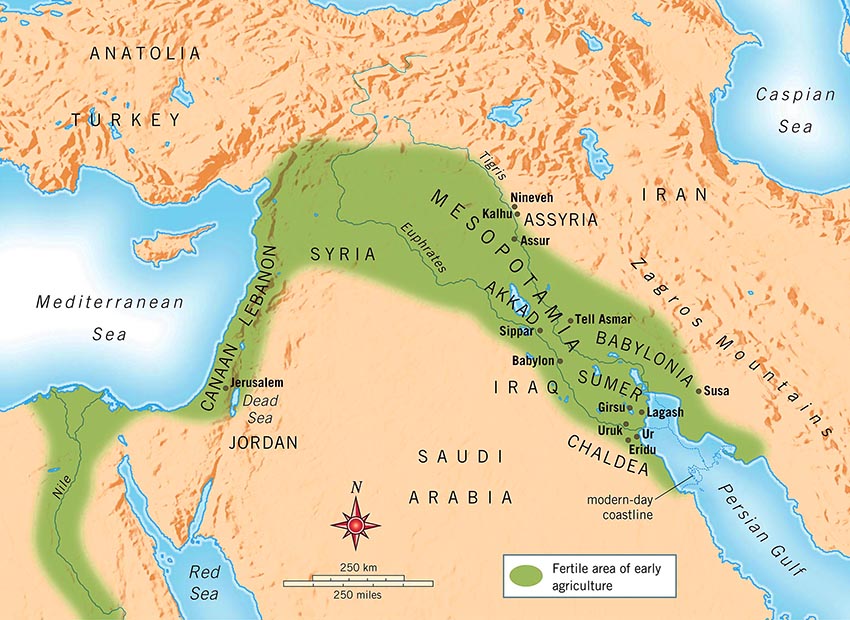
The Sumerian King List validates the biblical account of a world-wide flood.
“After the flood had swept over, and the kingship had descended from heaven [the second time], the kingship was in Kish“.
The meaning of this Sumerian word is over the whole world, evidence that this location was YHVH’s Melchizedek’s immediate post-flood center of rule and worship. Along with most of the world’s geography, Jerusalem would have remained underwater for some time while the floodwaters subsided.
Ĝushur / Fish became king for 1200 years.”
This attribute, like a nickname, memorializes Noah’s famous exploit of having made it through the great flood. The same individual is also commemorated with the title of Me–bara–si / Divine properties – [a compounding element] –connector, i.e. The One Who Connects With The Divine, AKA Melchizedek.
We can be certain that the pagan Sumerians were as disgruntled to admit this as they were in their theogony admitting that Enlil / Adam was created by YHVH, but also as unavoidable at that time due to both men’s living witness of their singular relationship with Almighty God to society during their exceptionally long lifespans.
Continuing with the Sumerian King List:
- Kullassina-bel /”All of them were lord” ruled for 960 years – indicates chaotic competition over small pieces of territory,
- Nanjiclicma / “#1” ruled, suggesting he won the competition, for 670 years
- En-tarah-ana ruled for 420 years
And it goes on and on without providing significant information until we arrive at an individual named as “king” with a long reign of 1500 years. In the context of perpetual warfare between rivals, this is the same first king, Noah, maintaining the entirety of his years of reign, given a new title exalting his victory reclaiming his city after having been temporarily driven out during war.
- ‘Etana’, meaning ‘the shepherd who ascended to Heaven and “made firm” all the lands’, signifying conceptual firmness, i.e. stability, peace and order to a warring population, as well as material terra firma, ruled for 1500 years.
- Balih, the son of Etana – first indication of a dynasty – ruled for 400 years. This is Shem by one of many titles.
Another period of non-dynastic rule during warfare by rival warlords then
- En-men–barag–e-si / Lord – [with] crown – [ruling from] the sanctum – priestly- connector became king; he ruled for 900 years. Called by archeologists the penultimate first king of the first dynasty of Kish.
Enmebaragesi is the first name confirmed by archaeological finds as an historical person. This is Noah, once again winning back his crown during perpetual conflict, confirmed by his embellished basic title of Mebarasi / Priest-King, In classic revisionist history by the winners of regime change, the Sumerians tried to convert YHVH’s Melchizedek into one of their own with deifying title of lord as god.
His identity is also confirmed through other literary references, in which he and his son Aga of Kish / Shem are portrayed as contemporary rivals of the same man called variously Dumuzid / Tammuz / Gilgamesh.
He is first reported in Sumerian documents using the antiquated Sumerian spelling “Bilba-mec [“c” pronounced sh] and also contemporaneously in much later Akkadian language documents in which the Sumerian “b”s were changed to “g”s. This is, however, consistent with the biblical account of long lives at this time in history.
Numerous tales have been told about Gilgamesh, and the whole collection has been described as the odyssey of a king who sought eternal life, clearly by an alternate route from the biblical account passed through the flood with Noah.
The Tummal Inscription credits Gilgamesh with building the walls of Uruk.[22] identified by scholars as the biblical Erech (Genesis 10:10). The oldest version of many variations of The Epic of Gilgamesh dates back to the 18th century BCE and is titled after its incipit / beginning words Shūtur eli sharrī (“Surpassing All Other Kings”). This clearly establishes Gilgamesh’ rivalry with Melchizedeks Noah and Shem. An inscription discovered in the archaic texts at Ur reads: “Gilgameš is the one whom Utu has selected” as his human hybrid ruler on earth, i.e. Antichrist.
“Aga / Shem, son of En-me-barage-si / Noah made the Tummal flourish and brought Ninlil / Mother of all living / Noah’s wife into the Tummal [for safekeeping].”
The Sumerian word Tummal is found in inscriptions of this period but not translated by archeologists, probably because it was clearly understood since Eastern royal households always guarded their women in what we call harems.
“Then Kic / Kish was defeated and the kingship was taken to E-ana / House of Heaven, temple complex [in Uruk].”
From one of the versions of the Sumerian King List:
envoys of Aga / Shem came from Kish to Gilgamec in Unug / Uruk. Aga laid siege to Unug with his men…Gilgamesh, addressed its warriors: “Let someone with courage volunteer“…Only Enkidu / hybrid bull-man went out through the city gate…and he took Aga the king of Kish, captive in the midst of his army.
Don’t miss what an achievement that was! Enkidu was so powerful this one hybrid was able to keep an entire army at bay! This rehybridization program was truly the redevelopment of WMDs!
- Gilgamec approached close to Aga:
- Aga my overseer?
- Aga my lieutenant?
- Aga my governor?
- Aga my commander?
- Aga my military commander?
Gilgamesh is bargaining with Aga for alliance as an alternative to his death and his city-state’s subjugation as a slave state, beginning small and increasing his offer to the highest honor possible as Aga shakes his head “no” to every inducement.
And Gilgamesh explains why he is making such a magnanimous offer.
“Aga gave me breath, Aga gave me life:”
Major plot revelation! Expressly and unequivocally stated in “gave me breath, life” Aga / Shem is the father of Gilgamesh!
The son of Shem is, like Cain with his father Adam, rejecting the essence of fatherhood at that time – his father’s authority while still claiming his father’s god-power by identifying himself with his father’s blood lineage, thus establishing Gilgamesh’s inherited authority / dominion over the earth.
- Then the Tummal fell into ruins / was conquered for the first time [by] Mes-ane-pada / Gilgamesh.

This alternate title for Gilgamesh glorifies the conqueror as having captured from Kish a list of sacred items in order of importance, equivalent to the Philistines capture of the ark of the covenant, In the pagan conviction, whom the god of this world hath blinded the minds of them which believe not, (II Corinthians 4:4) that the c2 force converting energy to mass and vice versa, cloned from the Creator, is now under their control.
- The “mes” was a collection of divine decrees, each one a “me” described in the poem, “Enki and the World Order” foundational to Sumerian religious and social institutions, technologies, behaviors, mores, and human conditions of Mesopotamian civilization via the relationship between humanity and the gods. These would be the words of YHVH’s prophets such as Adam, Enoch, Lamech and Noah, the “Books of Judgment” equivalent to our Bible’s books of Isaiah, Daniel, Revelation, etc., written in the years of wickedness leading up to the judgment of flood. Safeguarded through the flood by Noah, excerpts of which Moses included in the books of Genesis and Enoch.
- “Ki” is the earth
- Agga we know is Shem
- “cer” means “reddened [i.e. bloodied and/or burned, tortured], bound and fettered”,
That is not good, but frankly, only to be expected.
When Gilgamesh “carried away” the mes, he replaced YHVH’s Books of Judgment promoted by Noah and Shem at Kish with the pre-flood Sumerian decrees safeguarded in pyramids built to withstand the flood, and gathered and implemented after the flood. These are no doubt some of the quests in The Epic Of Gilgamesh for which Gilgamesh is hailed the “archetypal hero” by humanists.
After the city-state of Uruk was reclaimed by Gilgamesh, the first and only king of the third post-flood dynasty of Uruk was brought “in a collar to the gate of En-lil /Adam / Melchizedek’s [temple], clearly emphasizing Gilgamesh’s usurpation of the role of YHVH’s Melchizedek.
The conquered king of Uruk, called Lugalzegesi in the victory account, is one and the same as “Shem / Fame“, recognized both by this action and by the mockery in twisting his well-known identity.
- Lu=Abundant
- gal = large cup
- za = estate as in granted condition
- ge=written
- si=remember
as “Remember, as it is written, ‘My cup runneth over, surely goodness and mercy shall follow me all the days of my life, and I shall dwell in the house of the LORD forever.'” (Psalm 23)
Gilgamesh then built the alternative house of his lord in the city of Akkad, naming it and its Akkadian Empire (c. 2334–2154 BC) after himself as [Arph]-axad / “land of the Chaldeans, this people was not, till the Assyrian founded it for them that dwell in the wilderness: they set up the towers thereof, they raised up the palaces thereof;” (Isaiah 23:13)
As detailed in the relevant post on The Assyrian, this individual is the spirit of Antichrist manifesting in a sequence of rulers.
Using the classic Adversarial strategy of deceiving through confusing language, Gilgamesh too perverted YHVH’s Hebrew language, blending it with Sumerian to create the Akkadian language. Written using the Sumerian cuneiform script, prompting its use by numerous new languages in the region including Eblaite, Hurrian, Elamite, Old Persian and Hittite, and including Akkadian phonology, vocabulary and syntax. This clearly limited Hebrew and its records of YHVH from being transmitted to the burgeoning population.