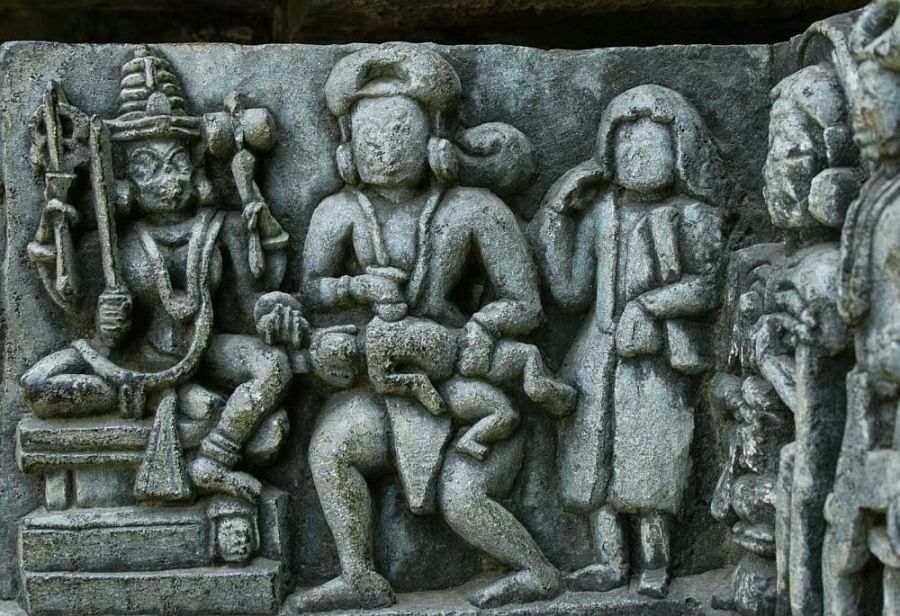
105) The Canaanite Pandemic

Canaan’s people were the ambassadors / evangelists / missionaries for the worship of a universal Seed of the Serpent to draw humanity away from the worship of the one true Seed of the Woman. Any features distinguishing between the gods of the nations can be attributed, not to different individual gods, but language and ecologically based cultural differences as the Canaanite nations were spread throughout the world.

According to the Canaanite pantheon the creator was known as Elion / עֶלְיוֹן “the most high / powerful” Elion was acknowledged by the Canaanites to be the father of the [lesser] divinities. However, in what is clearly the corruption of the sacred union of the Most High God with Jerusalem:  “the holy city, new Jerusalem, coming down from God out of heaven, prepared as a bride adorned for her husband.” (Revelation 21:2), the Canaanites presented him as having engaged in a sacred union / marriage with Beruth (Beirut in English), meaning “Our [Canaanite] City”. Each city’s supreme god was likewise grounded to his territory.

  1. Melqart and Tyre
  2. Chemosh and Moab
  3. Tanit and Baal Hammon in Carthage
  4. Baal Hadad and El can be distinguished amongst earlier Amorites and the neighboring Arameans to the east to have been almost identical in form and function to the Canaanite divinities.

Carried west by Phoenician sailors, ancient Canaanite culture can be seen not only in later Greek mythology but social morals embedded in many people groups.

Continue reading “105) The Canaanite Pandemic”

106) The Canaanites Kindle World War

In the mid-fifth century BC, the Father of History Greek researcher Herodotus of Halicarnassus visited Tyre, spoke to a priest, and learned that the town and the temple of Melqart were, at that time, believed to be 2,300 years old. In other words, the city was founded in the twenty-eighth century BC, prior to the biblical date of the Flood ~2350 BC.

Herodotus does not mention a world-wide flood, but he would have known of it as he systematically gathered history from multiple cultures. It is likely he saw no reason to report the histories and wisdom of “the world that then was” which was already preserved through the Flood in vaults or on the ark, then gathered in libraries available to Herodotus and other sages.

In support of this consideration, Herodotus likewise does not give an account of Assyria’s origin or of the history of the Semites in Mesopotamia. It’s as if he consigns these records to the same category as known history in the collected works of the sages. Instead, Herodotus’ account most evidently picks up Japhethite / European history where the holy scriptures drops it to focus on the Hebrew nation, immediately after the dispersal of nations from Babel.

Herodotus reports that the Phoenicians / Canaanites had “recently come from that which is called the Erythraian Sea / Persian Gulf to this of ours / Mediterranean Sea, and having settled in the coastland  where they continue even now to dwell, set themselves forthwith to make long voyages by sea.”

picture6

This account provides a reliable “absolute” vs “relative” date for this event as occurring during early emigration from the Mesopotamian / Land between Two Rivers and development into distinct people groups.

“And conveying merchandise of Egypt and of Assyria…”

This confirms the above date being after Asshur separated from Nimrod at Babylon and started his Assyrian Empire.

“they arrived at other places…”

Continue reading “106) The Canaanites Kindle World War”

107) The Trojan War

We can only understand the Trojan War in the context of its trigger – competition between nations to create weaponized hybrid beings. Mistake the Trojan War for a myth and you won’t understand what is assumed you know, so minimally detailed, in Revelation regarding the same military tactic at the end of time.

To begin with, Greece of this era was not in any way a nation. Instead, the rocky peninsulas and archipelagoes housed a number of small but powerful city-states, each of whom considered themselves proudly independent. So it was no mean feat when Agamemnon managed to bind them together into a unified force for the assault on Asian Troy. The equivalent situation in modern times is the European Union’s support of Ukraine against Russia’s invasion.

Trojan / Canaanite King Priam and Crown Prince Hektor assembled their allies from city- states all along the western Anatolian coastal regions (modern Turkey) and as far away as Elam (modern Iran). The equivalent modern situation is North Korean troops joining Russian forces in Ukraine.

The reason for the war was that Hamites weren’t the only ones parenting supermen. Every nation that aspired to power required a Mother of gods carrying hyper dimensional genes in her ovum. And the Trojans’ seizure of Helen was the equivalent of stealing the ways and means to produce nuclear weapons.

Before Helen, there was Medea. Even more famous than Helen in Greek mythology. Medea appears in the majority of the most ancient sources, including Argonautica by Apollonius Rhodius, Histories by Herodotus, Theogony by Hesiod, Metamorphoses by Ovid, and in several plays including Medea by Euripides.

Medea was the daughter of King Aeetes of Colchis, who traced his [pre-Flood] lineage to Apollo and an Oceanid, i.e. a female hybrid, so Medea carried hyperdimensional genes in her ovum. Medea was also priestess to the goddess of witches, Hecate. Altogether Medea was a prime acquisition for the western-most recently settled colonies of pioneers in Europe at this time when she fled her home with Jason of the Argonauts. However, she used her power to cut a swath of destruction across Greece in every city-state she visited.

Cersei Lannister, unquestionably named after Medea’s aunt and fellow sorceress Circe, can’t hold a candle to this pair of evil queen mothers.

Continue reading “107) The Trojan War”

108) The Biblical Perspective Of Virgil’s Aeneid

Troy having been destroyed beyond repair and the Greeks having been decimated, the survivors on both sides, led by their respective heroes Trojan Aeneas and Greek Odysseus, sail west over the same sea.

Accordingly the much later Roman account, the Aeneid, has both groups visiting some of the same locations, experienced the same difficulties and encountered the same strange creatures such as the Cyclops. Academics account for this by claiming Virgil plagiarized Homer’s epics the Iliad and the Odyssey, but the sea between Troy and Greece isn’t so large so the shipping lanes so numerous as to assume out of hand that the two groups wouldn’t run into the same remarkable circumstances. 

Gathering scattered auspicious lines from Roman Virgil’s Aeneid:

The Trojan chief [Aeneas] appear’d in open sight,
August [godly] in visage, and serenely bright.
His mother goddess, with her hands divine
Had form’d his curling locks, and made his temples…
Like polish’d ivory…Or Parian marble, when enchas’d in gold [anticipating Caesar’s statues]…
goddess-born…the great Aeneas…from celestial seed your lineage

“O hospitable Jove / Jupiter / Zeus! we thus invoke,
With solemn rites, thy sacred name and pow’r…

To the Cumaean coast at length he came,

Where there is a resident prophetess of Apollo,

Continue reading “108) The Biblical Perspective Of Virgil’s Aeneid”

SECTION XX: “The Assyrian” Chastens YHVH’s People

O Assyrian, the rod of mine anger, and the staff in their hand is mine indignation. I will send him against an hypocritical nation, and against the people of my wrath will I give him a charge, to take the spoil, and to take the prey, and to tread them down like the mire of the streets.” (Isaiah 10:5-6)

The Assyrian’s first mention in scripture defines him as Asshur, son of Shem, who helped his brother Arphaxad / Sargon the Great build his cities. Humanist archeologists applaud this as evidence of high culture and civilization but from a biblical perspective the Assyrian was carrying out Cain’s modus operandi of corralling slaves behind walls to enrich the ruling elite.

Like his brother Arphaxad, Ashur also repudiated the name given to him by his birth father and identified himself with a pagan god. This is documented in a temple inscription as his chosen name “the king Erishum / e-ri-šu which means “He hath desired – I will!” built the temple of Ashur on the site” in c. 1900/1905 BCE, well within Ashur’s lifespan.

Line-drawing of a seal of Erishum with the seated figure believed to be the god Ashur, and Erishum  being led towards him.

Historically, the Assyrian Empire is considered the greatest of the ancient Mesopotamian empires.

Continue reading “SECTION XX: “The Assyrian” Chastens YHVH’s People”

109) Amraphel = Father / Priest-King Of The Giant People

“And Cush the son of Ham, the son of Noah, took a wife in those days in his old age, and she bare a son, and they called his name Nimrod.” (Jasher 7:23)

Staying consistent with the biblical euphemisms, “took a wife” means “become one“.  In Cush’s case and in this context, the sexual union included merging giant genes.

Like his brother Canaan, Cush had to back-breed with his mother to guaranteed match ups with the lone giant genes he had received from her. This is within feasible lifespans documented.

Being in the same generation of his cousin Arphaxad, Cush would have lived until he was about 450 years of age, so his “old age” could have been about 350 years after the Flood, at the same time that Noah died.

  • 2350 BC – the flood
  • 2050 BC – lifespans of generations born during this time had dropped to less than 200 years.
  • 2000 BCNoah dies, Nimrod is born in the same generation as cousin Salah lived ~450 years
  • 1500 BC – Nimrod dies during the Hebrews’ sojourn in Egypt.
  • 1450 BC – Hebrews’ Exodus from Egypt

Corresponding as Nimrod’s birthdate does with Noah’s death, there are a number of possible reasons for that. Cush may have waited until Noah wasn’t around to curse him as he did Canaan before he engaged in the same depraved act. Cush may not have had access to his grandmother while Noah was alive, who, given the custom of marrying young women with longest fecund state, Noah’s wife is likely to have outlived Noah, and carrying powerful angel genes also lengthened her vitality. 

Regardless of speculation, the fact that can be extrapolated from scriptural documentation that Nimrod was born late in Cush’s life has nothing to do with personality formation from being spoiled by a doting father, although that doubtless happened. But the most important data being provided is that, by the time Nimrod was born as the most powerful type of 1st generation hybrid giant, the institutionalized hybrid Mother Goddess temple prostitutes had been popping out generations of continuously genetically degrading models. As time passed, there would be less and less evidence of gigantism as the full complement of growth-enhancing genes wouldn’t always be included in the haploid gamete (egg or sperm) after the process of meiosis shuffled and divided the contributing parent’s genes in half.

Continue reading “109) Amraphel = Father / Priest-King Of The Giant People”

110) Tribulation Drives Us To Life

Hannah Arendt (1906–1975) was one of the most influential political philosophers of the twentieth century. In examining the refugee crisis during World War II, she argues that statelessness is a consequence of the modern nation-state specifically excluding those who are not citizens. The Origins of Totalitarianism, examining the rise of the Nazi and Communist Russian regimes, is rooted in the phenomenon of excluding certain groups. We’re seeing this happening as a priority objective under President Trump’s second term, and should be able to extrapolate where this is leading. Seizure of wealth by eliminating the competition.

We are now witnessing the highest levels of displacement on record.

Continue reading “110) Tribulation Drives Us To Life”

111) The True God-Man Alliance Defeats Giants

The Book of Eli [Hebrew for My God] is a great movie – a religious man is attempting to keep the word of the Bible alive, following a world-wide apocalypse by fire equivalent to Noah’s flood. There’s action, but it’s not mindless action being shoved down the audience’s throat at every turn. There’s violence, but it’s calculated violence. Reciting the Bible word for word would have been a satisfying enough ending, but seeing Kunis as Solara become the new Eli following his death added another layer.

Watching this movie adds action and drama to the minimalistic biblical accounts of the battles fought by a handful of YHVH’s righteous followers to keep the knowledge of the One True God alive in the same post-apocalyptic era through their actions by faith in God’s word.

The Book of Jasher is quoted as an authoritative source by Holy Scripture, and its details of supernatural feats of victory are consistent with later biblical accounts of the same Spirit-empowered feats of valor and are therefore credible as the pre-existing basis for later warriors’ faith that the same God will likewise supernaturally empower their actions on his behalf.

The following has been condensed from the original, beginning with Jacob’s return from Harran to claim his inheritance of the Promised Land from his father Isaac.

Continue reading “111) The True God-Man Alliance Defeats Giants”

SECTION XXI: The Great Mountain

Long before Nimrod rebuilt the pre-flood city named Bab-ylon, Door of the Powers / Gods, YHVH had created what lay beyond the door – the false gods’ prison.

“take up this proverb against the king of Bab-ylonHell from beneath is moved for thee to meet thee at thy coming…it hath raised up from their thrones all the kings of the nations…How art thou fallen from heaven, O Lucifer, son of the morning!…
[But] Rejoice not…
  • for out of the serpent’s [Lucifer’s] root / identical clone shall come forth a cockatrice [first Satan, then his clone Apollo],
  • and his fruit / produce, different from the plant shall be a fiery flying serpent [the god-human hybrid, beginning with Marduk.” (Isaiah 14)

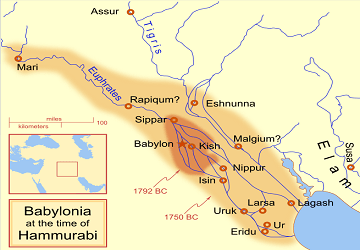
Due to a high-water table by the Euphrates River, there are few artifacts for the pre- and immediate post-flood eras of Babylon, but enough for secular archeologists to determine that the earliest rulers of Babylon were the biblical Amorites. A well-known Bronze Age people initially appearing in Sumerian records c. 2500 BC, i.e. about 200 years before the flood, they ruled most of Mesopotamia, and parts of Egypt until the start of the 16th century BC. This is consistent with the biblical date of the Hebrews Exodus from Egypt with YHVH’s mandate to wipe them out. Validating their biblical description as giants, the Amorites were named for their national god Amurru (Akkadian) or Martu (Sumerian), i.e. Amarutu / Mari-utu “A New Thing!” / Marduk, the first hybrid god-man. Details in Post 83 A New Thing.

Continue reading “SECTION XXI: The Great Mountain”

Long before Nimrod rebuilt the pre-flood city named Bab-ylon, Door of the Powers / Gods, YHVH had created what lay beyond the door – the false gods’ prison.

“take up this proverb against the king of Bab-ylonHell from beneath is moved for thee to meet thee at thy coming…it hath raised up from their thrones all the kings of the nations…How art thou fallen from heaven, O Lucifer, son of the morning!…
[But] Rejoice not…
  • for out of the serpent’s [Lucifer’s] root / identical clone shall come forth a cockatrice [first Satan, then his clone Apollo],
  • and his fruit / produce, different from the plant shall be a fiery flying serpent [the god-human hybrid, beginning with Marduk.” (Isaiah 14)

Due to a high-water table by the Euphrates River, there are few artifacts for the pre- and immediate post-flood eras of Babylon, but enough for secular archeologists to determine that the earliest rulers of Babylon were the biblical Amorites. A well-known Bronze Age people initially appearing in Sumerian records c. 2500 BC, i.e. about 200 years before the flood, they ruled most of Mesopotamia, and parts of Egypt until the start of the 16th century BC. This is consistent with the biblical date of the Hebrews Exodus from Egypt with YHVH’s mandate to wipe them out. Validating their biblical description as giants, the Amorites were named for their national god Amurru (Akkadian) or Martu (Sumerian), i.e. Amarutu / Mari-utu “A New Thing!” / Marduk, the first hybrid god-man. Details in Post 83 A New Thing.

Continue reading “SECTION XXI: The Great Mountain”