-
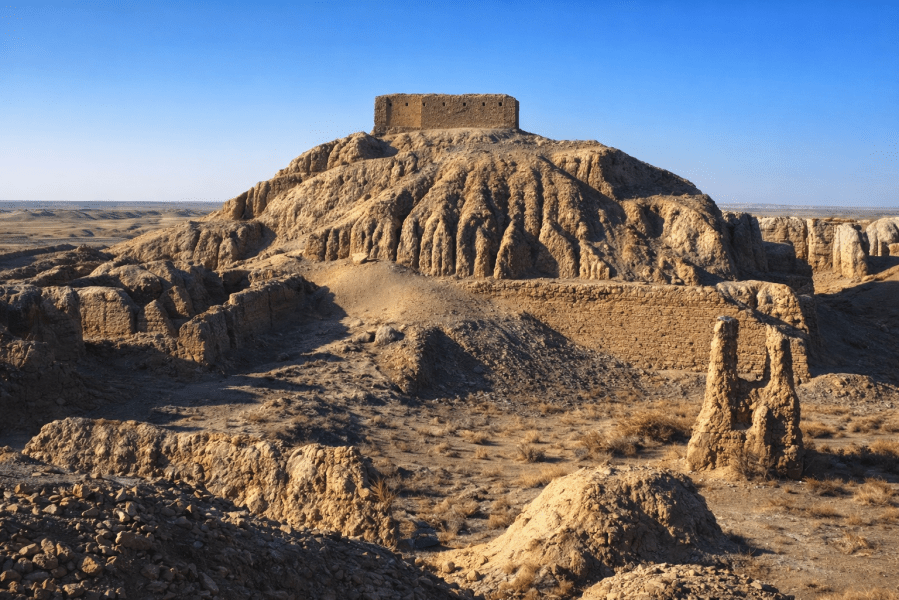
It was not until the Euphrates River receded enough to allow Sargon’s nephew Nimrod to begin constructing the tower / mountain of Babel.
This site was called “Babel / Confusion by YHVH’s peoplefor the variety of languages that stopped further development there, and surely also for the confusion thrown into Melchizedek’s efforts to lead humanity to salvation from sin and death available only through YHVH.
This expectation is supported by the archeological record that the first action of the first named ruler of the First Dynasty of Babylon, Sūmû-abum / First-One, was to capture Kish, Noah’s Melchizedekian spiritual center, from its ruling dynasty – Noah and Shem. This identifies Sumu-abum as Arphaxad, rebel son of Shem son of Noah, the first post-flood Antichrist Gilgamesh. Details in the relevant post.
The puzzle is that secular anthropologists and archeologists absolutely refuse to take the ancient Torah as a legitimate source of data.
In Hebrew, Hammurabi easily translates to “Ham Is My Father. As the founder of the first Amorite dynasty of Babylon, the genealogy, dates and actions identify him as the biblical Nimrod (grand)son of Ham, with Ham as his “father” is in the spiritual sense, specifically with Ham having crossed over from the pre-flood world when the gods were present and active with mankind. In the same spiritual fatherhood sense many kings across the Near East claimed Hammurabi as their ancestor.
Conceived late in Cush’s life, Nimrod had the power of a first-generation hybrid inheriting uncorrupted angel genes from the pre-flood world in contrast to the genetically washed-out generations he easily awed. His apparently true claim to be the re-embodiment of Marduk, the prototype hybrid god-man – making Nimrod himself the national god of the Babylonians – and foreshadowing the appearance of the Beast from the sea in Revelation.
His assertion that he is YHVH’s true sacral king countering Adam’s order of Melchizedek is clearly articulated in the preamble to Hammurabi’s Code of laws, and is most clearly recognized when contrasted with the American Constitution’s authorization by “We the people…”
- When Anu the Sublime, [name of the Creator grudgingly acknowledged in Sumerian culture] King
- of the Anu-naki, [sons of God / angels]
- and Bel, [Baal, Lord, Anointed representative, Adam at the beginning of this saga] the lord of Heaven and earth, who decreed the fate of the land,
- assigned to Marduk, [hybrid seed of the serpent, antichrist] the over-ruling son of
- Ea, [Satan cloned son of Lucifer] dominion over earthly man, [true, whenever earthly man sins he yields dominion]
- and made him [Marduk, the first hybrid] great among the
- Igigi, [other hybrids from the pre-flood era]
- they called Bab-ylon by his illustrious name [Gate of the gods], made it great on earth, and founded an everlasting kingdom [access to spiritual power] in it, whose foundations are laid so solidly as those of heaven and earth; [competing with Jerusalem]
- then Anu and Bel called by name me, Hammurabi, the exalted prince,[a standard procedure manifesting one’s new characteristics such as power and authority through adoption as a son of God/god as when God gave Jacob the new identity as Isra-el and Dani-el and his three Jewish compatriots were renamed after Babylonian gods] who feared god,..I should rule over the black-headed people like [as does] Shamash, [sun god father of hybrid Marduk]…
What follow Hammurabi’s preamble is a long and impressive list of accomplishments for and against a horde of peoples and gods and cities, which I will not reproduce in full:
- the irresistible warrior,
- the Potent, who made his kingdom everlastingly great – with many heirs to carry on
- the royal scion of Eternity – through his heirs
- he re-established – obviously from pre-flood civilization – and purified the worship of the old gods,
- he reunited the scattered inhabitants – into his workforce,
- he was the Elect i.e. Promised One of the oracle who fulfilled the prediction, i.e. the seed of the woman who defeats death and brings eternal life,
-
As you read the following account, keep in mind that the ancient Sumerian religious documents were carried forward as “the learning and the tongue of the Chaldeans” (Daniel 1:4) to subsequent nations.
-
“Nebuchadnezzar king of [Neo-]Babylon] dreamed dreams…Daniel answered in the presence of the king, and said… Thou, O king, sawest, and behold a great image…a stone [insignificant earthly entity like the chunk of clay out of which God formed the first human] was cut out without hands [by an invisible spiritual entity], which smote the image upon his feet [original empire]…Then was the [entire image with all subsequent empires] broken to pieces together… and the stone that smote the image became a great mountain, and filled the whole earth.” (Daniel 2)
After reviewing the Babylonian religion can we get a flash of insight into what Nebuchadnezzar most certainly recognized?
“The Great Mountain” is none other than the hybrid human made of clay who connects humans to God in heaven. Antichrist, who mimics the Seed of the Woman and son of YHVH, who saves from the damnation of hell.