SECTION XVI: The Stone Age Is Rubble

~ 3750 BC,  i.e. dated a couple of centuries after biblical Adam and Eve at ~ 4,000 BC, the Proto-Semitic peoples create was is called the Stone Age by anthropologists, divided into Paleo / ancient, Meso / middle, and Neo / new.

Since stone is impossible to date, this system is based on the findings of more or less refined flint arrowheads, stone tools, etc. which are attributed to a linear timeline of differences in Evolutionary mental development.

In reality, this is reflection of social development with farmers and herders using hard substances at hand to create sharpened tools and weapons as blatantly evident with the indigenous populations using stone missiles against the European invaders’ guns during the 16th century Age of Exploration, and Israel forced to rely on stone missiles during the Iron Age when the Philistines maintained exclusive rights to their superior forged metal weapons.

In reality, archeology unwittingly validates the biblical and rabbinical accounts of the way of Cain who corralled enslaved peoples into cities “east of Eden” under control of the gods for about 1,000 years / a reich, from ~3,350 to ~2350 BC, the date of Noah’s flood.

‘Between 3500 B.C. and 3100 B.C. / before Noah’s flood the foundations were laid for a complex culture in Mesopotamia, based on large urban centers rather than simple villages – what we associate with civilization. There are several theories about why and how the great cities grew to such a large and truly peculiar size and complexity compared to the rest of the world.

According to the renown war historian Arther Ferril, “A herd of blonde beasts of prey,” says Nietzsche, “a race of conquerors and masters, which with all its warlike organization and all its organizing power pounces with its terrible claws upon a population, in numbers possibly tremendously superior, but as yet formless, . . . such is the origin of the state…

Continue reading “SECTION XVI: The Stone Age Is Rubble”

99) Giantism Carried Through The Flood

From a biblical perspective the fact of giants after the Flood is not in question. 

There were giants in the earth 1) in those days [before the flood]; 2) and also after that [the flood], when the sons of God came in unto the daughters of men, and they bare children to them, the same became mighty men which were of old, men of renown.” (Genesis 6:4)

The only question debated is how these hybrid giants were produced after the flood, since the punishment was so severe as to prevent recurrence.

the angels which kept not their first estate, but left their own habitation, he hath reserved in everlasting chains under darkness unto the judgment of the great day. Even as Sodom and Gomorrha, and the cities about them in like manner, giving themselves over to fornication, and going after strange flesh, are set forth for an example, suffering the vengeance of eternal fire.” (Jude 6-7)

So what is another explanation for the production of giants after the flood?

99) Arcane Knowledge Carried Through The Flood

Thousands of miles around the globe from Mesopotamia to the Americas, we will find that the ancient Maya, Aztecs, and other ancient civilizations from around the world share the same motif of the mysterious Handbag of the Gods.

Since Noah’s ark carried animals and food to feed everyone through the 40 day flood and aftermath of a devastated world, and vegetation resprouted after the waters receded, this motif can only, like a cuneiform symbol, represent the concept of a briefcase full of the information passed through the flood to resume the exact same Luciferian religious-political system resumed after, as practiced before, the flood.

Drawing on scientific data, historical & literary sources, Hertha von Dechend, professor of the history of science at the University of Frankfurt, and a research associate at the Massachusetts Institute of Technology (M.I.T.), ranked the #1 university in the world, and also at M.I.T., Giorgio de Santillana professor of the history and philosophy of science, compiled years of study into Hamlet’s Mill: An Essay Investigating the Origins of Human Knowledge & Its Transmission Through Myth.

Contrasting with the orthodox viewpoint that the Old World and the New World each invented civilization independently, the authors argue that the myths from cultures all around the world have a common origin in astronomy – compelling evidence of the underlying unity of civilization, but much of the early history of humankind has been lost to natural catastrophes.

That would be the recent world-wide flood and associated tectonic breakup of the one single landmass with one single population into continents with a variety of climates and cultures as exists today. 

daijwjhv4aavojp

The first recorded world power was founded at the city-state of Ebla in the Early Bronze Age (c. 3500 bc). From a biblical perspective this must be attributed to Cain’s Reich / thousand year reign prior to the flood, details in post 83. The first archeologically discovered script, an advanced development from cuneiform, was found in Eblaite language texts, indicating its highly developed bureaucracy. 

Continue reading “99) Arcane Knowledge Carried Through The Flood”

100) The First Renaissance

Carl Sagan’s and Richard Turco’s A Path Where No Man Thought applied data from natural disasters of volcanoes and asteroid impacts to the same resulting phenomena from high-yield nuclear weapons exchanged in a world war. They found temperatures plunged world-wide due to the massive amount of smoke and ash lofted high in the sky.

Research into abrupt climate change refutes the evolutionary paradigm demanding long earth ages for all natural phenomena. The discovery of evidence for abrupt shifts in regional and global climates in the ice core records of Greenland  and Antarctica dates the last ice age to the time of Noah’s flood.

converted HIPS image

This matches the archeological map of civilization spreading throughout the habitable earth in the equatorial middle.

“Mesopotamia’s cities roared back into prominence within a couple of centuries.” 

Other than the assigned date, the Neo-lithic Age is consistent with the biblical account of the post-flood repopulation of the earth starting about 2300 BC, i.e. ~1500 years after Adam and Eve began the human race.

750ad0202
 

Continue reading “100) The First Renaissance”

100) Beauty And The Beast

The well-known Disney adaptation of Beauty and the Beast comes from a story written in 1740 when France’s Renaissance honoring the old gods was in full bloom.

Published in “The Young American and Stories from the Sea”, the Beast was a young prince who lost his father, his powerful mother waged war to restore his kingdom, and Belle is the fostered daughter of a disappeared king and a fairy.

Similar stories are found in all corners of the world – including but not limited to the Latin Cupid and Psych written in 2nd century AD, the Indian Panchatantra known to have existed in oral form well before it appeared in print in 500 AD, the Chinese tale of The Fairy Serpent. In the Italian tale of Zelinda and the Monster the Beast is a fire-breathing dragon.

When we strip away the elegant French dressing and ethnic varietals to the bare biblical perspective we recognize that

101) The Queen Of Heaven

As reported by the Sumerians beginning with the myth Enlil and Ninlil:

  1. Ani / Anu / Creator created
    1. En-lil & Nin-lil = Lord and Lady Spirit, Adam & Eve originally immortal like the spirit gods and continue to be called gods by the pagans. Their offspring:
      1. Nanna, [meaning #1, applied to the moon god] is one of the oldest godsin the Mesopotamian pantheon. He is first mentioned at the very dawn of writing  c. 3500 BCE as the #1 / firstborn, i.e. heir, son of Enlil and Ninlil / Adam and Eve, identifying Cain instead of Seth for the pagans. Ironically, the Akkadian called Nanna “Su’en or Sin”, which the Assyrians often spelled as En-Zu / Lord Wisdom [of this world] which links him to Satan’s title of En-ki / Lord [of the] Earth. 
      2. Nin-gikuga / lady of the “pure” reed (don’t expect honesty in this bunch either in terms of morality or 100% god spirit) is identified as a consort of En-ki. / Lord [of the] Earth. As a clone son of Lucifer, this identifier is not of a specific individual but a type – one of the fallen angels are therefore identifiable for their purpose in breeding demigods, attempting to become Lord [of the] Earth in this way. Most Importantly, the god list An = Anum directly identifies Nin-gikuga with Damkina, the first human woman who bore a hybrid god-man son to a rebel angel. Details in the relevant post.
        1. The goddess Nin-Gal / “Lady [who is] Great” which also means “queen” but in this god-controlled era defines a goddess, is recognized as a daughter at some level of genealogy to both Nin-lil / Eve and Nin-gikuga / the first human woman to birth a demigod. We can conclude that her prominence is due to celebrating the achievement of creating demigods. “Her position as the high god ‘Nanna’s’ wife is the best attested aspect of her character.” In an era obsessed with breeding warring demigods, this explains why her (fore-) father Nanna / Cain took his (grand)daughter ‘to wife’, Although from a biblical perspective Cain himself did not carry giant genes so could not in fact father demigods, he would still be the [foster] father/authority to children produced by a surrogate father. The lifestyle just gets nastier, like peeling back the layers of the Epstein files.
          1. Ninhursagwas known as a nurturing mother goddess of fertility and growth who was ranked highly among gods. She was revered as the “Mother of Gods” and “Mother of Men” and honored for creating both divine and mortal beings – consistent with the random shuffling of all genes in the process of forming sperm and egg. She influenced kingship, supporting rulers and their stability.
          2. Nuska was a Sumerian god associated with fire and light whose main cult center was Nippur, a pre-flood special seat of the worship of the Sumerian god Enlil / Adam, ruler of the cosmos, subject to An / Creator alone.  This obviously is a Luciferian humanistic cult since it elevates Adam to godhood, found in the temples to Enlil in the post flood pagan cities.
          3. I-nanna / Praisethe moon god Cain , confirmed by her identity as “the most important female deity of ancient Mesopotamia at all periods” evidenced, despite name changes to Ishtar in Akkadian and Nikkal in Hurrian, Ugaritic and Hittite, by the same traits offertility,associated with political power and war and veneration as Queen of HeavenThis can only be one of the first human women to bear hybrid demigods.

This consideration is supported by the Sumerian storyInanna and Su-kale-tuda (c. 1800 BCE, ~500 years after the flood when hybrids were no longer being generated by fallen angels) reporting Inanna’s rage at being raped by a menial / human laborer, i.e. instead of an elite hybrid.

Her cult was deeply embedded among the Canaanites to the west and in Mesopotamia where Arphaxad’s Akkadians transformed a male deity – the original fallen angels who procreated with human women – to a female goddess procreator. After the splitting of one into multiple nations Inanna was known by the AkkadiansBabylonians, and Assyrians as Ishtar (English} / Ashtoreth in Semitic, Isis in Egypt, and other variant spellings.

Scholars believe that Inanna and Ishtar were originally separate, unrelated deities which were conflated with one another and came to be regarded as effectively the same goddess. That would most likely be due to

1) Inanna being the honorary title distinguishing the one pre-flood woman who salvaged hybridization through the flood, followed by

2) Ishtar as a different honorary title distinguishing the many fertile hybrid women who produced lineages in the many nations and languages that shortly followed. 

Her essential title in any language is “the Queen of Heaven”,reflecting her role in bringing heaven to earth through the god-men she propagated. The Hebrew title “Queen of Heaven” (read backward)מלכת השמיםMalkath haShamayim” (Jeremiah 44:17) is transliterated in historical records as the name Semiramis (English).

The earliest historical records of Queen Semiramis are so old they are filed as “legendary”due to the lack of supporting documentation. although recorded by approximately 80 ancient writers including PlutarchEusebiusPolyaenusValerius MaximusOrosius, and Justinus [24] and associated with IshtarAstarte since the time before Diodorus.[12]

The oldest legend is that she was the wife of Ninus, the founder of Nineveh., i.e. biblical Asshur. From a biblical perspective this validates the proliferation of hybrids by every ruler at that time, from Sargon to Nimrod thence to Asshur.

Her fame spread so early among the nations that thousands of years later multiple cultures and religions such as Armenians and the Assyrians of Iraq, Moslems in Syria, Turkey, and Iran still use Shamiram and its derivative Samira as a given name for girls.[10]

The later therefore better attested historical Shammuramat, the original Akkadian form of the name, was the Assyrian (still) wife of Shamshi-Adad V (ruled the Neo-Assyrian Empire 824 BC–811 BC). After the king’s death she ruled as regent for five years, before her son Adad-nirari III came of age and took the reins of power.[11] She conquered much of the Middle East and the Levant. She is clearly the prototype of “the kings of the earth have committed fornication with her, and the merchants of the earth are waxed rich through the abundance of her delicacies…she saith in her heart, I sit a queen, and am no widow, and shall see no sorrow.” (Revelation 18:3,7)

The name of Semiramis came to be applied to various monuments and places in Assyria and throughout Mesopotamia as a whole, MediaPersia, the Levant, Anatolia, the Arabian Peninsula, and the Caucasus in slightly changed forms, even some named during the Middle Ages.

Herodotus, (c. 484 to 425 BC,) credits Semiramis with building the artificial banks that confined the Euphrates[16] and said her name as on a gate of Babylon.[17] Strabo, a Greek geographer, philosopher, and historian who lived in Asia Minor during 64 or 63 BC to 24 AD, credits her with building earthworks and other structures “throughout almost the whole continent”.[28] Nearly every stupendous work of antiquity by the Euphrates or in Iran seems to have been ascribed to Semiramis, even the Behistun Inscription of Darius.[14][15]

Roman historian Ammianus Marcellinus (c. 330 – c. 400), who wrote the penultimate major historical account surviving from antiquity, reports “Semiramis, that ancient queen who was the first person to castrate male youths of tender age”.[29]

103) Abominations Version 2

The first hybrid producer Canaan had literally hundreds of years to grow fertile families of hybrid giants. Not all are specifically named in the Bible as giants, but in context they are certainly included. 

“And Canaan begat [named as his heirs]

      1. Sidon his “first born” / ranked above the others – best known by their maritime rival Japhethite Greek name of Phoenicians.
      2. and Heth
      3. the Jebusite – who conquered the city of God
      4. the Amorite
      5. the Girgasite
      6. the Hivite
      7. the Arkite 
      8. the Sinite
      9. the Arvadite
      10. the Zemarite
      11. the Hamathite.”

      According to archeologists, the Canaanites were not made up of a single ethnic group but consisted of a diverse population evidenced by a great variety of burial customs and cultic structures.

      This is consistent with Canaan

      1. fathering multiple hybrids with his grandmother with varying giant traits determined by the shuffle of the genes during meiosis of sperm and egg,
      2. with the resulting fertile giant offspring generating diverse hybrids based which mix of giant genes they received
      3. with the differences entrenched by the incestuous breeding necessary to ensure maximum expression of gigantism.

      See relevant post for details.

      Continue reading “103) Abominations Version 2”

      SECTION XVII: The Age Of Heroes Was Monstrous

      After any catastrophe, humanity is intent on re-establishing the pre-apocalypse civilization, which takes on legendary perfection and loses its dark shadows in the mists of time. Our own Western culture prides itself on the Renaissance, i.e. the Rebirth, of ancient culture, including the gods and demigods, after centuries of perpetual war plunging Rome’s civilization into the Dark Ages.

      The same was true in the centuries following the diluvian apocalypse survived by only eight humans in that Dark Age – literally as we now know, from atmospheric analyses by Carl Sagan and others.

      Hesiod’s Age of Heroes referred to the Mycenaean age and the stories told by Hesiod’s fellow poet Homer. Demigods whose power was traced to their lineages of the pre-Flood gods fought in the great wars between rival fledgling nation states coming into existence after the recent Flood.

      The Greeks saw the “Age of Heroes” as transitional, standing between an earlier period in which gods and immortal giants inhabited the world and the current “Age of Iron,” defined by purely human toil and corruption. In this capacity, heroes were looked upon as powerful and even semi-divine ancestors who could act as benevolent helpers or dangerous avengers to their living descendants. The ancients’ definition of “hero” is recreated with the Marvel Comics world of superhumans.

      Unlike the pre-flood demi-gods with the maximum amount of hyperdimensional DNA, as time passed the post-flood bearers carried lesser percentages of hyperdimensional genes with every generation mating with pure humans diluting the mix.

      The Greek “hero” therefore is not defined by size, but noted for having accomplished one or more of the following feats:

      1. Killed monsters.
      2. Founded a city, kingdom, or dynasty.
      3. Invented a new technology or trade.
      4. Participated in one or more “heroic” expeditions of a military or athletic nature.

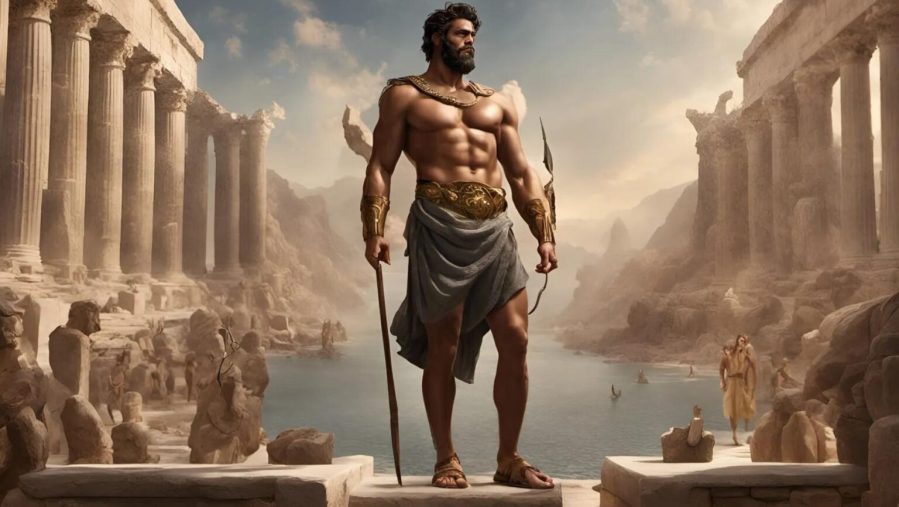
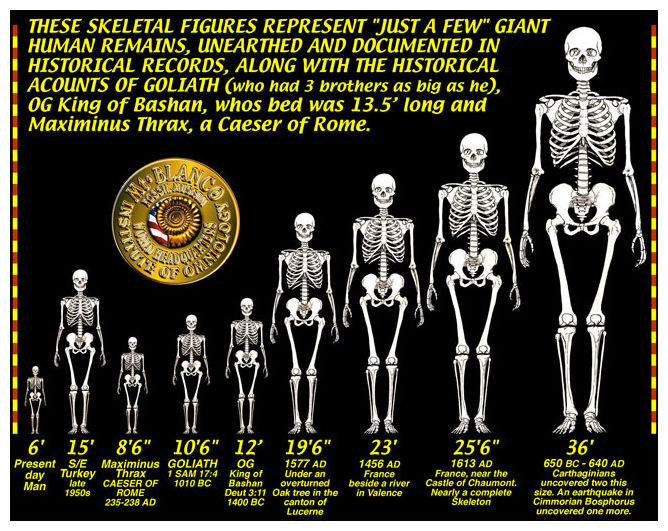
      Still, larger than typical size continued to be a characteristic of hybrids. Archeological and paleontological findings provide supporting evidence for the existence of giants in the post-flood nations.

      giant_skeletons_chart

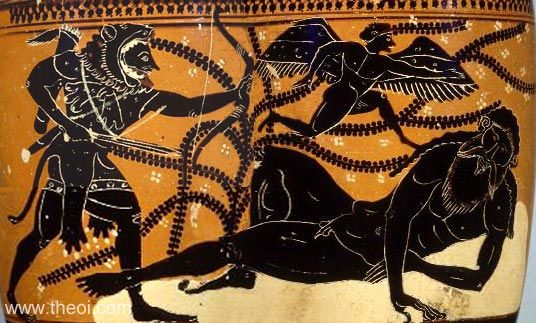
      Compelling reports and traces of fierce giants terrorizing the local population are found in virtually every ancient culture.

      87046205267679858_xh909jod_bl1-4alkyoneus

      Continue reading “SECTION XVII: The Age Of Heroes Was Monstrous”

      104) The Canaanite Pandemic

      The Canaanites were the ambassadors / evangelists / missionaries for the worship of a universal Seed of the Serpent to draw humanity away from the worship of the one true Seed of the Woman. Any features distinguishing between the gods of the nations can be attributed, not to different individual beings, but language and ecologically based cultural differences as the Canaanite nations were spread throughout the world.

      According to the Canaanite pantheon the creator was known as Elion / עֶלְיוֹן “the most high / powerful” Elion was acknowledged by the Canaanites to be the father of the [lesser] divinities. However, in what is clearly the corruption of the sacred union of the Most High God with Jerusalem:  “the holy city, new Jerusalem, coming down from God out of heaven, prepared as a bride adorned for her husband.” (Revelation 21:2), the Canaanites presented him as having engaged in a sacred union / marriage with Beruth (Beirut in English), meaning “Our [Canaanite] City”. Each city’s supreme god was likewise grounded to his territory.

      1. Melqart and Tyre
      2. Chemosh and Moab
      3. Tanit and Baal Hammon in Carthage
      4. Baal Hadad and El can be distinguished amongst earlier Amorites and the neighboring Arameans to the east to have been almost identical in form and function to the Canaanite divinities.

      Carried west by Phoenician sailors, ancient Canaanite culture can be seen not only in later Greek mythology but social morals embedded in many people groups.

      Continue reading “104) The Canaanite Pandemic”

      105) Other Hamite Giants

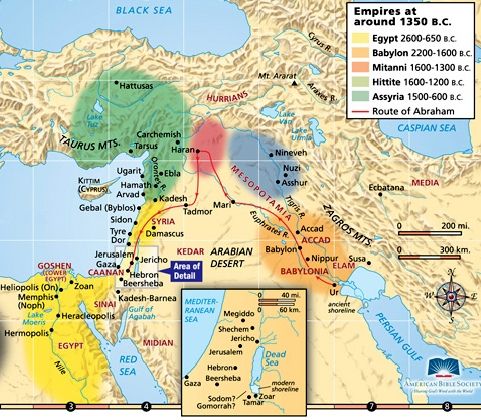
      Geography validates the biblical account of emigration from the Mesopotamian homeland held by the Semites. Hemmed in as it was by mountains to the east and west and the huge desert to the South, emigration occurred along a short land route we call the Fertile Crescent to destinations world-wide at shipping demarcation points at the Persian Gulf and the Mediterranean Sea.

      When we accept the biblical report of when the single land mass Pangea did not separate into the continents as they are today, we find that a total of about 1800 years total for Shem through his great-grandson until great-great-grandson Peleg in whose days the earth was divided.

      This is more than enough time for the post-world-wide flood aftershocks – undoubtedly a series of them – to shatter the entire earth’s crust into the giant puzzle. See relevant post for details.

      1800 years before the breakup of Pangea is more than enough time for Semites, as confirmed by anthropology, to travel overland to what became India, China, and the Americas. The Olmec heads in the Yucatan bear witness of the mixture of Semites and Hamites in the region at that time, with the Hamite giants clearly the dominators.

      The Japhethites / Gentiles / Europeans likewise fled the Hamite giants, going further west and north by the Mediterranean, Aegean, Black and Atlantic seas as the ice retreated.

      seba-and-havilah-and-sabtah-and-raamah-and-sabtecha

      “the (4) sons of Ham;

        1. Canaan – the first to breed giants who immediately seized the most valuable land – gateway to Paradise (Genesis 10:6-7)
        2. Cush and the sons of Cush;
          1. Nimrod who famously restored Babylon, “gateway of the gods” at the Euphrates River to access their power.
          2. Seba
          3. Havilah – where there is gold
          4. Sabtah
          5. Sabtechah:
          6. Raamah and the sons of Raamah;
            1. Sheba – precious stones, spices, gold
            2. Dedan.
        3. P(h)ut / Libya
        4. Mizraim / Egypt

      Cush / Kush promptly resettled the city-state of Kerma which had been founded in 3,400 BC, i.e. a thousand years before the flood. Under Cush this re-emerged as the dominant political force in the region until 1450 BC, controlling an area as large as Egypt.

      Cush’s son Mizraim restored the city of Thebes. at the headwaters / source of the Nile, taking the pagan name of Mentuhotep {Mentu / Falcon god of war is satisfied) the Second. I.e., like his cousin Gilgamesh, he is rejecting his YWVHist forebears to identify himself with the pre-flood gods. He is credited with ending the turbulent First Intermediate Period – political chaos following the flood – after the collapse of the Old (pre-flood) Kingdom, and becoming the first pharaoh of the Middle Kingdom, noted for reuniting his Upper with lower Egypt.

      A series of short-lived conquerors of Lower Egypt at the mouth of the Nile, ruling from Herakleopolis, are documented by archeologists as the 7th, 8th, 9th and early 11th Dynasties, but often grouped by archeologists into the Tenth Dynasty or Dynasty X, due to chaos and lack of solid evidence in this turbulent era. Unnamed except for assumed Egyptian titular gods, in biblical context they are most likely warrior Canaanite giants doing what they naturally do.  After they desecrated the sacred ancient royal necropolis of Abydos in Upper Egypt, Pharaoh Mentuhotep II dispatched his armies north and succeeded in unifying his country, In recognition of the unification he changed his titulary to Sematawy (Ancient EgyptianSmȝ.w(j), meaning “He who unifies the two lands”).

      Next, to protect itself from its southern neighbor, Mizraim / Egypt built a series of massive fortresses along the Nile River. These were recently flooded in our time by the building of the Aswan Dam, but the re-created fortress of Buhen is representative of the others. Its walls made of brick and stone are 16 ft thick and 33 ft high, larger than Canaanite Jericho whose walls were only 6 feet thick and 26 feet high.  The fort housed about 1,000 soldiers, 300 archers and their families.

      47682

      This mighty fortress fell to the Kingdom of Kush / Cush, but was recaptured by Egypt just in time to protect the Hebrews’ rear flank as they left Egypt to face the Canaanite giants.

      By combining Genesis 14 and Deuteronomy 2 we discover there were many species of giants just in Canaan, let alone how many “undocumented aliens” worldwide.

      “Bera king of Sodom, and with Birsha king of Gomorrah, Shinab king of Admah, and Shemeber king of Zeboiim, and the king of Bela, which is Zoar…joined battle with…Chedorlaomer the king of Elam, and with Tidal king of nations, and Amraphel king of Shinar, and Arioch king of Ellasar; four kings with five.” (Genesis 14:8-9)

      It is reasonable to deduce that the five city-states, confederate as they were with the mountain giants, also had inbred hybrid non-human traits. How else would the city-states at the Dead Sea calculate that they had a chance to win a battle after the named giants, even having the high ground advantage, had been defeated

      This deduction is supported by the record that the Dead Sea Pentapolis was initially the only target of the Mesopotamian alliance, and that standard war strategy was implemented during the second phase wherein armies must eliminate the enemy’s peripheral defenses before concentrating its full forces on the enemy stronghold.

      normandy-map-world_war_ii_in_europe.gif 

      The Sodomites’ compulsion to consort with the angelic visitors despite being struck blind provides evidence that they were seeking to engage in primary hybridization empowerment and knew it was worth giving up their eyesight. 

      And there came two angels to Sodom at even; and Lot sat in the gate of Sodom: and Lot seeing them rose up to meet them; and he bowed himself with his face toward the ground…And he pressed upon them greatly [he knows what is going to happen]; and they turned in unto him…But…the men…of Sodom, compassed the house round, both old and young, all the people from every quarter: And they called unto Lot, and said unto him, Where are the men which came in to thee this night? bring them out unto us, that we may know them [unite in ways more than temporarily joining together physically in sex – have part of them permanently left behind as with AIDS] But the me…smote the men that were at the door of the house with blindness [but that didn’t stop them] so that they wearied themselves to find the door. (Genesis 20:1-11)

      The drastic judgment levied against the Dead Sea Pentapolis is certainly consistent with the judgment imposed on the devil and his angels / messengers, including hybrids, by the flood. Contrast this with God’s longsuffering towards humanity.

      This image has an empty alt attribute; its file name is burningman2-e1585919605673.jpg

      As a side note, becoming a pillar or pile of salt describes the moist body being instantly desiccated into nothing but the minerals in the body like sodium, potassium, calcium, etc. which, in combination with each other, are both scientifically and colloquially called “salts”.

      There is no reason to assume that Lot’s wife was singled out to be vaporized by the fiery blast, just that she was the only one of Lot’s family who removed herself from the extra-dimensional shield provided by the angel escorts when she pulled away to “look back”. If the reader is a parent, surely you can understand her agony at the loss of her children left behind in Sodom, even possibly deliberately committing suicide to join their fate.

      This leads one to speculate on, at least some of, the origins of the heavy concentration of salts in and around the “Dead” Sea. Eew. And people swim in this.

      deadseasalt

          Deuteronomy 2 lists many of the giant nations that took over the land of Canaan in the years during which the Hebrew nation was developing under Abraham and his heirs. Note that the non-Hebrew nations who destroyed them prior to the Hebrews entering the land of Canaan under Moses and Joshua were rewarded with the land they cleared out – exactly like the twelve tribes of Israel who were required to fight for their inheritance.

          • Meddle not with the children of Esau, Edomites, Jacob’s brother ergo your relatives, which dwell in Mount Seir, for I will not give you of their land because I have given mount Seir unto Esau for a possession. Don’t pillage them – buy from them food and water.
            • they destroyed the Horims  (a breed of giants “like” the Emims)
          • Distress not the Moabites, because I have given Ar unto the children of Lot for a possession.
            • The Emims dwelt therein in times past, a people great, and many, and tall, Which also were accounted giants, as the Anakims;
          • And distress not the Ammonites either, because I gave both the children of Lot a possession.
            • and also they destroyed the Zamzummims; giants as the Anakims;
          • And [included in the list of “distress not” while not repeated] the Caphtorims
            • which came forth out of Caphtor, destroyed the Avims, and dwelt in their stead.

          Caphtor apparently merged to some degree with his brother Cashlu to produce what became known in that land of Canaan as the Philistines, from which was derived the modern designation Palestinian. Note that the Philistines were not among the tribes to be driven out of the land, and certainly benefitted the Israelites at this stage of history. While they also had their own giant, Goliath’s solitary show on the field of battle and breeding practice to produce more indicates he was a rarity, likely a mercenary. The Philistines must have driven out other giants, benefitting the incoming Hebrews during the Exodus, for the LORD to give them a piece of his land as very clearly mapped out in the relevant post, like the Edomites, Moabites and Ammonites.

          “I have given into thine hand Sihon the Amorite, king of Heshbon, and his land: begin to possess it, and contend with him in battle.”

          Only Og king of Bashan remained of the remnant of giants; behold his bedstead was a bedstead of iron; is it not in Rabbath of the children of Ammon? nine cubits was the length thereof, and four cubits the breadth of it, after the cubit of a man.”(Deuteronomy 3:1-11)

          goliaths-and-og-and-regular-ancient-jewish-guy

          israel-mt_-hermon-massif

          Photo of Bashan / Golan Heights in Syria. A nursing school classmate of mine had been posted there during his time with the United Nations’ peacekeeping mission between Israel and Syria. He said the view was breathtaking.

          This is such a military stronghold that immediately upon the collapse of the Syrian government in 2024 Israel’s army swept in unimpeded and took control.