
In 1883, Krakatau’s dormant volcano erupted to stupendous effect, obliterating its three islands, and killing tens of thousands of people.
The sound of the eruption alone… “was heard as far as 3,000 miles…the equivalent of a blast in Dublin being heard in New York. Half the crew of British ship some 40 miles away reported having their ear drums “shattered”—if they had been closer, they might well have been killed by the force of the sound alone...
“the subsequent tsunami…reached over a hundred feet (30 meters) in height, sweeping 165 coastal villages and settlements out to sea. The wave is said to have traveled around the globe three and a half times at astonishing speed, causing tsunamis as far as South Africa and flinging huge chunks of coral reef onto the land as it went. Some of these sections of coral weighed as much as 600 tons…
There was a lasting effect on the world’s climate, too: aerosols emitted into the atmosphere by the blast led global air temperatures to drop by as much as 2.2 degrees Fahrenheit (1.2 degrees Celsius).
According to a 2006 article in the journal Nature, the volcano caused oceans to cool for as much as a century, offsetting the effect of human activity on ocean temperatures. If the volcano had not erupted, the authors argue, our sea levels might be much higher than they are today.
The super-volcano at its heart continues to bubble away… it’s simply a matter of time.
Interesting way to phrase that: “a matter of time.”
Krakatoa became one of the most famous volcanoes ever, not just because of its fearsome power and effects, but because it was the first really gigantic volcano to blow in the era when humans had communications technology — telegraph lines and printed newspapers — to transmit accounts of what was happening, as well as scientific instruments to measure its effects.
And that is important because climate change is widespread, rapid, and intensifying
The Working Group I contribution to the Sixth Assessment Report addresses the most up-to-date physical understanding of the climate system and climate change, bringing together the latest advances in climate science, and combining multiple lines of evidence from paleoclimate, observations, process understanding, and global and regional climate simulations.
The Younger Dryas is one of the most well-known examples of abrupt change. This near-glacial period is named after a flower (Dryas octopetala) that grows in cold conditions and became common in Europe during this time.
-
One explanation is the one involving a thermohaline [warm salt water] circulation (THC) shutdown,
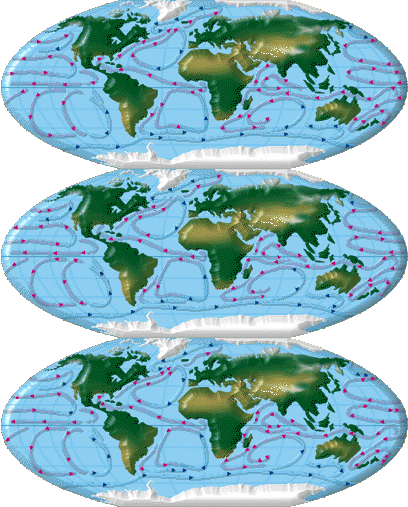
triggered by a catastrophic discharge of freshwater from Lake Agassiz on what is now the border of Canada and the U.S.

Figure 2: (Left) The outline of Lake Agassiz just before the catastrophic flood. At that time its outlet was to the south into the Mississippi drainage. (Right) The outline after the opening of the eastward outlet. A volume of 9500 cubic kilometers of water was suddenly released to the northern Atlantic through the St. Lawrence Valley (Leverington et al. 2000). (Source: Broecker, 2003)
The consequence was a rapid reduction in northward ocean heat transports, leading to an abrupt cooling over Northern Europe and North America.
In the early 20th century alarm Harlan Bretz and Joseph Pardee proposed that 500 cubic miles of water eroded the Grand Coulee and scablands of eastern Washington State, leading to research on the possibility that a catastrophic washout also explains the formation of the Grand Canyon.
Silt and mud layers provide evidence of the remains of a water source upstream from the Grand Canyon holding 3,000 cubic miles of waters. In eastern Arizona, ancient “Hopi Lake breached its natural dam – the Kaibab upwarp, destabilizing Canyonlands Lake which also breached its natural formation dam, cutting out Marble Canyon. Vernal Lake also cut a channel through Book cliffs. All these lakes emptying in unison have the force to cut down the Grand Canyon quickly form it as we see it today.
A good modern example of hydraulic force was demonstrated in 1983 when heavy snowmelts threatened the Glen Canyon Dam above the Grand Canyon. Engineers were releasing 93,000 cubic feet of water per second to keep the dam from overtopping…suddenly large chunks of concrete and bedrock were thrown from the tube. Immediately the tube was closed. Engineers found that the 3-foot steel-reinforced concrete wall was pitted and a cavity was cut…[that] required 63,000 cubic feet of concrete to fill the hole… it is estimated erosion was happening at 1,000 cubic feet per minute.
- High-velocity flows rip loose blocks of bedrock and carry them along.
- Cavitation takes place when fast-moving water passing over irregular rock, generates vacuum bubbles that explode at the surface with the force of sledgehammer blows that can pulverize rock.
- Kolks are like underwater tornadoes whose vortex exerts extreme suction of bedrock.
- Sapping is when the land rapidly detaches.
Evidence of these catastrophic forces at the Grand Canyon show that it did not take hundreds of thousands of years for the Colorado River to slowly wear down the Canyon.
And then there are the 2½ average miles of sedimentary layers topping the entire earth as evidence of catastrophic burial.
It would seem that, in addition to its utter lack of grounds (yes, that’s a pun) for acceptance as a legitimate theory, uniformitarianism has been disproved.
But in order to maintain the fundamental time requirement for Evolution, belief in uniformitarianism must be maintained, with only a grudging concession to the evidence for catastrophism.
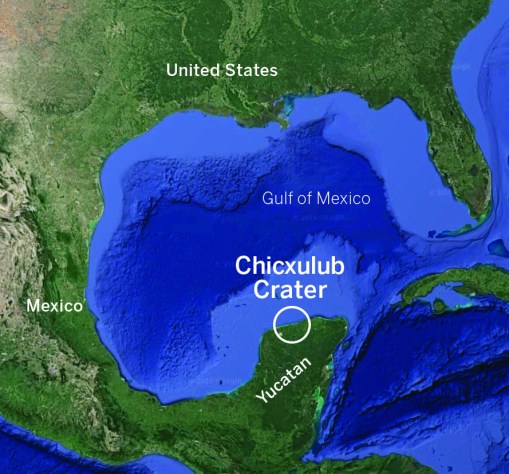
Major asteroid impacts have caused large-scale extinction on Earth in the past. Most famously, the Chicxulub impact is widely believed to have caused the mass extinction that wiped out the dinosaurs…the roughly 10-mile-wide Chicxulub asteroid…in the Gulf of Mexico] hit with the force of 100 million atomic bombs, quickly opened a massive hole nearly 19 miles deep and 120 miles wide…pushed rock up from 6 miles below the surface…Those rocks travelled approximately 20 miles in a few minutes, first being pushed outward from the impact, then rebounding upward above the Earth’s surface and finally collapsing outward to form a ring of peaks around the center of the impact.
There are almost certainly other dangers out there with grave potential impacts that we can’t predict.
The Tunguska Impact–100 Years Later
According to NASA, the generally agreed upon theory is that on the morning of June 30, 1908, a 220-million-pound space rock about 120 feet across, traveling at a speed of about 33,500 miles per hour, entered the atmosphere of Siberia.
During its quick plunge, the space rock heated the air surrounding it to 44,500 degrees Fahrenheit. At a height of about 28,000 feet, the combination of pressure and heat caused the asteroid to explode, releasing energy equivalent to about 185 Hiroshima bombs, felling a forest over 830 sq miiles.
Major asteroid hit on Earth is well overdue
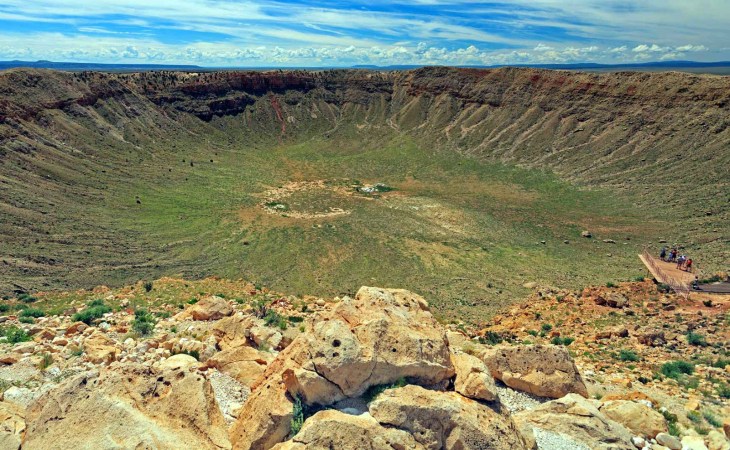
New research related to what caused the 1.2 km wide [3/4 of a mile] hole in the ground at Meteor Crater in the Arizona desert is a reminder…
ATLAS is an asteroid impact early warning system being developed by the University of Hawaii and funded by NASA which scan the whole sky several times every night looking for moving objects.
ATLAS will provide one day’s warning for a 30-kiloton “town killer,” a week for a 5-megaton “city killer,” and three weeks for a 100-megaton “county killer”.
The Scout Hazard Assessment webpage maintained by NASA-JPL’s Center for Near Earth Object Studies interprets the observations using sophisticated computer programs, checking for immediate threats and requesting further measurements of asteroids whose orbits remain uncertain. Both websites are publicly accessible to anyone in the world.
The pattern of seafloor spreading indicates that Pangea did not break apart all at once but rather fragmented in distinct stages.
According to the National Oceanic and Atmospheric Administration, these developments contributed to the series of extinction events that took place. “All of the “Big Five” were caused by some combination of
- rapid and dramatic changes in climate,
- plus intense volcanic activity rapidly altering the environments on land or the ocean.
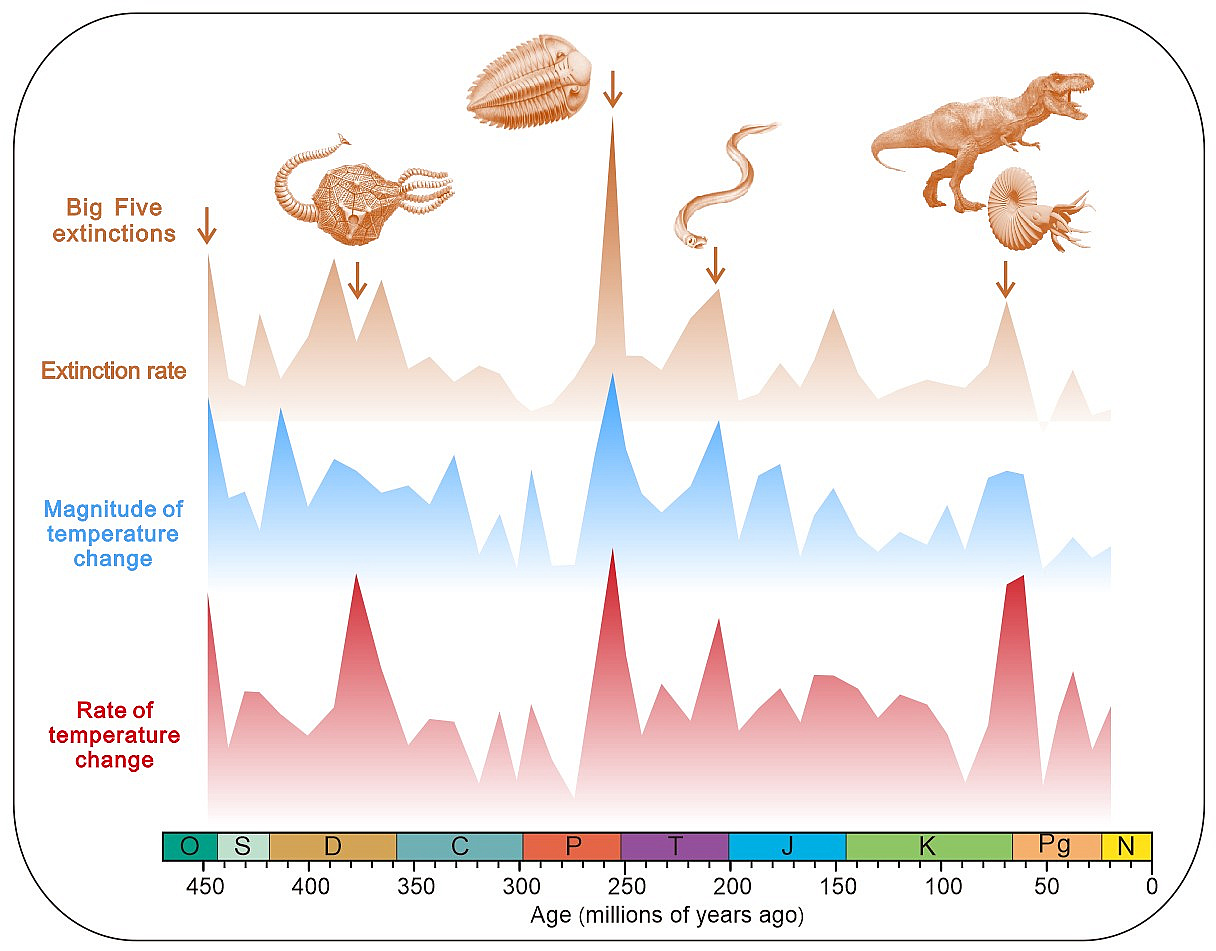
This is consistent with the biblical report of stages of creation in Genesis 1 by the God of light, called “days“, followed by cataclysmic “nights” of darkness indicative of the Adversary’s destruction. See relevant post for details.
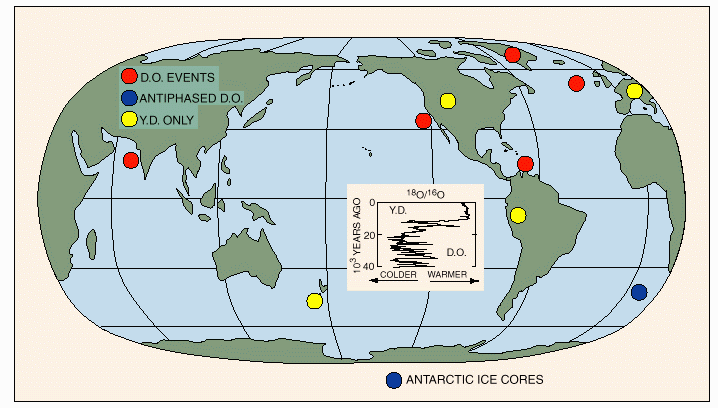
A series of large and abrupt climate swings occurred repeatedly, as attested by the number of red dots on the picture.”
-
Hundreds of large mammal species disappeared during the transition from the last glaciation to the present interglacial period, from around 50,000 to 5,000 years ago.
The low end of this estimate puts this catastrophic event in the same time frame as Noah’s world-wide flood. Organic remains preserved in ice from this era demonstrate the rapidity of the onset of climate change. The end of the Younger Dryas was particularly abrupt. In Greenland, temperatures rose / warmed 10°C (18°F) in a decade (Alley 2000).
A recently discovered explanation for abrupt climate change is Polar Shift. The evidence that the poles have flipped places 183 times is contained in the layers of magnetic minerals inside rocks, which have locked in place the strength and direction of Earth’s magnetic fields in the order in which they occurred.
It’s not clear what causes geomagnetic reversal. An impact event could create a reversal, or a continental slab subducting into the mantle.


 Kingdom Come