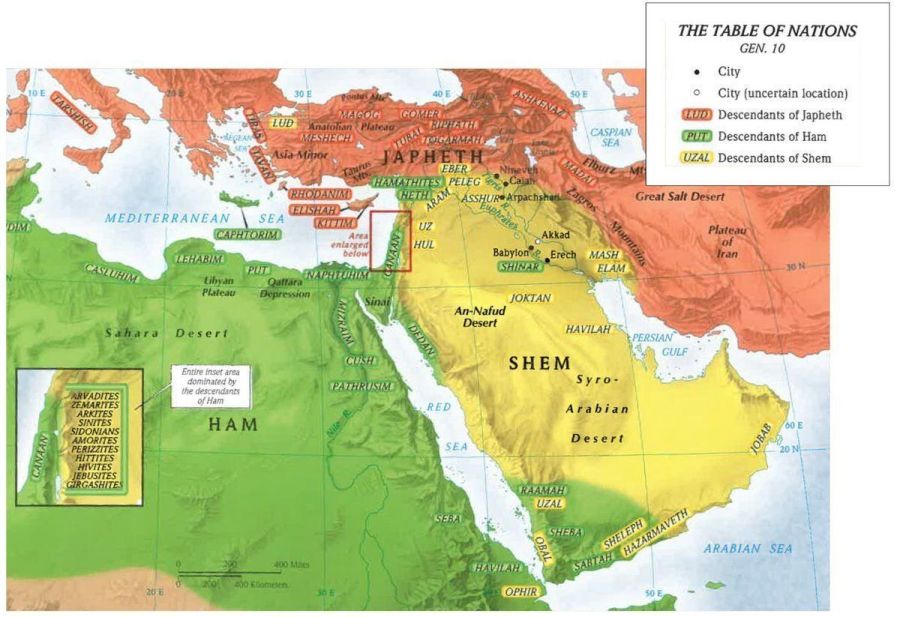
Semites, the term first used in the 1770s by members of the Göttingen school of history, was derived from Shem, but in keeping with the rejection of the biblical account has been replaced by Mongoloid as the designation for the racial group associated with people of the Middle East, including Arabs, Jews, Akkadians, and Phoenicians.
Information from Josephus’ Antiquities of the Jews 1:6:4: unless otherwise referenced.
- Elam – ancestors of the Persians in Ilam and Khuzestan in mountainous southern Iran, edging over into Iraq, with its own unique language, using Sumerian cuneiform for writing, only deciphered since 2017.
- Asshur – founder of the Assyrian Empire in modern northern Iraq
- Arphaxad – Chaldeans, founder of all the indigenous Mesopotamian peoples
- Salah
- Eber
- Peleg – in whose days the earth was divided
- Joktan whose multitude of sons “journeyed east”, suggest east Asians and the indigenous peoples of the Americas such as Yucatán Peninsula and Joktan, which is pronounced “Yoktan” in Hebrew, or “Yuktan” in Arabic, like “Joseph” is pronounced “Yusef”. The young Earth creationist geneticist Nathaniel Jeanson identifies Joktan as the progenitor of Y-chromosomal haplogroup K2, whose descendants are found in Central and East Asia.[13]
- Almodad
- Sheleph
- Hazarmaveth
- Jerah
- Hadoram
- Uzal
- Diklah
- Abimael
- Sheba – Sabeans, modern Yemen
- Ophir – India or possibly Peru
- Havilah – in the Arabian Peninsula
- Jobab: [double checking here, yep!] “all these were the sons of Joktan.”
- Eber
- Salah
- Lud – associated with settling Lydia in Asia Minor, modern eastern Turkey, after whom was named a prominent promoter of the apostle Paul’s missionary endeavors.
- Aram – notable for his language of Aramean, which became the common language of the region of what the Greeks renamed Syria.
- Uz now called Lebanon, founded Damascus: originally included in the land of Uz. now called Lebanon. By linking Abraham’s potential heir Eliezar’s birthplace to Damascus at this same very early era, quite possibly Eliezar was one of Job’s younger sons.
- Hul founded Uartu, now Armenia.
- Gether founded the Bactrians in modern Uzbekistan, home of one of the world’s most ancient prophets, Zoroaster / Zarathustra, who traveled through Mesopotamia opposing polytheism as worship of Daevas / evil spirits. He preached that there is only one God, the creator, Ahura Mazda / Lord Wisdom of Asha / Truth, opposed by Angra Mainyu / Ahriman of Druj / Lie. He stressed the importance of free will and urged the people to follow the path of righteousness and truth.
- Mash / Meshech unknown, not surprisingly given the breakup of Pangea early on in this era, separating peoples not only geographically but historically.
Moses’ and Josephus’ directories of the fathers of the nations are limited to the Middle East and close perimeter, so Salah’s descendants must be peoples in the Far East and the Americas.
Just a short boat ride from the mouth of the Euphrates River, corresponding to Josephus’ report that Shem’s descendants migrated east to the Indian Sea and (roughly), the Indus River Valley civilization, along with Mesopotamia and Egypt, was one of the three cradles of civilization.
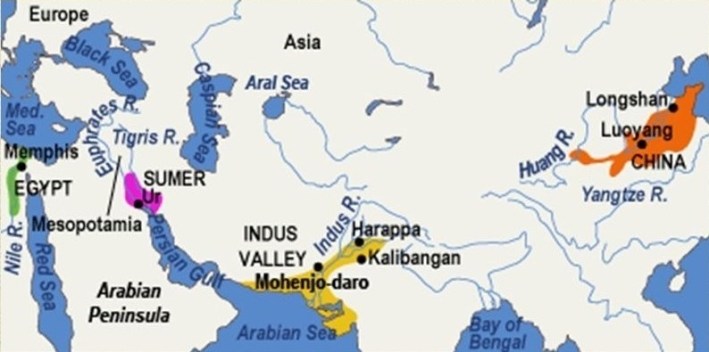
The alternate name of the Indus Valley civilization – the “Sarasvati” civilization”. Languages are characterized by unique sound systems, known as phonologies. East Asian languages often lacks the specific “L” and “R” distinction present in English, and both sound almost the same. Substituting the “L” sound with “R” is a well-documented linguistic phenomenon. Another clue is that with its language has been “tentatively” identified as Semitic.
Archaeological excavations indicate that the region was depopulated about 1900 BC and replaced with Aryan, i.e. Japhethite, peoples, establishing the eastern leg of the Indo-European straddle, and pushing the original inhabitants further east. This corresponds in time with 1766 BC as the traditional date for the founding of the first historic dynasty in China.
And moving even further east, across the Pacific Ocean, pottery is the classic means by which archeologists identify different civilizations. Which pottery is from the Saravati Indus Valley Civilization and which from Pre-Columbian American?
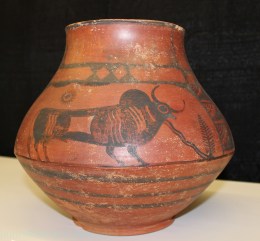
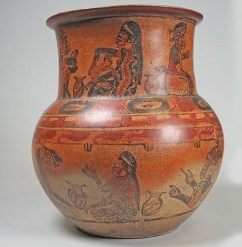
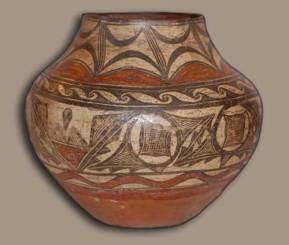
There are many other cultural similarities between Salah’s Far Eastern and South American cultures, some good examples found in this attached website.
In the following graphic, notice how the edges of the continents fit together exactly like a jigsaw puzzle, demonstrating that the people on the landmasses were separated at the same time as the landmass itself.

This explains the settlement timing and pattern for South America, which mainstream science has, with its long-earth ages paradigm, insisted must have occurred during the last Ice Age on the current multi-continental configuration by Asians crossing the Bering Straits on an ice bridge and gradually walking south.
An increasing body of archaeological and genomic evidence has hinted to a complex settlement process. Researchers provide provides the most complete genetic evidence to date for complex ancient Central and South American (i.e., the furthest south so supposedly the last) migration routes, including strong Australasian. That did not come from Alaska’s Bering Straits.
Researchers also discovered evidence of Neanderthal and Denisovan ancestry. As detailed in relevant posts, these are the genetic signatures of the hybrid giants.