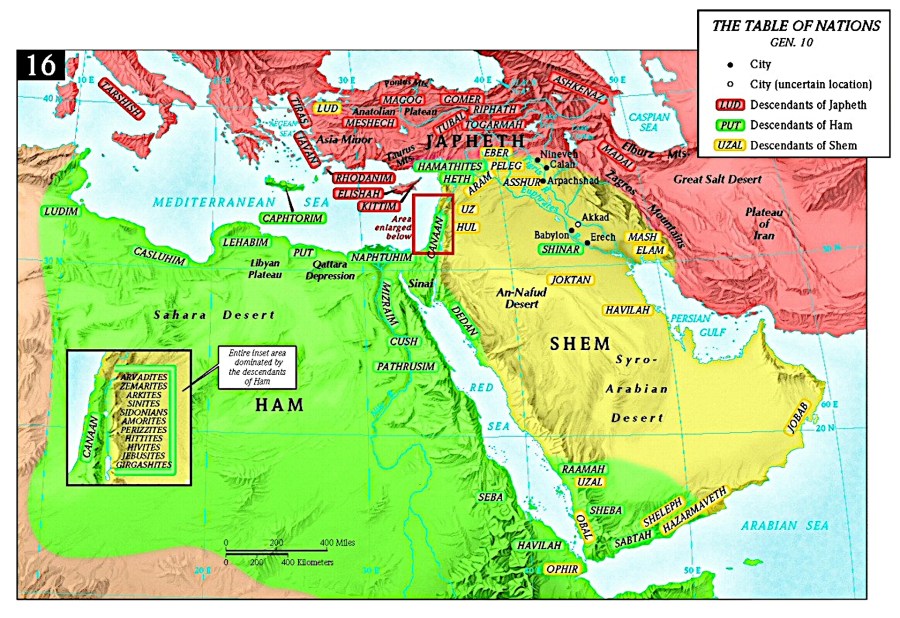
Japhetite, found in ethnological and linguistic writing from the 18th to the 20th century for Europeans, is now called Caucasian, from the Caucasus Mountains, the natural mountainous boundary between Europe and Asia.
Josephus, drawing on the earlier works of
Herodotus and Plutarch reports the Japhethites as the
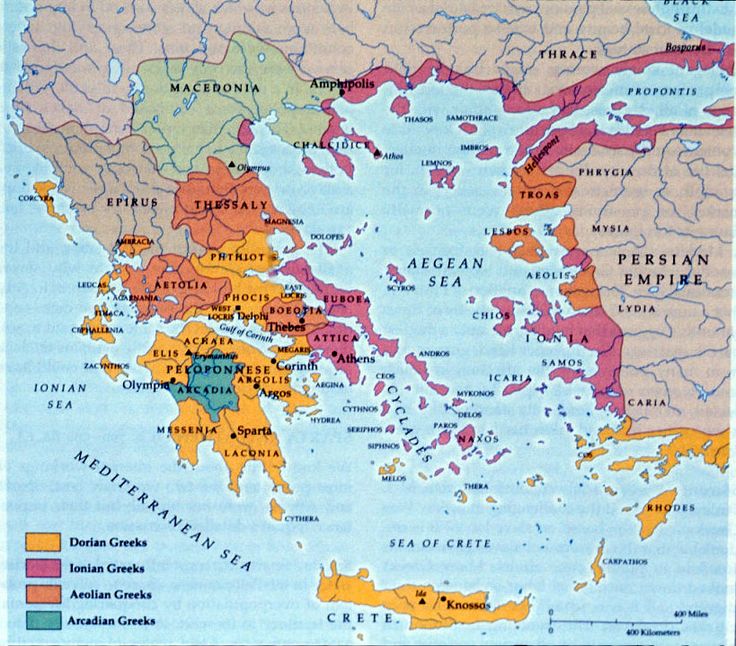
Indo-European speaking peoples, who in the earliest days emigrated east to the Indus River Valley, west to the shores of the Aegean Sea, and north throughout European coasts.
The sons of Japheth:
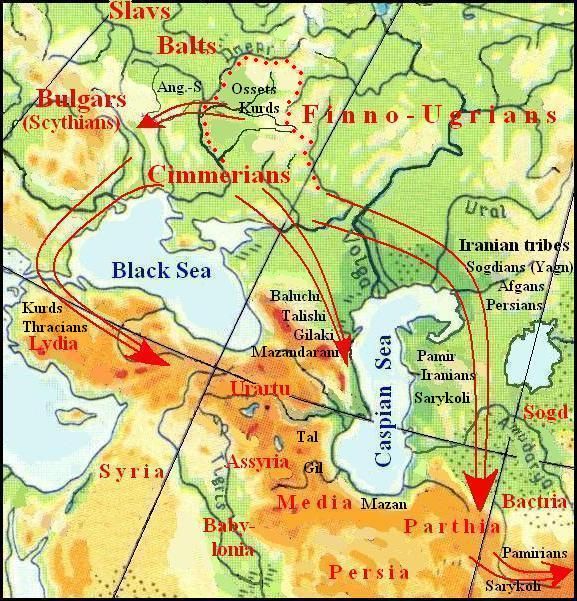
- Gomer – whose sons were collectively identified as the Cimmerians [hard C] or Gimarrai, linguistically still identifiable with modern Crimea, strategically holding the Helles-pont / Greek-bridge, the narrow strait between the Aegean and Black Seas, (which is why in 2026 Russia is fighting Ukraine to get it).
- Ashkenaz in the Caucasus Mountains near Mount Ararat appears in Assyrian records as “Ishkuzai,”as a people pouring in from the north, from which the name Scythians, pronounced Skythians, is derived. This territory identifies the sect of Jews who settled in northern Europe and developed a regionally differentiated Jewish identity from the main body of diaspora Sephardic / Spanish Jews.
- Riphath is memorialized in the Riphaean mountain range in what is now northeastern Turkey. His descendants became known as Paphlagonians. They were listed among the allies of the Trojans.
- Togarmah – The Hittites in the 14th century BC refer to Tegarama, a region in what is now modern Turkey on a main trade route between Carchemish and Haran. Records from Sargon II and Sennacherib mention the destruction of the city of Til-gari-manu, 30 miles east of modern Gurun in Turkey. His descendants were called Phrygians by Greeks (Ant 1.6.1)
- Elishah – the Aegean maritime city-states depicted by Homer in the early days
- Tarshish – two settlements, likely trading partners, Tartessus in Spain and Tarshish Asia Minor partners
- Kitt-im / the Kits in modern Cyprus
- Dodan-im AKA Rodan-im, in Rhodes
- Magog is the first recognizable eastern branch of the Japhethites, famous for leading the apocalypse prophesied in Ezekiel 38:1-39:1 and Revelation 20:8 representing the final opponents of God’s King. “Son of man, set thy face against Gog, the land [at the time of the prophecy being the region of the Ukraine. of Magog [who is] the chief prince of [the alliance with] Meshech [another son of Japheth] and Tubal, and prophesy against him / Magog, I will send a fire on Magog, and among them that dwell carelessly [without caution or preparation for war] in the isles [collection of independent entities not necessarily separated by water, in this context the Balkan States] …the nations that are in the four quarters of the earth [i.e. World War]. This is unfolding in 2026 between Russia and Eastern Europe.
- Madai – father of the Medes and have always lived south and west of the Caspian Sea according to Josephus. The Greek historians Strabo and Herodotus both confirm that the Medes were of Indo-European origin. Along with the Persians they are the ancestors of modern Iranians / Aryans.
- .Javan is transliterated from Hebrew into English up through Ezekiel until Daniel and Zachariah where it is translated as “Greece“, consistent with its entrance at this time on to the world stage. When we understand that the letter “J” was only added to the English alphabet after the 1611 edition of the King James Bible it is easy to recognize the Greek translation as Iawones, ancestor of the Ionians in Homer’s Iliad, written about 800 BC of peoples and events occurring about 1200 BC.
- Elisha was the father of the Eliseans, changed to the Aeolians according to Josephus, but whose early appearance in history is demonstrated by his ancient name still being used in the Armana tablets as the Alashia, by the Egyptians as the A-ra-sa, and by the Hitttites as Alasiya
- Tarshish – twin trading posts spanning the Mediterranean from Spain to Asia Minor.
- Kittim settled Cyprus
- Dodan-im / people of Dodan, speculated to be the same as Rodan in Rhodes due to a proposed scribal error since the Hebrew letters for D and R are extremely similar. Another explanation, and more probable given the inerrancy ascribed to God’s word, is that these Dodan-im are the same as the Dardans located in northwestern Anatolia who claimed descent from Dardanus, a famous pre-flood hybrid king still memorialized in the name of the narrow strait – the Dardanelles – that separates Asia and Europe. A contingent of Dardanians were among Troy’s allies in the Trojan War.
- Tubal settled a region in the center of Asia Minor / Anatolia / modern Turkey called Tabal in the Assyrian records of Tiglath-pileser I (1100 BC), where they were known for their metallurgy and trade with Tyre (Ezekiel 27:13). Josephus calls Tubal’s descendants the Thobelites, later known as the Iberes or Iberians (Spain) (Ant 1.6.1), and Nennius states that the Iberian, Spanish and Italians – quite likely the Etruscans in northern Italy – were also descended from Tubal.
- Meschech founded a small but formidable warrior kingdom in Asia Minor, known as Moschoi in Greek and Muski in Assyrian. The Muski later migrated to an area of Armenia, south-east of the Black Sea, establishing mountain strongholds. Mita, the Muski ruler in Asia Minor is probably to be identified with the legendary king Midas of Greek tradition. There is a possible connection between Mechesh and the old tribal name of the Muscovites of Russia, after whom Moscow (Moskva) is named, and the lowland around Moscow retains the name of Meshech in “Meschera”.
- Tiras was worshipped by his descendants as Thuras or Thor, the god of thunder and war. Troy was named after him as well as the Taurus mountain range. His people, called the Thracians (and marauding pirates) by the Greeks, covered an exceptionally large region from Macedonia in the south including most of Yugoslavia to the Adriatic in the west, reaching to the Danube in the north and the Black Sea in the east It is easy to track them through time to the later Norsemen.
Published by kingdomcome777
A grandmother who loves to study the Bible and bases life on "know the truth, and the truth shall make you free."
View all posts by kingdomcome777