According to genetic studies, at one time in the past humanity experienced a “population bottleneck…a sharp reduction in the size of a population due to environmental events such as…flood.” “[M]ost Eurasian men (living outside Africa)…can be traced back to four ancestors, consistent with the Hebrew account.
- “Noah was…perfect in his generations [his genes had not been corrupted]. And Noah begat three sons,
- Shem,
- Ham, and
- Japheth.” (Genesis 6:9-10)
The Greek version of Noah is called Deucalion, matching the Greek word for 10 is deka with Noah as the 10th generation from Adam. Being in the high god’s favor, he and his wife survived the world-destroying flood in a boat, and were instructed to repopulate the earth.
Josephus reports that the “Japhethites” are the Indo-European speaking peoples, also defined as “Gentiles”.
The descendants of Japheth are grouped according to his sons.

- Ezekiel 13, 19 and Josephus’ report of Javan as the founder of Ionia are consistent with Homer’s Iliad report of Iawones as ancestor of the Ionians, Javan is translated phonetically throughout the English language Old Testament until Daniel and Zachariah where it is translated as “Greece”, consistent with its up and coming role in forwarding world events.
- Javan’s son Elishah conforms to the Greek Aeolus whose early appearance in history is demonstrated by his ancient name still being used in the Armana tablets as the Alashia, by the Egyptians as the A-ra-sa, and by the Hitttites as Alasiya. Joseph reports that by his day the name of the ancient Eliseans was changed to the Aeolians.
- Tarshish, Javan’s second son continued sailing to the far reaches of the Mediterranean Sea, which was consequently once known as the Sea of Tarshish. Herodotus wrote that Tartessus was an unfrequented port beyond the Pillars of Hercules, now known as the Straits of Gibraltar. This aligns with the location of pre-Flood Atlantis, the re-establishment of which would certainly be a grand coup. Strabo located Tartessus in Spain. In the 4th century BC the historian Ephorus describes “a very prosperous market called Tartessos, with much tin carried by river, as well as gold and copper from Celtic lands”, very lucrative during the Bronze Age for the Phoenicians located in Cilicia at another city also named of Tarsus (Paul’s home town), undoubtedly the eastern-most end of a west-to-east shipping route.
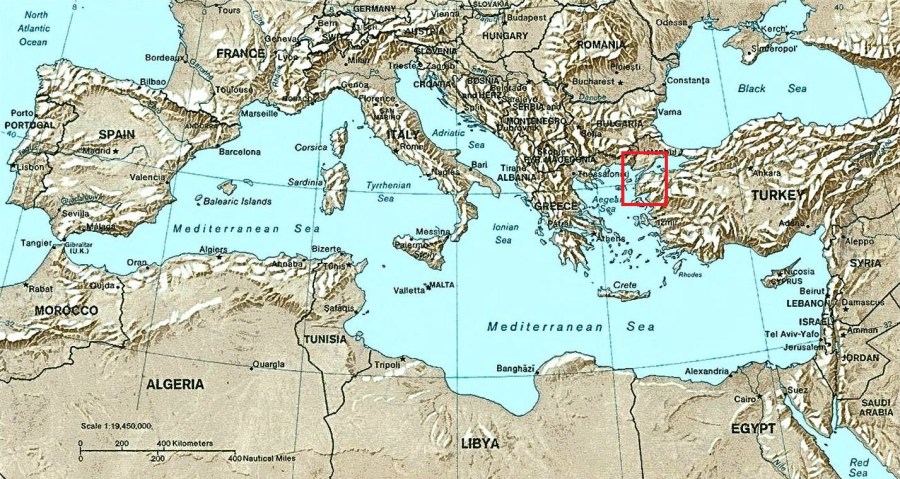
- Javan’s son Dodan conforms to the Greek Dorian. Dodanim is translated as Rodanim in the Septuagint (1 Chronicles 1:7) and is likely the origin of the name of the island of Rhodes, home to the Colossus idol. Get it? Giant? Dodan was a god to his descendants and worshipped as the incarnation of Jupiter / Zeus. Greeks refer to the Dardani, or Dardanians of Asia Minor who remained settled in the area still today called the Dardanelles, AKA the Helles-pont / Bridge to Greece. As the boundary between the continents Europe and Asia, the Dardanelles is a permanent battleground – right where you would post your strongest warriors. Dodan is also pronounced and spelled Dedan, which is listed among the high-status nations trading with Tyre (Ezekel 27:1-15). Think of this like having offices at the World Trade Center. In every way, including the downfall – “all thy men of war, that are in thee, and in all thy company which is in the midst of thee, shall fall into the midst of the seas in the day of thy ruin. The suburbs shall shake at the sound of the cry.” (Ezekiel 27:27-28)
- Javan’s son Kit, the founder of the Kittim, is found in Old Phoenician records name as Kt, or Kty who settled on island of Cyprus, giving name to the ancient Cypriot city of Kition, now the city of Larnaca. The Bible refers to these Greek warships from Kittim bringing destruction culminating with Isaiah’s prophecies of against Tyre in the 8th century BC.
- Gomer founded a people known to the ancient Greeks as the Cimmerians [hard C] or Gimarrai (both C and G being guttural consonants and frequently interchanged in languages or dialects). The Greek writers Herodotus and Plutarch both identified Gomer with the district of Cimmeria, linguistically identifiable with modern Crimea and strategically as the northern hammer against the Hellespont.

- Ashkenaz in the Caucasus Mountains near Mount Ararat
- Riphath is memorialized in the Riphaean mountain range in what is now northeastern Turkey. His descendants became known as Paphlagonians. They were listed among the allies of the Trojans.
- Togarmah – probably the origin of the names of the countries of Turkey and Turkmenistan. The Hittites in the 14th century BC refer to Tegarama, a region on a main trade route between Carchemish and Haran. Records from Sargon II and Sennacherib mention the destruction of the city of Til-gari-manu, 30 miles east of modern Gurun in Turkey. His descendants were called Phrygians by Greeks (Ant 1.6.1)
- Magog is famous for leading the apocalypse prophesied in Ezekiel 38:1-39:1 and Revelation 20:8 representing the final opponents of God’s King. During the Cold War Magog was interpreted as Russia, but Magog is a person. Current events are lining up with Ezekiel’s prophecy.“Son of man, set thy face against Gog, the land [at the time of the prophecy being the region of the Ukraine. of Magog [who is] the chief prince of Meshech and Tubal, and prophesy against him [Magog], I will send a fire on Magog, and among them that dwell carelessly in the isles…the nations that are in the four quarters of the earth [i.e. World War]…
- Persia [always associated with the Medes] / Iran
- Ethiopia
- Libya
- Gomer, and all his bands;
- the house of Togarmah of the north quarters, and all his bands:
- and many people with thee…
- Madai is the father of the Medes according to Josephus. Along with the Persians they are the ancestors of modern Iranians and have always lived south and west of the Caspian Sea. The Greek historians Strabo and Herodotus both confirm that the Medes were of Indo-European origin
- Tubal settled a region in the center of Asia Minor / Anatolia / modern Turkey called Tabal in the Assyrian records of Tiglath-pileser I (1100 BC), where they were known for their metallurgy and trade with Tyre (Ezekiel 27:13). Josephus calls Tubal’s descendants the Thobelites, later known as the Iberes or Iberians (Spain) (Ant 1.6.1), and Nennius states that the Iberian, Spanish and Italians – quite likely the Etruscans – were also descended from Tubal.
- Meschech founded a small but formidable warrior kingdom in Asia Minor, known as Moschoi in Greek and Muski in Assyrian. The Muski later migrated to an area of Armenia, south-east of the Black Sea, establishing mountain strongholds. Mita, the Muski ruler in Asia Minor is probably to be identified with the legendary king Midas of Greek tradition. There is a possible connection between Mechesh and the old tribal name of the Muscovites of Russia, after whom Moscow (Moskva) is named, and the lowland around Moscow retains the name of Meshech in “Meschera”.
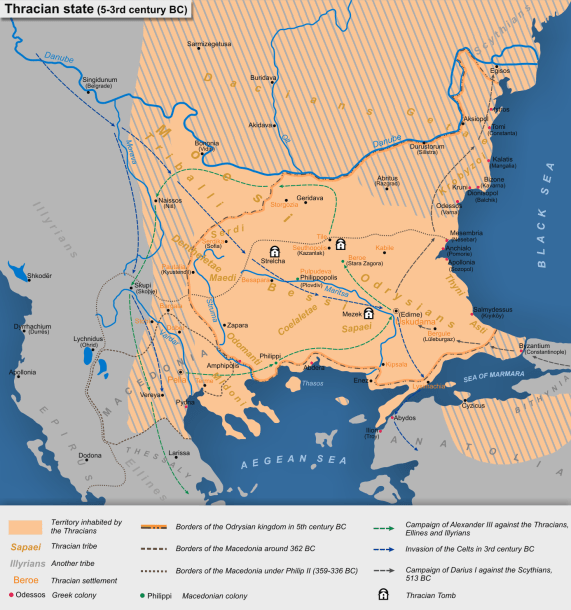
- Tiras was worshipped by his descendants as Thuras or Thor, the god of thunder and war. Troy was named after him as well as the Taurus mountain range. His people were called the Thracians (and marauding pirates) by the Greeks. They covered an exceptionally large region which including most of Yugoslavia to the Adriatic in the west and Macedonia in the south reaching to the Danube in the north and the Black Sea in the east.
While “Gentile” originally meant a descendant of Japheth, by the time of the Roman Empire “Gentile” meant “descendant of the original gens/ Roman tribes. The key feature is that these were said to have originated before the foundation of Rome (traditionally 753 BC) by ancestral gods through their hybrid demigods at the Trojan War (traditionally ended 1184 BC) [during the time of the book of Judges].
Any person who was a member of a Roman gens was an heir of these ancestors, entitled to privileges, unlike the mass of slaves and freedmen. This is recognizable from the translation into English as social category of gentleman, corresponding to the French gentilhomme (nobleman), which in the 14th century comprised the hereditary ruling class.
Roman citizenship required membership in a gens, but was not restricted only to birthright. The legal process granting Roman rights and responsibilities was accomplished through adoption as sons into a Roman tribe with the bestowal of the new tribal / gens name / identity. Adoption swept away the existing state of being an inferior person or converting a non-person slave or captive into a person, and bestowed a new and improved identity including
- a new past heritage glorifying the father of the nation,
- rights and privileges in the present
- and protection by the gods after death.
In theory, each gens functioned as a state within a state, governed by its own elders and assemblies, following its own customs, and carrying out its own religious rites. The gentile assemblies had the responsibility of adoption and guardianship for their members, with certain cults associated with specific gentes.
The subjects in the Roman Empire at the time the New Testament letters were written understood exactly the concepts Paul explained happened to those who put their faith in the Promised Savior Son of YHVH / Singularity / Creator through the records preserved by Judaism.
- “God sent forth his Son…to redeem them that were under the [bondage of the] law,
- that we might receive the adoption of sons.
- And because ye are sons, God hath sent forth the Spirit of his Son into your hearts,
- crying, Abba, Father / ancestor God
- Wherefore thou art no more a servant / slave,
- but…an heir of God through Christ.“ (Galatians 4:4-7)


 Kingdom Come