The Sargonid dynasty was the final ruling dynasty of Assyria during the apex of its power when the borders of the empire grow to encompass the entire Ancient Near East, the East Mediterranean, Asia Minor, the Caucasus and parts of the Arabian Peninsula and North Africa, subjugating Babylonia, Elam, Persia, Urartu, Lydia, the Medes, Phrygians, Cimmerians, Israel, Judah, Phoenicia, Chaldea, Canaan, the Kushite Empire, the Arabs, and Egypt. They either personally ruled as, or installed, the kings of Babylon,
Sennacherib is one of the most famous Assyrian kings for the role he plays in the Hebrew Bible, destroying the city of Babylon in 689 BC which his son Esarhaddon (681-669 BCE) promptly rebuilt, while also renovating and expanding the great Assyrian capital, Nineveh.
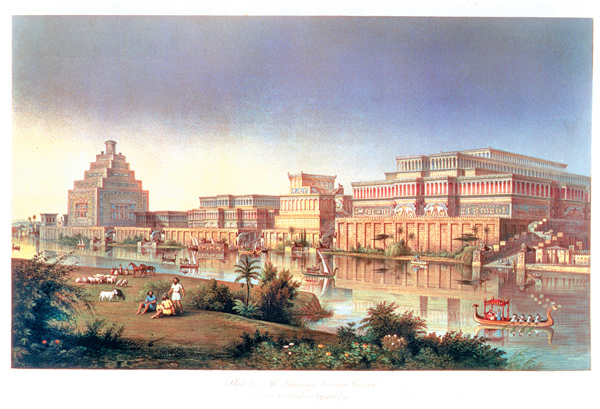
The last great ancient Assyrian king, Ashurbanipal (668-627 BCE), is best known for the vast library he collected of literary works from all nations in Mesopotamia. When in 612 BCE Nineveh was sacked and burned by a coalition of their enemies the flaming walls falling down on the library of Ashurbanipal baked the clay tablets, preserving the history of Mesopotamia and burying them away from looters to the edification of archeologists and anthropologists thousands of years later.
Two hundred years later in 400 BC Xenophon’s Ten Thousand Greek mercenary soldiers marched across Anatolia in a famously unexpectedly successful retreat from a failed war with Persia.
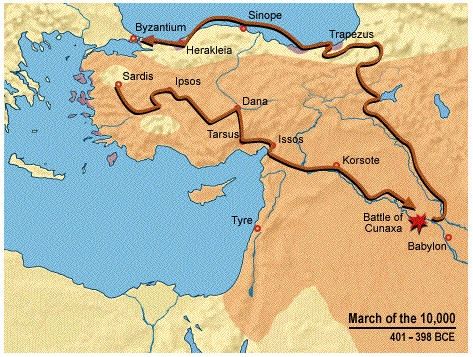
In his memoire (Anabasis) certain ruins described by Xenophon have been identified beyond a doubt as Nineveh, surrounded by 8 miles of walls 50 feet thick and up to 100 feet high. The evidence of sacking is particularly gruesome.
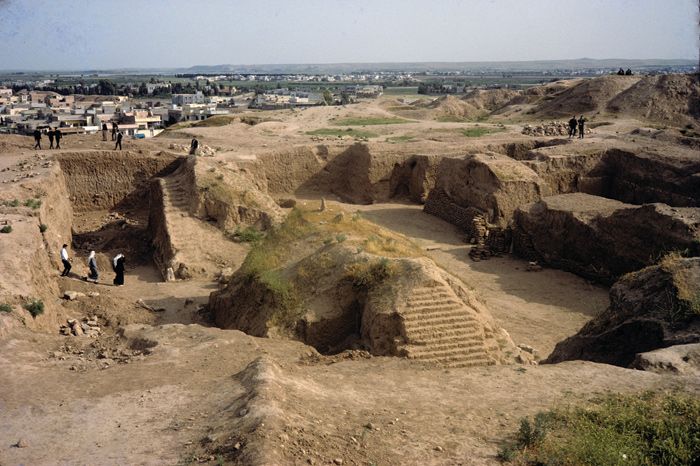
When the Greek empire under Alexander the Great defeated the mighty Persian Empire he was welcomed through the gate of Babylon as a savior, not a conqueror, because he commanded the rebuilding of all the temples which had been destroyed by Xerxes. Babylon remained in the possession of successive Persian Empires for nine centuries, but as the West grew in importance Babylon’s significance declined, the population significantly decreased, the city itself fell into ruins. Babylon is notable at this time only for Trajan taking a side trip during his Second Mesopotamian Campaign in 116 AD, and finding, as at Ninevah, merely mounds and stones and ruins.
The Adversary’s religious center had been moved to Seleucid Greek territory to the city of “Pergamos…where Satan’s seat is…where Satan dwelleth.” (Revelation 2:12-15)
Therefore Peter’s reference to the church at “Babylon” (I Peter 5:13) is not the actual Chaldean Babylon, but like the number 666, a veiled reference to an evil entity whose name is best not spoken aloud. Within the text we can determine that Peter is referring to Rome. (I Peter 1:1), which corresponds historically with the Roman Empire’s replacement of the Greek, and leading opposition to YHVH’s Savior at this time.
In 650 AD the Muslim Empire incorporated the province of Babylon, overturning paganism while permitting freedom of monotheism found in the Babylonian Talmud, the Gnostic Mandaean religion, Eastern Rite Christianity and the religion of the philosopher Mani, and fighting the Byzantine Christians at Constantinople as heretics to monotheism, which they were.
in 1921 the British Empire created the modern Iraqi state from the ruins of the Ottoman Empire, building a replica of the Ishtar Gate and a reconstruction of Ninmakh Temple on site. We can deduce from this action that the British were pawns of the Adversary.
In 1978 Saddam Hussein, began the “Archaeological Restoration of Babylon Project” including the Southern Palace of Nebuchadnezzar, with 250 rooms and five courtyards. Copying Nebuchadnezzar’s practice of inscribing each brick with his name as an everlasting memorial. One frequent inscription reads: “This was built by Saddam Hussein, son of Nebuchadnezzar.
When United States forces invaded Iraq in 2003, they constructed a military base on top of the ruins of Babylon.
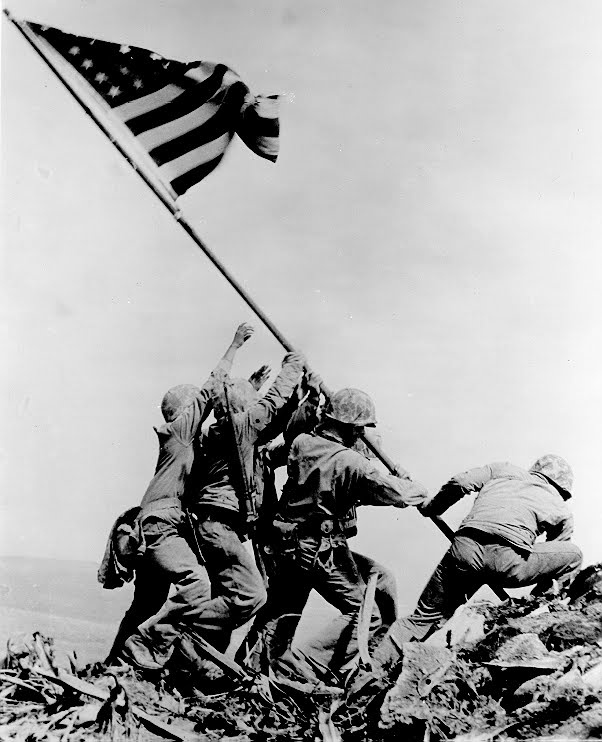
Doesn’t planting a flag always proclaim ownership?
-
Following through on the basic premise of this post that ancient places and presentations may change over time until their ultimate destiny is fulfilled, we can anticipate that the current iteration of Babylon will fulfill its ultimate destiny of utter destruction.
We should also expand our awareness of how the Babylon of our day is accomplishing its goal of connecting the false gods with humanity.

- let us build ourselves a city – think Houston’s Space Center technological power base
- and a strong tower – think launch pad with metal frame
- and its top – think capsule
- reaching heaven – think outer space beyond the firmament
- and we will make ourselves famed – think Space Race between Russia and the U.S.
- so that we may reign upon the whole world, in order that the evil of our enemies may cease from us – think the Reagan administration’s Strategic Defense Initiative
- that we may reign mightily over them – think maintaining hegemony over the other nations
- and that we may not become scattered over the earth on account their wars – think the U.S. military scattered all across the world fighting its enemies.
Surely we can recognize the glaringly obvious clues in NASA naming their space exploration vehicles after the ancient gods.


 Kingdom Come