
Besides Shem, King David has the only other Old Testament explicit declaration of filling the position of Melchizedek, in a psalm written by and about himself. This is quoted in application to Jesus Christ by the author of the letter to the Hebrews, but the context of David’s psalm is the blessing God conferred on David himself. Jesus Christ never herded sheep, nor yet has become the ruler of the nation of Israel.
“Thus saith the LORD of hosts / armies, I took thee from the sheepcote, from following the sheep, to be
- ruler over my people, over Israel:
- And I was with thee whithersoever thou wentest,
- and have cut off all thine enemies out of thy sight,
- and have made thee a great name, like unto the name of the great men that are in the earth.
- Moreover I will appoint a place for my people Israel, and will plant them, that they may dwell in a place of their own, and move no more; neither shall the children of wickedness afflict them any more, as beforetime…
- Also the LORD telleth thee that he will make thee an house. And when thy days be fulfilled, and thou shalt sleep with thy fathers, I will set up thy seed after thee, which shall proceed out of thy bowels, and I will establish his kingdom….and I will stablish the throne of his kingdom for ever.
- I will be his father, and he shall be my son. If he commit iniquity, I will chasten him with the rod of men, and with the stripes of the children of men: But my mercy shall not depart away from him, as I took it from Saul, whom I put away before thee.
- And thine house and thy kingdom shall be established for ever before thee: thy throne shall be established for ever.
“The LORD said unto my Lord, Sit thou at my right hand,
- until I make thine enemies thy footstool.
- The LORD shall send the rod of thy strength out of (Mount) Zion:
- rule thou in the midst of thine enemies.
- The LORD hath sworn, and will not repent, Thou art a priest for ever after the order of Melchizedek.
- The LORD at thy right hand shall strike through kings in the day of his wrath.
- He shall judge among the heathen,
- he shall fill the places with the dead bodies;
- he shall wound the heads over many countries.” (Psalm 110)
Note particularly that King David’s description of Melchizedek, supported by his lifestyle, is that the King of Righteousness is no wuss. As detailed in the previous post, he is a Man of War. He brings peace, for sure – like the white-hatted heroes of the American Wild West, one way or another – surrender or die!
David’s proclamation of “Death to the enemies of God’s people!” is consistent with the first documented mention of Melchizedek by name honoring Abram for the “slaughter of the kings”.
“And David said to Solomon, My son, as for me, it was in my mind to build an house unto the name of the LORD my God: But the word of the LORD came to me, saying, Thou hast shed blood abundantly, and hast made great wars: thou shalt not build an house unto my name, because thou hast shed much blood upon the earth in my sight. Behold, a son shall be born to thee, who shall be a man of rest; and I will give him rest from all his enemies round about: for his name shall be Solomon, and I will give peace and quietness unto Israel in his days.” (I Chronicles 22:7-9)
The Son of David who brings the ultimate peace and quiet isn’t born for another 1,000 years, but the same statements that apply prophetically to the immediate and the long-term sons / dynastic heirs to David’s kingdom must also apply to David himself.
“I have found David my servant; with my holy oil have I anointed him: With whom my hand shall be established: mine arm also shall strengthen him…my faithfulness and my mercy shall be with him: and in my name shall his horn be exalted…
He shall cry unto me, Thou art my father, my God, and the rock of my salvation. Also I will make him my firstborn, higher than the kings of the earth.
My mercy will I keep for him for evermore, and my covenant shall stand fast with him. His seed also will I make to endure for ever, and his throne as the days of heaven. If his children forsake my law, and walk not in my judgments; If they break my statutes, and keep not my commandments; Then will I visit their transgression with the rod, and their iniquity with stripes. Nevertheless my lovingkindness will I not utterly take from him, nor suffer my faithfulness to fail. My covenant there will I not break, nor alter the thing that is gone out of my lips. Once have I sworn by my holiness that I will not lie unto David. His seed shall endure for ever, and his throne as the sun before me. It shall be established for ever as the moon, and as a faithful witness in heaven. Selah.” (Psalm 89:20-37)
The phrases “He shall cry unto me, Thou art my father…I will make him my firstborn, higher than the kings of the earth” must be referring to David, not Jesus Christ, since the passage continues to discuss the disposition of this grant to his children who forsake God’s law. These are David’s sinful, human children, not sons of God on whom his righteousness has been restored through union with Jesus Christ.
The following excerpt from James M. Gibbs, Ph.D.’s doctoral dissertation on the meaning of “son of God” is very enlightening.
…the concept of sonship in Hebrew family life, which underlies all OT and Jewish thought on the subject, is that a son is one designated or acknowledged as such by a father…the father-son relationship is not primarily physical but rather an interpersonal one created by a sovereign act of the father. The son is to be obedient to, submissive to and dependent upon his father. The perfect son then is the incarnation and extension of his father’s will and character, and he points to his father, not to himself. If he is the Son of God in the unique sense that the NT claims for Jesus, then he will incarnate the demands of God’s righteousness, and he will present the demand for discipleship, the demand for obedience, obedience however not to the Son as such but to God the Father, that is, to the Father’s will as made manifest by the Son. Thus the concept of Son of God on OT-Jewish lines is basically moral, interpersonal and theocentric.
When the king is spoken of as Yahweh’s son (as in Ps 2.7, a favourite text with NT writers), it is in terms of adoption by God for obedient service rather than in terms of divinization…it has its own distinctive emphasis on the obedient subordination of the king as son…we never find in Israel any expression of a ‘metaphysical’ conception of the king’s divinity and his relation to Yahweh. It is clear that the king is regarded as Yahweh’s son by adoption, When, in Ps. 2.7, Yahweh says to the king on the day of his anointing and installation, ‘You are My son; I have begotten you today’, He is using the ordinary formula of adoption, indicating that the sonship rests on Yahweh’s adoption of the king…. Yahweh has ‘called’ and ‘chosen’ the king, made him His son, anointed and endowed him with His spirit…The king performs the will of Yahweh, and through him Yahweh’s blessing to land and people is transmitted; he represents Yahweh before the people…This is consistent with the notion of ‘son’ as basically designating a role or function rather than being an ascription of honor…But gradually the main emphasis came to be placed upon him as the representative of Israel before God, as a representative man from the chosen people. In this he was seen as the chief priest of the people…”
But David wasn’t a priest! you protest.
Not in the Levitical system, true.
That proves the point! But he certainly represented the national God of Israel to his people, as did all the kings in that era.
In the preceding posts we saw that all the pagan gods adopted their human rulers as their sons as well as appointed them their representative priest-kings.
Take David’s heir to the throne of Judah, Ahaz. When he rejected the God of Israel he became both the son and the priest of the pagan god.
“Ahaz sent messengers to Tiglathpileser king of Assyria, saying, I am thy servant and thy son: come up, and save me out of the hand of the king of Syria, and out of the hand of the king of Israel, which rise up against me…
And king Ahaz went to Damascus to meet Tiglathpileser king of Assyria, and saw an altar that was at Damascus: and king Ahaz sent to Urijah the priest the fashion of the altar, and the pattern of it, according to all the workmanship thereof. And Urijah the priest built an altar according to all that king Ahaz had sent from Damascus…
and the king approached to the altar, and offered thereon. And he burnt his burnt offering and his meat offering, and poured his drink offering, and sprinkled the blood of his peace offerings, upon the altar. “ (II Ki 16:1-16)
What we may have missed in the history lessons is that even Christian kings claimed to be priests of the Christian God. The divine right of kings existed under the Medieval popes but even after the Reformation became more entrenched with the king’s full assumption of spiritual power as head of the state church.
In England it is not without significance that the sacerdotal vestments, generally discarded by the clergy – dalmatia, alb and stole – continued to be among the insignia of the sovereign.” King James of KJV fame based his arguments for his right to absolute power in part on the biblical record that kings are “God’s lieutenants upon earth”, although he stretched the point when he claimed that “Kings are justly called Gods, for that they exercise a manner or resemblance of divine power upon earth.
King David’s position in the higher level Melchizedekian order is evident in the record that he, like Moses, exercised authority over the Aaronic priesthood and was the anointed ruler over not just Israel, but the whole earth.
- “And David…prepared a place for the ark of God, and pitched for it a tent [functioning exactly like Moses]…
- And David called for…the priests, and for the Levites…And said unto them...sanctify yourselves, both ye and your brethren, that ye may bring up the ark of the LORD God of Israel unto the place that I have prepared for it. For because ye did it not at the first, the LORD our God made a breach upon us, for that we sought him not after the due order…
- And David was clothed with a robe of fine linen, and all the Levites that bare the ark, and the singers, and Chenaniah the master of the song with the singers:
- David also had upon him an ephod of linen…So they brought the ark of God, and set it in the midst of the tent that David had pitched for it: and they offered burnt sacrifices and peace offerings before God.
- And when David had made an end of offering the burnt offerings and the peace offerings,
- he blessed the people in the name of [as the representative of] the LORD. And he dealt to every one of Israel, both man and woman, to every one a loaf of bread, and a good piece of flesh, and a flagon of wine.
- And he appointed certain of the Levites to minister before the ark of the Lord, and to record, and to thank and praise the LORD God of Israel…
Then on that day David delivered first this psalm to thank the LORD into the hand of Asaph and his brethren…
- [speaking first to God’s chosen nation Israel] O ye seed of Israel his servant, ye children of Jacob, his chosen ones...Be ye mindful always of his covenant…Saying, Unto thee will I give the land of Canaan, the lot of your inheritance. When ye were but few, even a few, and strangers in it [obviously referring to Abraham, Isaac, Jacob and his 12 sons] And when they went from nation to nation, and from one kingdom to another people; He suffered no man to do them wrong: yea, he reproved kings for their sakes, Saying, Touch not mine anointed [obviously Abraham, Isaac, Jacob...] and do my prophets no harm…
- [speaking in his role as Melchizedek to the rest of the nations of the whole earth]
- Sing unto the LORD, all the earth; shew forth from day to day his salvation.
- Declare his glory among the heathen; his marvellous works among all nations…
- Give unto the LORD, ye kindreds of the people, give unto the LORD glory and strength. Give unto the LORD the glory due unto his name: bring an offering, and come before him: worship the LORD in the beauty of holiness.
- Fear before him, all the earth:
- the world also shall be stable, that it be not moved. Let the heavens be glad, and let the earth rejoice: and
- let men say among the nations, The LORD reigneth.“ (I Chronicles 15-16)
Further proof of David’s Melchizedekian role is found in other psalms. These are not just prophesying of Jesus Christ’s future perfected relationship with YHWH but also testifying of David’s current personal relationship with YHWH.
Take Psalm 2 for instance. There is nothing there that can’t be attributed to David’s personal experiences. Surely that is how the audience of his day understood them.
“Why do the heathen rage, and the people imagine a vain thing? The kings of the earth set themselves, and the rulers take counsel together, against the LORD, and against his anointed, saying, Let us break their bands asunder, and cast away their cords from us.
He that sitteth in the heavens shall laugh: the Lord shall have them in derision. Then shall he speak unto them in his wrath, and vex them in his sore displeasure. Yet have I set my king upon my holy hill of Zion. I will declare the decree:
the LORD hath said unto me, Thou art my Son; this day have I begotten / permanently accepted as mine. Ask of me, and I shall give thee the heathen for thine inheritance, and the uttermost parts of the earth for thy possession. Thou shalt break them with a rod of iron; thou shalt dash them in pieces like a potter’s vessel.
Be wise now therefore, O ye kings: be instructed, ye judges of the earth. Serve the LORD with fear, and rejoice with trembling.
Kiss the Son [of God, the ruler], lest he be angry, and ye perish from the way, when his wrath is kindled but a little. Blessed are all they that put their trust in him.” (Psalm 2)
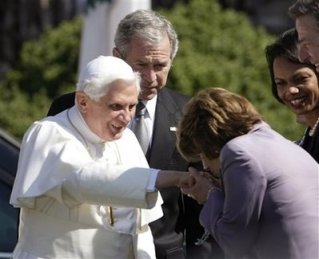 Kissing the Son / vicar of God is a common expression of publicly acknowledging a ruler’s authority.
“And the LORD said unto [Elijah]…I have left me seven thousand in Israel, all the knees which have not bowed unto Baal, and every mouth which hath not kissed him.“ (I Ki 19:13-18)
“Then Samuel took a vial of oil, and poured it upon his head, and kissed him, and said, Is it not because the LORD hath anointed thee to be captain over his inheritance?” (I Sam 10:1)


 Kingdom Come