The spiritual heritage of the United States of America is notorious. Most of the most important American government leaders, institutions, monuments, buildings, and landmarks both openly acknowledge and incorporate religious words, symbols, and imagery into official venues. Such acknowledgments are even more frequent at the state and local level than at the Federal level, where thousands of such acknowledgments exist.
The Puritans in England’s colonial New England communities covenanted their citizens to realize the spirit as well as the letter of the law in their daily activities. There was an emphasis on self-control as a part of self-rule, the primacy of commitments based in consent, giving meaning to ideas such as justice and liberty.
But the early 17th century, the Renaissance movement had paved the way to the Age of Enlightenment questioning traditional authority and embraced the notion that humanity could be improved through rational change. The American and French Revolutions were directly inspired by Enlightenment ideals.
The Declaration of Independence (1776) follows the covenant form and, when linked to the frame of government supplied by either the Articles of Confederation (1781) or the U.S. Constitution (1787), established a national compact.
But! The Founding Fathers did not enter into a covenant with the God of the Bible. They founded a Republic modeled on Roman, Greek and Egyptian heritage spectacular demonstrated in the Greek and Roman influences on Washington, D.C. Architecture and absorption of conquered gods and practices.
Washington, Jefferson, Franklin, Madison, Monroe and many other of the Founding Fathers were Deists – a philosophical belief in human reason as a reliable means of solving social and political problems. Deists believe in a supreme being who created the universe to operate solely by natural laws—and after creation, is absent from the world. This belief in reason over dogma helped guide the founders toward a system of government that respected faiths like Christianity, while purposely isolating both from encroaching on one another so as not to dilute the overall purpose and objectives of either…

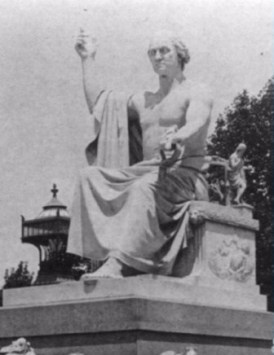
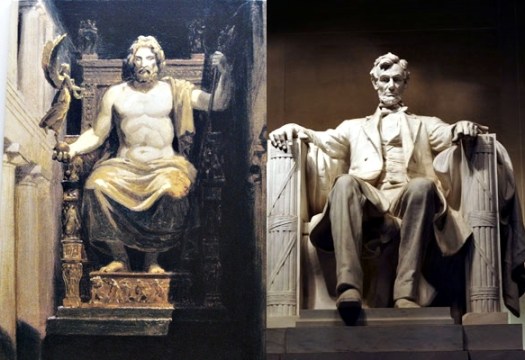 Both statues of Washington and Lincoln were deliberately modeled after Zeus, with Washington’s entitled “Enthroned Washington” and Lincoln’s placed in a monument expressly modeled after one of Zeus’ temples and defined as a temple on the plaque above Lincoln’s head. The timing and association of these images of Zeus is no accident of history.