“And the whole earth was of one language, and of one speech.” (Genesis 11:1)
Secular linguistics have determined that a single Superlanguage was spoken during the last ice age. This was the natural consequence of the geological activity of Noah’s flood blowing smoke into the atmosphere, blocking the sunlight
While Professor of Evolutionary Biology Mark Pagel and his team (of course) allocate 20,000 years for the separation of a Superlanguage into seven Eurasiatic / Indoeuropean / Japhethite language families, common experience proves that each generation adapts their parents’ language due to rapidly evolving – in the true sense of the word – experiences and deliberate social distancing. At that time, in Pangea, those experiences included new ecologies as emigrating groups moved away from the warmest to colder climates encountering new geologies, plants and animals for which they had to invent nouns which were then adapted into verbs and conventions for word order in sentences.
“And it came to pass, as they…” (Genesis 11:2)
“They” are obviously referring to the most recently referenced group of people, logged in Genesis 10 under the patriarchal first three generations after the flood:
- By these were the isles of the Gentiles / Japhethites divided in their lands; (v 5)
- These are the sons of Ham, after their families, after their tongues, in their countries (v 20)
- the sons of Shem, after their families, after their tongues, in their lands, after their nations (v 31)
These people lived from 500-400 years without modern legal or social restrictions on reproduction in families desperately clinging to each other for sheer survival, with exponential population growth driving expansion in every geographical direction in search of sustenance and living space, the real “hunter-gatherers” 
“As they journeyed from the east…”
This supports the archeological determination that among the ancient civilizations, the Chinese is the one that has continued uninterrupted to this day. To decode this exceptional continuity, China launched a long-term project more than two decades ago to trace its civilizational origins.
that they found a plain in the land of Shinar [which couldn’t possible hold the entire population of the world by this time]; and they dwelt there. And they said one to another…Go to, let us build us a city and a tower, whose top may reach unto heaven; and let us make us a name / attribute [clearly of hyperdimensional, unbeatable power], lest we be scattered abroad upon the face of the whole earth.” (Genesis 11:3-5)
This is NOT a democratic decision. THEY are the decision makers, the rulers, the elite at the top of the heap of the mass of impoverished workers making their wealth. Think Nazi Germany’s goal of entrenching itself in authority. Or what just happened after President Trump took power for himself and his cronies in 2026.
Established by Sargon of Akkad after defeating the Sumerian king Lugal-zage-si, it replaced the system of independent Sumero-Akkadian city-states and unified a vast region, stretching from the Mediterranean to Iran and from Anatolia to the Persian Gulf, under a centralized government. Sargon and his successors, especially his grandson Naram-Sin, expanded the empire through military conquest, administrative reforms, and cultural integration. Naram-Sin took the unprecedented step of declaring himself a living god and adopted the title “King of the Four Quarters.” The Semitic Akkadian language became the empire’s lingua franca, although Sumerian (a language isolate) remained important in religion and literature. The empire was documented through inscriptions, administrative tablets, and seals, including notable sources like the Bassetki Statue. Enheduanna, Sargon’s daughter, served as high priestess and is recognized as the first known named author in history.
The Akkadian Empire reached its political peak between the 24th and 22nd centuries BC, following the conquests by its founder Sargon.
After Nimrod / AKA Hammurabi, son of Cush, seized the city of Akkad from his older cousin Arpha-xad / Gilgamesh, son of Shem, along with the other city-states of Sumer he transformed them into the Akkadian Empire,archeologically confirmed to have been established in the early post-flood era (around 2334 BCE). This was the first empire in world history due to there not having been separate states to coalesce into an empire prior to the flood.
How this was accomplished unequivocally validates the biblical account of the tool of language.
empire united the Semitic Akkadian and Sumerian speakers under one rule and exercised significant influence across Mesopotamia, the Levant, modern-day Iran and Anatolia, sending military expeditions as far south as Dilmun and Magan in the Arabian Peninsula.[4][page needed]
Under Sargon and his successors, the Akkadian language was briefly imposed on neighbouring conquered states such as Elam, Lullubi, Hatti and Gutium. Akkad is sometimes regarded as the first empire in history, though the meaning of this term is not precise, and there are earlier Sumerian claimants.[5][6]
The Akkadian state was characterized by a planned economy supported by agriculture, taxation, and conquest. It also saw developments in art, technology, and long-distance trade, including connections with the Indus Valley. Despite its strength, the empire faced internal revolts, dynastic instability, and external threats. Sargon’s sons, Rimush and Manishtushu, struggled to maintain control; both died violently. Naram-Sin’s successors were weaker, leading to fragmentation and vulnerability. The empire eventually collapsed due to a combination of internal unrest and severe environmental and economic stress caused by a major drought associated with the 4.2-kiloyear climate event, which led to crop failures, famine, urban decline, and population displacement, followed by an invasi
“And the LORD came down to see the city and the tower, which the children of men builded. And the LORD said, Behold,
- the people is one / united,
- and they have all one language;
- and this they begin to do:
- and now nothing will be restrained from them, which they have imagined to do…
So the LORD scattered them abroad from thence upon the face of all the earth:” (Genesis 11:5-9)
“Behold, the LORD maketh the earth empty, and maketh it waste, and turneth it upside down, and scattereth abroad the inhabitants thereof.” (Isaiah 24:1)
on by the Gutians.
It is commonly taught that God imposed different languages on different groups as a miraculous event, but when we don’t just skip over this passage because we’re so familiar with it from Sunday School (yawn), but instead analyze its separate phrases, we understand that it is more likely that language changes occurred as a natural process of isolation between groups of workers on the Babylon Project, exactly as occurred during the Manhattan Project.
The clash between the scientists and the military was primarily over the scientists’ need for open collaboration versus the military’s insistence on secrecy while establishing laboratory and security procedures. Oppenheimer insisted on the need for collaboration between scientists to solve the complex scientific, engineering and technical issues of developing an atomic bomb. General Leslie Groves was adamant that the project had to protect the knowledge of the atomic bomb from falling into the wrong hands.
When a position becomes available at NASA, a supervisor assigns a security clearance level to the job, and a human resources officer confirms it. Level 4 positions are “special-sensitive” jobs involving top-secret information. Level 3 positions are “critical-sensitive” jobs involving secret information. Level 2 positions are “noncritical-sensitive” positions. Access to the most-sensitive information is only granted on a “need to know” basis to individuals considered “mission critical” for a particular task. The top secret aspects of each particular work sector are communicated through words known only to that group.
Even at a non-secret work site the terms used becomes specific to that group.
We can also certainly expect that some desperate and brave people developed secret plans to flee slavery, using a secret code / language to communicate plans among the group, as was done in America’s own Underground Railroad.
A published linguistics lecture at prestigious University of Pennsylvania:gives us to understand that all changes in language involve changes or segregation in location.
- Migration
- Conquest
- Trade bring speakers of one language into contact with speakers of another language where words are often borrowed.

- Deliberate social differentiation by adoption of distinctive language norms in addition to dress, adornment, gesture, etc. through vocabulary (slang or jargon), pronunciation (usually via exaggeration of some variants already available in the environment), morphological processes, syntactic constructions, and so on.
The Adversary’s response of regathering the scattered knowledge includes gathering all the peoples of the world under his control. This philosophical consideration of adversarial rivalry is supported by the biblical counter claim that:
-
“The sceptre shall not depart from Judah, nor a lawgiver from between his feet [explicit reference to sexual reproduction of human descendants] , until Shiloh /He whose it is, the One who is entitled to the scepter come; and unto HIM shall the gathering of the people be.” (Genesis 49:10)
How? Same way everything was created into being, and sustained for eternity.
Through the WORD.
At the same time that the Adversary’s plans were limited through multiple languages, YHVH was spreading knowledge through a universal language. We can date the beginning of this language by its name in association with Shem’s son Aram.
Aram-aic is the ancient language of the Semitic [Shemite] family group, which includes the Assyrians, Babylonians, Chaldeans, Arameans, Hebrews, and Arabs…In a phenomenal wave of expansion, Aramaic spread over Palestine and Syria and large tracts of Asia and Egypt, replacing many languages…
For about one thousand years it served as the official and written language of the Near East, officially beginning with the conquests of the Assyrian Empire, which had adopted Aramaic as its official language, replacing [Arphaxad’s] Akkadian…
Aramaic had been adopted by…the tribes of the Northern Kingdom [deported] by Sargon II who took Samaria in 721, [and] the two tribes of the Southern Kingdom of Judah who were taken into captivity to Babylon by Nebuchadnezzar in 587. Hence, the Jews who returned from the Babylonian Captivity brought Aramaic back with them to the Holy Land…[Yeshua / Jesus spoke the Word in Aramaic]
The large colony of Orhai Jews [in modern Turkey], and the Jewish colonies in Assyria in the kingdom of Adiabene whose royal house had converted to Judaism, possessed most of the Bible in this 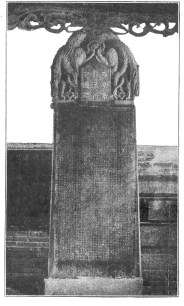 [Aramaic] dialect, the Peshitta…This Peshitta version of the Old Testament was taken over by all the Churches in the East, which used, and still use Aramaic, as far as India, and formerly in Turkestan and China. The Peshitta Tenakh was completed during Apostolic times with the writings of the New Testament…
Modern Aramaic, in its various dialects, is spoken in modern-day Iraq, Iran, Syria, Israel, Lebanon, and the various Western countries to which the native speakers have emigrated, including Russia, Europe, Australia and the United States.”
(Hsian-Fu (Xian) Monument commemorating the arrival of Christianity to China in 635-781 A.D.)
It’s always the power inherent to the Word of God that opposes and defeats the enemy.


 Kingdom Come