
-
-
Geology’s discovery that a substantial portion of our oceans came from the ice and minerals on asteroids, and possibly comets, that crashed into Earth validates the biblical account of Nights of destruction of Creation.
-
Even more scientifically validating of the biblical account of Creation is geology’s discovery of a series of supercontinents synchronizing exactly with a total of eight restorations following eight destructions – the seven nights by the Adversary during Creation week plus God’s destruction by Noah’s flood.
Day Three – First Restoration
- Evening: restoring the work of the morning
“And God said,
- Let the waters under the heaven be gathered together unto one place,
- and let the dry land appear…”
-
And the evening and the morning were the third day / timeless era of creation overcoming the night timeless era of destruction.” (Genesis 1:9-13)
Ancient Supercontinents
- Vaalbara – “a hypothesized supercontinent that existed approximately 3.6 billion years ago. The primary evidence for its existence is when an asteroid impact left small glassy spheres found worldwide. This is consistence with the creation of heaven and earth (Genesis 1:1)
- Ur – the German prefix meaning “Original”. A relatively young landmass with few mountains or other significant geological features, understandable because Earth has had to undergo countless events to have its current features. This is consistent as the remnant of the original landmass that was submerged by the “deep” waters destroying earth by the Adversary on Night 1.
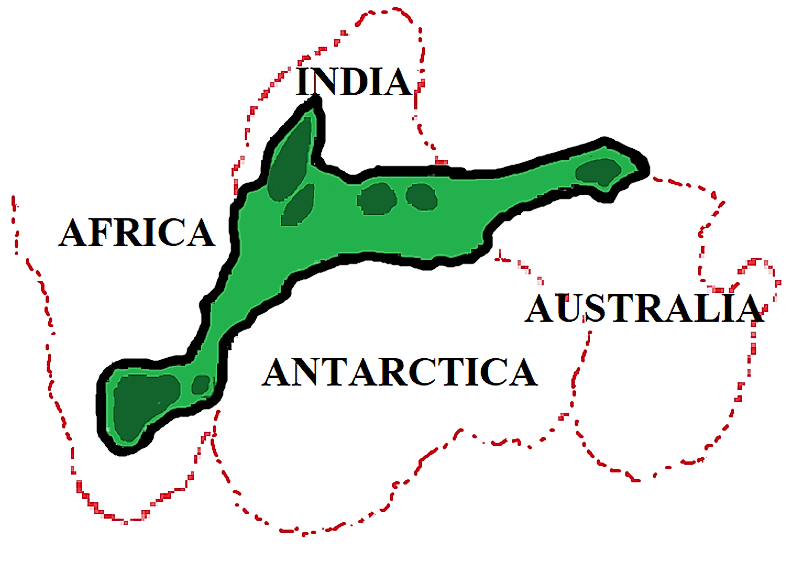
3. Kenorland was formed by the collision of several smaller continents, evidenced in greenstone belts (layers of metamorphic rock) in a region of modern-day Australia. The Kenoran orogeny, a period of intense mountain-building activity, also created vast mineral deposits. This is consistent with ongoing destruction and restoration of the second night and day, although only the firmament is mentioned in scripture.
- Kenorland – Geologists named the continent after the Kenoran orogeny, a Precambrian thermal event in Canadian, representing some of the oldest rocks and vast mineral deposits in North America. This was treated as a geological accretion event, i.e. structural deformation of the underlying continental crust by pressure from a large moving mass from volcanism or continental drift.
- However, in 1944 an astronomical accretion model – that Earth formed from meteoric material – was proposed. Since then, the model has been further developed, and it is now accepted that stars form by the gravitational collapse of interstellar gas. As the cloud collapses, losing potential energy, it heats up, gaining kinetic energy, and the conservation of angular momentum ensures that the cloud forms a flattened disk—the accretion disk. The astronomical accretion for Kenorland accounts for thermal event in Canada, formation of the oldest rocks, and vast mineral deposits.
- On Earth, erosion, volcanic resurfacing and tectonic activity are continually erasing astronomical impact craters from the rock record. Despite this, 174 confirmed impact structures have been documented to date with several more sites being recognized each year (Fig.9), although the record is notably incomplete. In particular, there are few confirmed impact sites in South America, Central Africa and large parts of Asia. It is also notable from Fig.9 that the majority of the recognized impact sites also occur on land. This is due to two main factors: the relatively unexplored nature of the ocean floor, and the lack of criteria to validate suspected impact sites without actual samples, as mentioned above.
- “And God said, Let there be a firmament in the midst of the waters, and let it divide the waters from the waters. [Without explicitly stating this, as if it so minor as to be not worth mentioning there is opposing force against this project. From the hyper-dimensionals dimension of outer space, ergo meteorites, apparently loaded with water, possibly ice.] And God made the firmament, and divided the waters which were under the firmament from the waters which were above the firmament: and it was so. And the evening [of destruction] and the morning [establishing that which was made] were the second day.” (Genesis 6-8)
- Arctica + Atlantica in two pieces north and south.
- Biblical day three corresponds to the creation of vegetation. “And God said [applied Force to convert forms of energy and mass into different forms], Let the earth bring forth [converting one form of mass to another, as is observable in the growth of vegetation from elements in the ground] grass, the herb yielding seed, and the fruit tree yielding fruit after his kind, whose seed is in itself, upon the earth: and it was so.” (Genesis 1:9-13) This, of course, was opposed by hyper-dimensional forces from space, again with the water as evidenced by the results.
- Biblical night three corresponds to the second ice age, and the coal deposits. The conversion of dead vegetation into coal is called coalification. The process requires oxidation of the dead plant matter to be prevented by mud or acidic water, trapping immense amounts of carbon, which are then deeply buried by sediments. The heat and pressure of deep burial causes the loss of water, methane and carbon dioxide and increased the proportion of carbon. Of the factors involved in coalification, temperature is much more important than either pressure or time of burial. 90% of all coal beds were deposited in the Carboniferous and Permian periods during the Late Paleozoic icehouse, a time of global glaciation. The rapid formation of coal ended in the Permian–Triassic extinction event.
- “And God said, Let the waters under the heaven be gathered together unto one place, and let the dry land appear: and it was so. And God called the dry land Earth; and the gathering together of the waters called he Seas: and God saw that it was good. And the evening and the morning were the third day.” (Genesis 1:11-13)
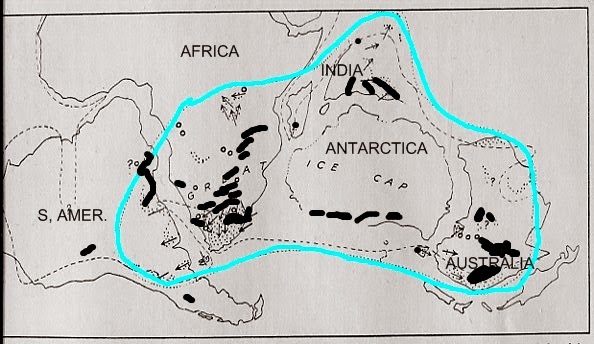
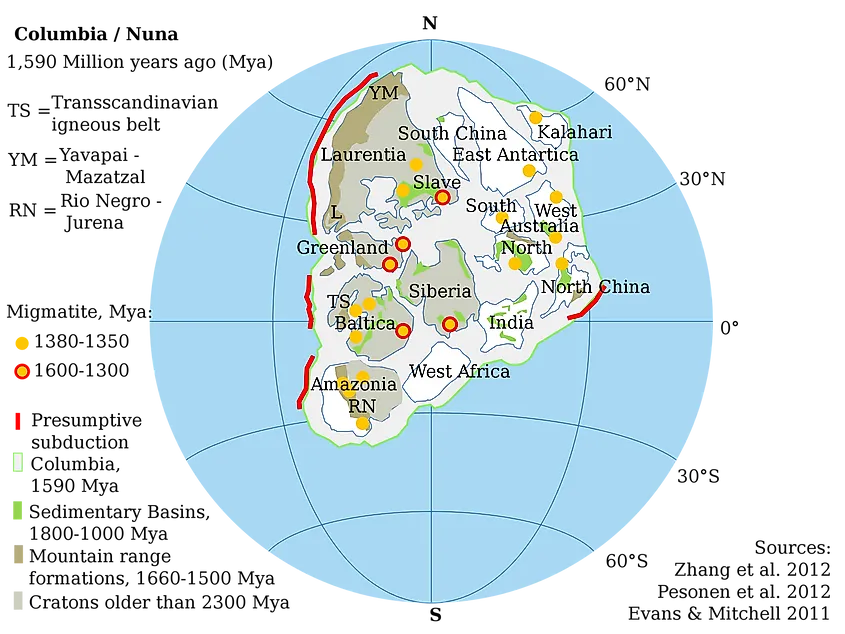
- Columbia (Nuna) – Evidence provided by geological and paleomagnetic data of the formation of some of the oldest rocks on Earth during the third ice age.
- Biblical day four -“And God said, Let there be lights in the firmament of the heaven…to give light upon the earth, And to rule over the day and over the night, and to divide the light from the darkness:” (Genesis 1:14-19)
- Rodinia – provided new habitats for early life forms, allowing for evolution. Geologists need to learn more about Rodinia due to limited geological evidence. Seriously? So this is strictly imaginative to support Evolution.
- Pannotia – Geological and paleomagnetic evidence places it at the South Pole enclosed by a global ocean. Its breakup contributed to the formation of new oceans triggering the Cambrian explosion – crustaceans and starfish, sponges, mollusks, worms, chordates, and algae. Corresponds to the Mississippian and Pennsylvanian Strata of marine and aerial life forms, and the fourth ice age.
- “And God said, Let the waters bring forth abundantly the moving creature that hath life, and fowl that may fly above the earth in the open firmament of heaven. And God created great whales, and every living creature that moveth, which the waters brought forth abundantly, after their kind, and every winged fowl after his kind: and God saw that it was good. And the evening and the morning were the fifth day.” (Genesis 1:20-23)
- Gondwana And Laurasia – Biblical day six, with Gondwana including South America, Africa, Madagascar, India, Australia, and Antarctica. and Laurasia including the northern continents. Fossil evidence – consistent with the biblical account – it was home to many unique species, such as dinosaurs, marsupials, and early flowering plants. Remnants of Gondwana are in various parts of the world. Corresponds to the Permian – our current – era of land animals and humans, and the fifth ice age.
- “And God made the beast of the earth after his kind, and cattle after their kind, and every thing that creepeth upon the earth after his kind: and…God created man in his own image, in the image of God created he him; male and female created he them.” (Genesis 1:25-27)
- Pangaea – “And on the seventh day God ended his work which he had made.” (Genesis 2:2)
This single supercontinent is where the pre-Flood peoples lived, not breaking into the pieces as we know them until after the Flood.
-
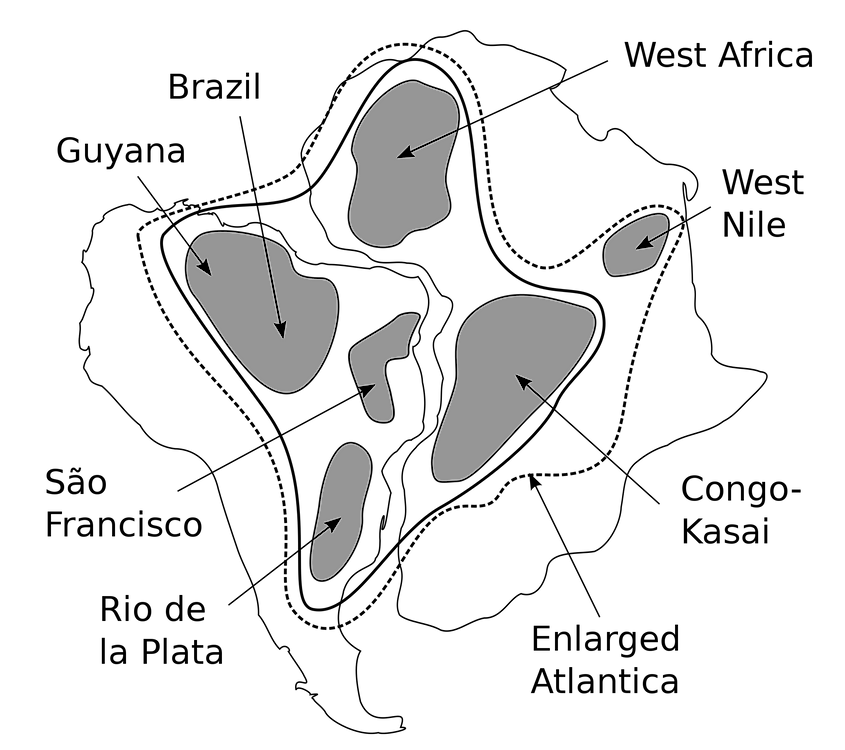
4. Atlantica, formed by the collision of smaller land masses, caused massive volcanic activity and mountain-building, which led to changes in sea levels and ocean currents and had a dramatic effect on the earth’s climate – making it hospitable for biological life. This is consistent with Day 3 restoration and creation of botany.
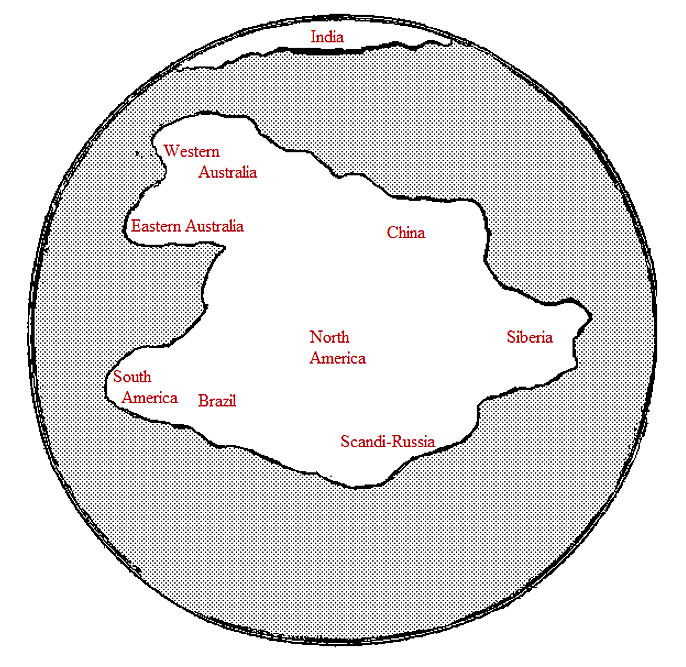
5. Columbia (Nuna) is believed to be one of the first supercontinents. This would be accounted for by lowered[- sea levels due to deepening sea floors from impact craters and undersea volcanic activity. This significantly increased the opportunity for new life forms on Earth as it created new habitats. This is consistent with day four restoration and creation of the sun.
Rodinia is a proposed intermediary supercontinent but has limited geological evidence.
6. Pannotia is another supercontinent proposed in the early 1990s based on geological and paleomagnetic evidence locating Pannotia at the South Pole, surrounded by a global ocean. This is consistent with day five restoration with creation of sea and air creatures.
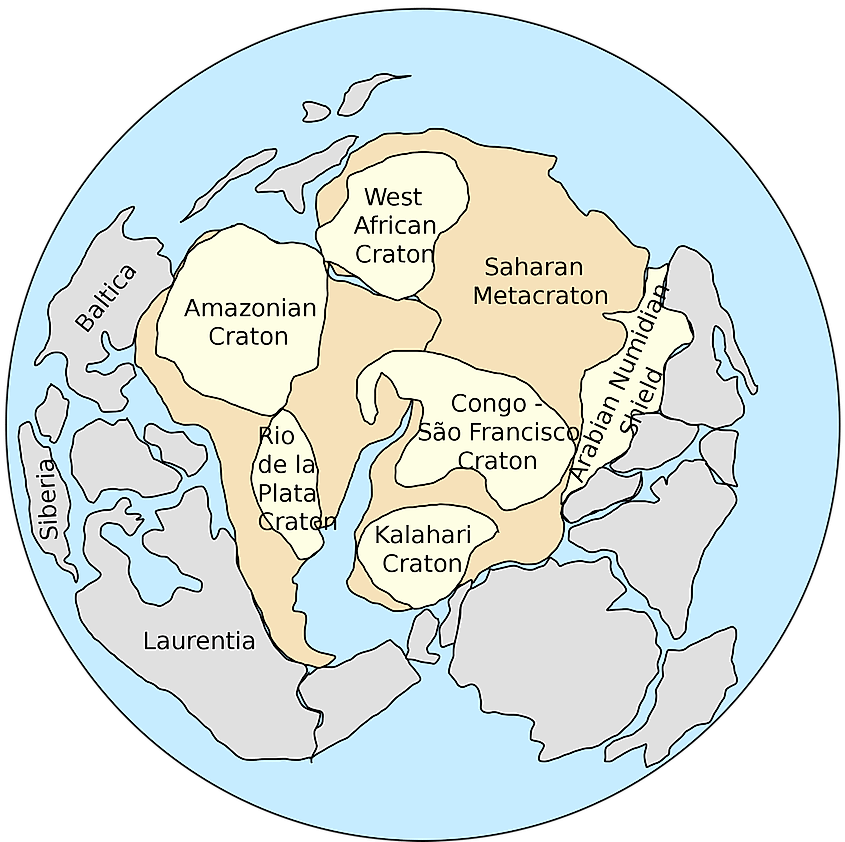
Gondwana was formed by the accretion of multiple land masses including South America’s Andes Mountains and Africa’s Karoo Basin. It was home to many unique land animal species and flowering plants. This is consistent with day six of restoration and creation of land animals and humans.
Fossils indicate the presence of the Jurassic period, i.e. dinosaurs on Gondwana. This is consistent with this supercontinent lasting until Noah’s flood.
“Now these are the generations of Noah… unto Eber were born two sons: the name of one was Peleg; for in his days was the earth divided;” (Genesis 10:1,25)
Laurasia existed at the same time as Gondwana.
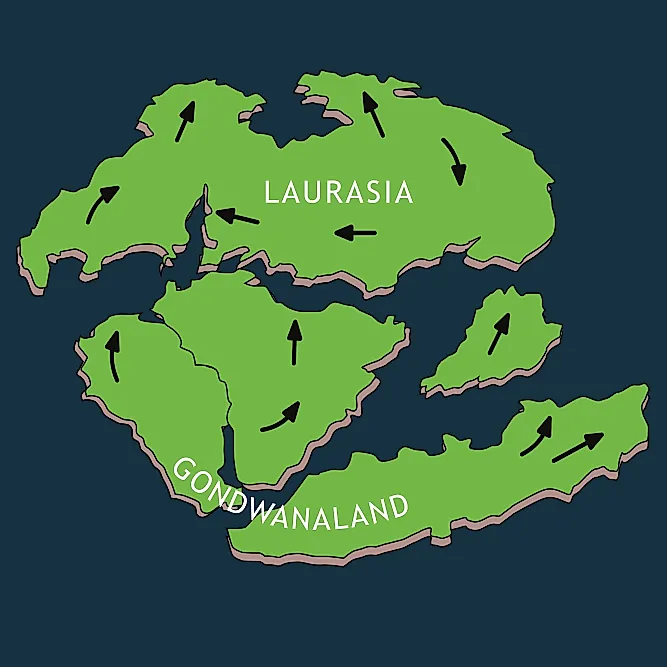
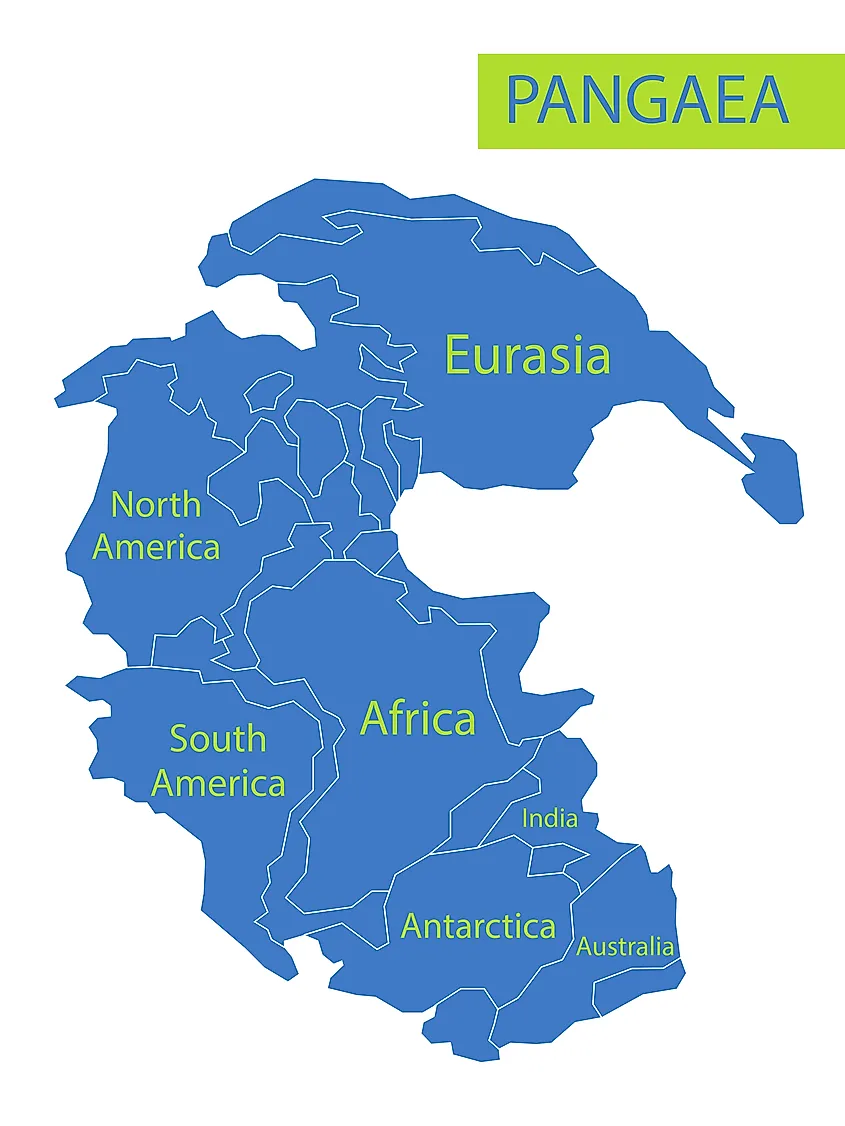
Pangaea is from the Greek words pan, meaning “entire,” and “gaia,” meaning “earth.” This last supercontinent was formed during the restoration of God’s initial single land mass by the merging of Gondwana, Laurasia and Siberia, South surrounded by a single large ocean called Panthalassa. Due to its distance from the ocean, the center of the continent was dry and fairly barren.
The breakup of Pangaea into the continents as we know them today shaped Earth’s current climate and ecology. This event, caused by tectonic and astronomical events, is arbitrarily assigned by Evolutionists to 200 million years ago, however is documented in the Bible as occurring shortly after Noah’s flood, or ~2,000 BC.
“And unto Eber were born two sons: the name of one was Peleg; for in his days was the earth divided;” (Genesis 10:25)

 Kingdom Come