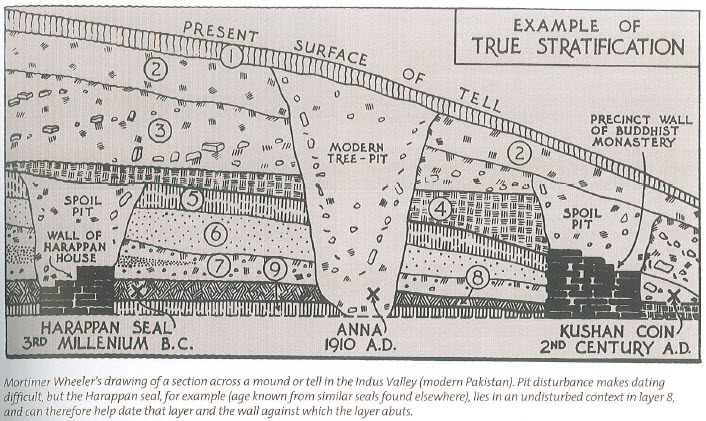
Relative dating stems from the idea that…objects closer to the surface are more recent in time relative to items deeper in the ground.
Relative dating can be determined through comparing finds in carefully mapped strata.
One of the world’s oldest landfills was recently uncovered in Jerusalem….Through a systematic excavation of this landfill, Tel Aviv University archaeologist Yuval Gadot and his team have been able to shed light on Jerusalem during a particularly tumultuous chapter of its history—when Rome ruled, the Temple stood, and Jesus preached.
From the earliest agricultural villages through the early modern era, people have used clay vessels for almost every sort of activity…

Earthenware vessels of different periods on display at Archaeological and Ethnographic Museum in Turkey from archeological sites estimated to date back to about 5,000 BC.
Several problems arise with the use of stratification for dating. Rodents, for example, can create havoc in a site by moving items from one context to another. Natural disasters like floods can sweep away top layers of sites to other locations.
Nonetheless, relative dating is paleontology’s basis for dating fossils back to millions of years old.
geologists must make an initial assumption about the way rock strata are formed. Of course, it only applies to sedimentary rocks…
- Once we assume that all rock layers were originally horizontal,
- we can make another assumption: that the oldest rock layers are furthest toward the bottom, and the youngest rock layers are closest to the top.
- This rule is called the Law of Superposition.
I think we can all recognize that this assumed “Law” violates known evidence that during a volcanic explosion – as an airline steward once amusingly explained while giving us passengers instructions to secure our belongings -“shift happens.”

From a long earth age perspective, using relative dating, this depth should cause evolutionists to conclude that stone age cultures had managed to build this a bomb.
In a cave called the Mountain of the Gods, a mecca of sorts for the local people in the Tsodilo Hills of Botswana, the discovery of carvings on a snake-shaped rock along with 70,000-year-old spearheads nearby has dramatically pushed back the earliest evidence for ritual behavior, or what could be called religion.

Upon finding a six-meter-long rock that bore a striking resemblance to a snake, including a mouthlike gash at the end, a researcher reported, “My first words I remember saying are, ‘My god…”
Hmmm. Could that be as in ” the god of this world hath blinded the minds of them which believe not, lest the light of the glorious gospel of Christ, who is the image of God, should shine unto them.” (II Corinthians 4:4)?
Reliable markers of the site’s longevity lay buried…In a one-meter-wide, two-meter-deep excavation right next to the snake, the researchers uncovered more than 100 multicolored spear points from a total of 13,000 man-made artifacts.
The tips closely resemble those found elsewhere in Africa that researchers have dated at up to 77,000 years old, Coulson says. Judging from the rare colors of the stone points and the pattern of fragments, people from far and wide likely brought them to the cave partially made and finished working them there, she explains.
The self-serving circular reasoning in this account is glaringly obvious.
- Snakes currently feature prominently in the traditions and the mythology of the San, sometimes called the Bushmen, who currently visit the site for religious purposes.
- The researchers date the use of the stone snake by the artifacts found with it although it is impossible to date when these stones were worked into artifacts.
- In an inexcusable misuse of the term “reliable”, researchers deceptively claim they can be dated by their resemblance to those found elsewhere which have been dated to 77,000 years old.
- The reliability of that dating of 77,000 years old is not provided, and is in fact impossible to provide.
- The reality, as stated by the article, which, significantly, has not been published, is that this site has been in continuous use for just the last few thousand years by the San people whose offerings are most certainly among the artifacts discovered and can absolutely be reliably expected to have been worked into arrowheads within a few thousand years. And yet there is no distinguishing them from those claimed to be 77,000 years old.

The San populated South Africa long before the arrival of the Bantu-speaking nations, and thousands of years before the arrival of Europeans…The San are the best model we have for the hunter-gatherer lifestyle…
Rock art by the late Stone Age hunter-gatherers can be found in the form of paintings or engravings in almost every district in South Africa…Although many are not well preserved, collectively they represent a remarkable record of the beliefs and cultural practices of the people who made them. Most were created by San hunter-gatherers…
The San have a rich oral history and have passed stories down from generation to generation. The oldest rock paintings they created are in Namibia and have been radiocarbon-dated to be 26,000 years old.
No they haven’t. At best the substrate rock has been radiocarbon-dated, not the paint.
Pinpointing the ages of rock art and cave art can be maddeningly difficult. Sometimes the only clue to the age of an artwork is the style in which it was painted or carved. Still, these…help us to imagine…vast expanses of time.
Alternately, we could imagine kids passing the time during a thunderstorm, or highly intelligent but artistically impaired adults like myself just doing the best we can with crude implements. Michaelangelo is a famous artist precisely because he is so rare.


 Kingdom Come