Good King Jehoshaphat of Judah was open to a peaceful restoration of the entire nation of Israel, and rightly believed that the desolation of Israel could only be ended by a restoration of relationship with YHVH. In the following succession of the kings of Judah and Israel the kings of Israel are listed first to minimize the repetition of who is king of which nation.
From I Kings 15-16
- There was war between Rehoboam and Jeroboam all the days of his life.
- And there was war between Abijam and Jeroboam.
- And Nadab the son of Jeroboam began to reign over Israel in the second year of Asa son of Abijam, and Baasha of the house of Issachar, conspired against him and reigned in his stead, he left not to Jeroboam any that breathed.
- And there was war between Asa and Baasha all their days during which Asa took all the silver and the gold that were left in the treasures and sent them to Benhadad / son of the god of war king of Syria to pay him to attack and desolate Israel for him, after which Israel could only afford to fight amongst themselves.
- Elah the son of Baasha reigned over Israel two years
- Zimri, captain of half his chariots, conspired against him, as he was drinking himself drunk and killed him and was made king by his army. He reigned seven days during which he slew all the house of Baasha.
- Omri, the captain of the host, followed by all Israel, besieged Zimri, who, when he saw that the city was taken, burnt the king’s house over him with fire, and died. Then half of the people followed Tibni the son of Ginath, to make him king; and half followed Omri in battle, Tibni died
- Omri reigned twelve years. And he bought the hill of Shemer for two talents of silver, and built the city which he named after the owner of the hill, Samaria. Omri walked in all the way of Jeroboam the son of Nebat, and in his sin wherewith he made Israel to sin, to provoke the Lord God of Israel to anger with their vanities.
- And in the thirty and eighth year of Asa king of Judah began Ahab the son of Omri to reign over Israel in Samaria twenty and two years.
“Jehoshaphat the son of Asa came down to the king of Israel and Ahab said unto Jehoshaphat, Wilt thou go with me to battle to Ramothgilead? And Jehoshaphat said to the king of Israel, I am as thou art, my people as thy people, my horses as thy horses.”
The second strategy to unite two nations is intermarriage between royal dynasties, practiced since the Late Bronze Age to
- avoid the inevitable border conflicts
- promote peace and trade between nations
- secure a military alliance against a third dynasty,
- provide a legal claim of inheritance to expand into the allied territory whenever the allied monarch failed to leave an undisputed heir.
Ahhh, don’t forget “maintain the fallen angels’ power genes” after the flood.
We see this strategy under King David in his extension of the boundaries of Israel.
“Absalom the son of Maacah the daughter of Talmai king of Geshur.” (II Samuel 3:3)
“Geshur” is the Hebrew transliteration from this nation’s own language by matching the shared Semitic root *g-ṯ-r “, which means “to be strong”. This is highly suggestive of “mighty” men, hybrid giants, and in fact is one of the nations notorious for giants. In the list of “the kings of the land, which the children of Israel smote, and possessed their land” the Israelites did not get past “the border of the Geshurites”.
“Stronghold” also describes its excavated city walls which had to have been built by giants, being between six and eight meters wide, even thicker / stronger than those at Jericho. This was, like Jericho, due to its prime location. Currently called the Golan Heights this is such strategic high ground between warring factions that the United Nations maintains a peacekeeping force there.
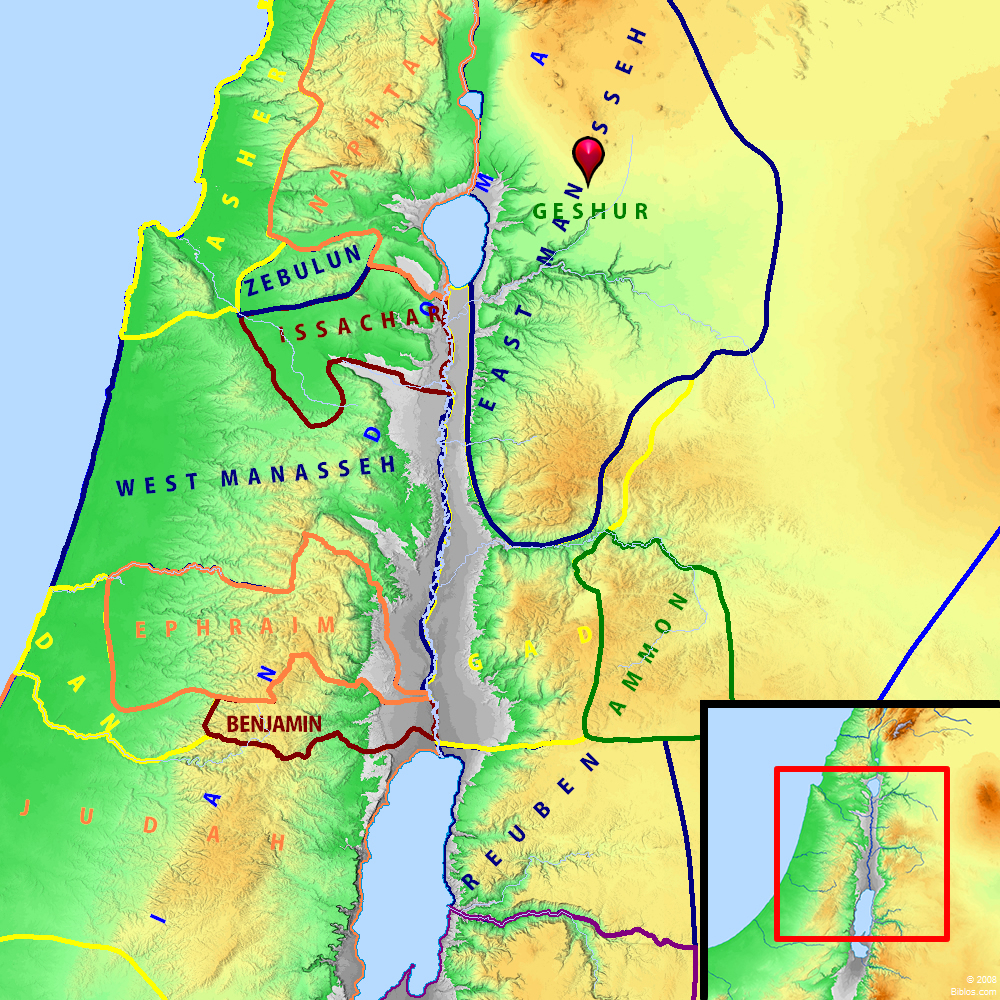
When Absalom fled to Geshur to escape the legal consequences of murdering his brother, King David did not extradite him. Undoubtedly partly because of his love for Absalom, but very likely because of the geographical ability of Geshur to harbor their son indefinitely. Which also explains why David chose alliance over another failed military takeover.
Absalom’s attempted coup against his powerful father was undoubtedly underwritten by his powerful maternal kingdom.
So nation A making an alliance with nation B runs the risk of
- being absorbed into nation B
- rather than absorbing nation B.
Solomon’s alliances through marriage absolutely proves this.
“And all the earth sought to Solomon, to hear his wisdom, which God had put in his heart. And they brought every man his present [to forge a political alliance]…
king Solomon had seven hundred wives, princesses, and three hundred concubines, besides the daughter of Pharaoh…Of the nations concerning which the LORD said unto the children of Israel, Ye shall not go in to them, neither shall they come in unto you: for surely they will turn away your heart after their gods….and his wives turned away his heart….when Solomon was old…Solomon went after
- Ashtoreth the goddess of the Zidonians,
- Milcom the abomination of the Ammonites,
- Chemosh, the abomination of Moab
- Molech, the abomination of the children of Ammon
- And for all his strange wives, which burnt incense and sacrificed unto their gods.
thus saith the LORD, the God of Israel, Behold, I will rend the kingdom out of the hand of Solomon…(But he shall have one tribe for my servant David’s sake, and for Jerusalem’s sake, the city which I have chosen out of all the tribes of Israel:) Because that they have forsaken me, and have worshipped Ashtoreth the goddess of the Zidonians, Chemosh the god of the Moabites, and Milcom the god of the children of Ammon, and have not walked in my ways, to do that which is right in mine eyes, and to keep my statutes and my judgments, as did David his father.” (I Kings 11)
After the kingdom was split it naturally lost a lot of its economic and military power.
Isabella / Jezebel, the successor to the thrones of Castile and Leon first significant power play was a marriage alliance to her neighbor, Ferdinand of Aragon. The union of these two contiguous realms would indeed constitute a magnificent kingdom, homogeneous in language, manners, and religion, and become the Spanish Empire.
“And Ahab the son of Omri did evil in the sight of the LORD above all that were before him…he took to wife Jezebel the daughter of Ethbaal king of the Zidonians, and went and served Baal.” (I Kings 16:29-31)
As seen in his father-in-law’s name of Eth-baal / United with Baal, daughter Jeze-bel’s name, a phrase used in rituals calling on baals to inhabit the worshipper, and the king of Babylon bestowing new divinity affinities to indicate alliance rather than subjugation of royal seed of Israel, the higher ranking king of Zidon followed the standard practice of publicizing the new alliance with their Canaanite gods through his new name.
The Urdu meaning of Ahab, which was picked up in Arabic, is Strong, as in the god-man hybrids.
Don’t forget the arcane practice of incest to pull out recessive giant genes. And as Ahab then turned his attention to expanding his reach into Judah, his primary strategy was to embed his own baal-infested spawn into the royal Judean lineage.
The following quoted passages are from II Kings 8-11 and II Chronicles 18-22.
- in the fifth year of J(eh)oram the son of Ahab king of Israel…
- J(eh)oram the son of Jehoshaphat king of Judah began to reign… and slew all his brethren with the sword, and divers also of the princes of Israel…And he walked in the way of…the house of Ahab: for [Athaliah] the daughter of Ahab was his wife:
- and Ahaziah his son reigned in his stead. His mother’s name…was Athaliah the daughter of Omri. He also walked in the ways of the house of Ahab: for his mother was his counsellor to do wickedly. Wherefore he did evil in the sight of the Lord like the house of Ahab: for they were his counsellors
- J(eh)oram the son of Jehoshaphat king of Judah began to reign… and slew all his brethren with the sword, and divers also of the princes of Israel…And he walked in the way of…the house of Ahab: for [Athaliah] the daughter of Ahab was his wife:
Recall that political and marriage alliances are made by a covenant accepting the oversight of each others’ gods. Regardless of Jehoshaphat’s good intentions to convert Israel back to YHVH, Judah is inexorably being pulled away from monotheism into the polytheism of Israel’s gods / baals.