
- avoided the inevitable border conflicts
- promoted peace and trade between nations
- secured a military alliance against a third dynasty,
- provided a legal claim of inheritance to expand into the allied territory whenever the allied monarch failed to leave an undisputed heir. (Emphasis added.)
We see this strategy being accomplished under King David in his extension of the boundaries of Israel.
“Absalom the son of Maacah the daughter of Talmai king of Geshur…(II Samuel 3:3)
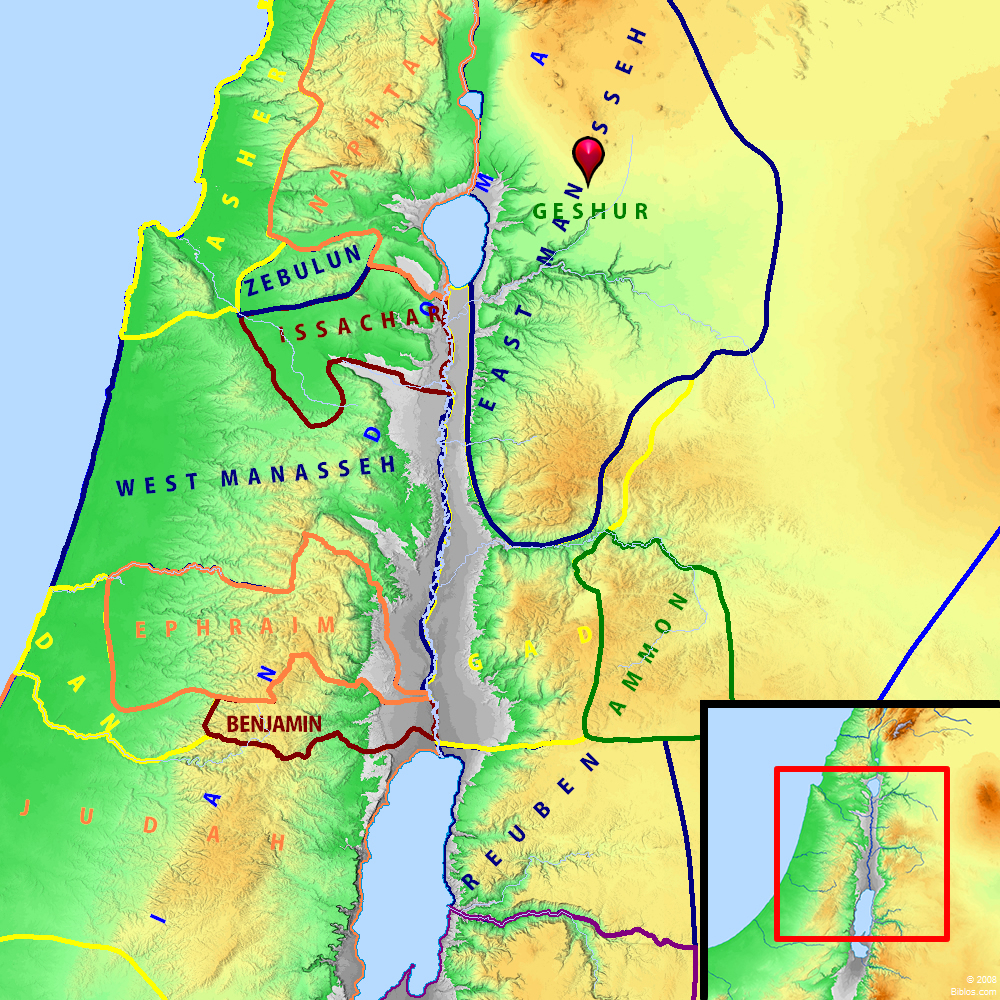
Geshur was a powerful nation holding a military advantage with what is now called the Golan Heights. This is such strategic high ground that in our day the United Nations maintains a peacekeeping force there.
When Absalom fled to Geshur to escape the legal consequences of murdering his brother, King David did not extradite him. Undoubtedly partly because of his love for Absalom, partly because of his own blood guilt over Uriah the Hittite, but very likely because of the geographical ability of Geshur to harbor their son and the high number of deaths that would cost to storm their stronghold.
Absalom’s arrogance in attempting a coup against his powerful father was undoubtedly underwritten by his powerful maternal kingdom’s conviction that aged David had proven himself too weak to defend his claim, or the surrounding nations that depended on his leadership to keep the peace, and that Absalom could win their support as he had done in an election with the men / movers and shakers of Israel.
So nation A making an alliance with nation B runs the risk of
- being absorbed into nation B
- rather than absorbing nation B.
Solomon’s alliances through marriage absolutely proves this.
“And all the earth sought to Solomon, to hear his wisdom, which God had put in his heart. And they brought every man his present [to forge a political alliance]…
king Solomon had seven hundred wives, princesses, and three hundred concubines, besides the daughter of Pharaoh…Of the nations concerning which the LORD said unto the children of Israel, Ye shall not go in to them, neither shall they come in unto you: for surely they will turn away your heart after their gods….and his wives turned away his heart….when Solomon was old…Solomon went after
- Ashtoreth the goddess of the Zidonians,
- Milcom the abomination of the Ammonites,
- Chemosh, the abomination of Moab
- Molech, the abomination of the children of Ammon
- And for all his strange wives, which burnt incense and sacrificed unto their gods.
thus saith the LORD, the God of Israel, Behold, I will rend the kingdom out of the hand of Solomon…(But he shall have one tribe for my servant David’s sake, and for Jerusalem’s sake, the city which I have chosen out of all the tribes of Israel:) Because that they have forsaken me, and have worshipped Ashtoreth the goddess of the Zidonians, Chemosh the god of the Moabites, and Milcom the god of the children of Ammon, and have not walked in my ways, to do that which is right in mine eyes, and to keep my statutes and my judgments, as did David his father.” (I Kings 11)
After David’s kingdom was split it naturally lost its power. The reunification of the kingdoms of Judah and Israel to reestablish the former power and glory of David’s empire became the primary game plan for both kingdoms.
[When] Isabella / Jezebel was announced to all the courts of Europe as the successor to the thrones of Castile and Leon…Isabella…turned her eyes to her kinsman, Ferdinand of Aragon.
The union of these two contiguous realms would indeed constitute a magnificent kingdom, homogeneous in language, manners, and religion.
Ahab, like David, began his kingdom’s expansion by forging an alliance with the powerful port city of Sidon. In Ahab’s case, his covenant included marriage to Eth-baal’s daughter Jezebel and included exchanging names. Without question, just like the king of Babylon bestowed new divinity affinities on the royal seed of Israel, the higher ranking king of Zidon followed the standard practice of publicizing the new Israelite ally’s new identity with the Canaanite gods through his new name.
The Urdu meaning of Ahab, which was picked up in Arabic, is Strong.
In terms of being made strong by the joining affinity with the Canaanite gods, this makes sense. And don’t forget the arcane strategy of pulling out recessive giant genes.
And as Ahab then turned his attention to expanding his reach into Judah, his primary strategy was to embed his own spawn into the royal Judean lineage.
King Jehoshaphat of Judah was open to a peaceful restoration of the entire nation of Israel, which had been attempted militarily but failed in skirmishes over the last 61 years since the secession from his great-grandfather Rehoboam, grandfather Abijah, and father Asa.
Think of it like the American southern Confederate States winning the Civil War under the superior General Robert E. Lee in 1885, and in 1946, facing the encroaching Nazi Empire, trying to woo the richer northern Leagues of States back under their way of doing things.
So Jehoshaphat also used the standard political alliance through marriage.
The following quoted passages are from II Kings 8-11 and II Chronicles 18-22.
- in the fifth year of J(eh)oram the son of Ahab king of Israel…
- J(eh)oram the son of Jehoshaphat king of Judah began to reign… and slew all his brethren with the sword, and divers also of the princes of Israel…And he walked in the way of…the house of Ahab: for [Athaliah] the daughter of Ahab was his wife:
- and Ahaziah his son reigned in his stead. His mother’s name…was Athaliah the daughter of Omri. He also walked in the ways of the house of Ahab: for his mother was his counsellor to do wickedly. Wherefore he did evil in the sight of the Lord like the house of Ahab: for they were his counsellors
- J(eh)oram the son of Jehoshaphat king of Judah began to reign… and slew all his brethren with the sword, and divers also of the princes of Israel…And he walked in the way of…the house of Ahab: for [Athaliah] the daughter of Ahab was his wife:
Recall that political and marriage alliances are made by a covenant accepting the oversight of each others’ gods. Regardless of Jehoshaphat’s good intentions to convert Israel back to YHVH, Judah is inexorably being pulled away from monotheism into the polytheism of Israel’s gods / baals.
One evidence of the absorption of Judah into Israel is that, since the marriage alliance with the introduction of the Canaanite bloodline into the seed of David, both Judah’s and Israel’s kings have the same names.
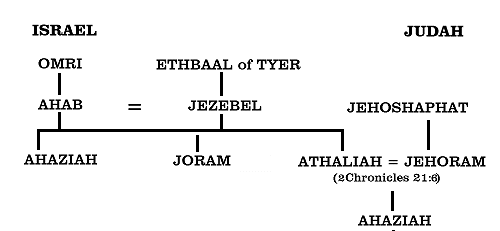
Ahaz-iah is definitely Hebrew, with iah = YHVH at the end, or at the beginning like Jeho-azah. This is more readily recognized as Ieho in the original 1611 KJV before the introduction of the letter J to the English alphabet.
Bear in mind that English spelling requires the addition of the letters for vowels, which are not present in Hebrew.
Vowels and consonants are sounds, not letters. Depending on your accent and how thinly you slice them, there are about 20 vowels and 24 consonants…A vowel is a speech sound made with your mouth fairly open, the nucleus of a spoken syllable. A consonant is a sound made with your mouth fairly closed.
There is no sound for V in ancient Hebrew with the lower lips vibrating against the upper teeth, only the w sound, only a sound made by the lips close but not fully closed while expelling air. YHVH is properly pronounced by opening the mouth to inhale a gasp of air, making a sound something like yah, then expelling the breath, making a sound something like wah. In other words, the first word spoken by ha Adam when God breathed into this new creation the breath of life.
So the difference between iah and ieho and YHVH when combined with other syllables at the same time is differentiated only by the shape of the mouth entering from a preceding syllable or exiting to a succeeding syllable.
Leaving Ahaz to define – Grasped. In other words – Strong.
The linguistic similarities between the Hebrew Ahaz and the Urdu/Arabic Ahab are unmistakeable, to the lips and tongue positions being barely open for z but closed for b.
The difference between the names
- Jeho-azah
- Ahaz-iah
is indicated by the position of Jeho / iah / YHVH. When in front he grasps / strengthens the person so named. When in back he is grasped / defeated by the person so named.
This interpretation is supported by the application of this attribute to a king of Israel who calls on YHVH.
“And the anger of the LORD / YHVH was kindled against Israel, and he delivered them into the hand of Hazael king of Syria, and into the hand of Benhadad the son of Hazael, all their days. And Jehoahaz besought the LORD / YHVH, and the LORD hearkened unto him…And the LORD / gave Israel a saviour / strengthened this king so that they went out from under the hand of the Syrians…Now the rest of the acts of Jehoahaz, and all that he did, and his might, are they not written in the book of the chronicles of the kings of Israel?” (II Kings 13:3-8)
- When Israelite Ahab / Strong by the pagan Sidonian gods with whom he politically covenanted
- named his son Ahaz-iah, he is unquestionably passing on his own name of Strong and at the same time specifically attributing to him the defeat of YHVH.
- So when Judean Jeho-ram, following through on the marriage covenant with Ahab,
- also names his son Ahaziah, he is absolutely bringing Judah into the pagan covenant.


 Kingdom Come