Jesus himself established that the criteria for entrance into God’s eternal kingdom is not calling on the Romanized name of Jesus Christ but by the way we treat his people.
“When the Son of man shall come in his glory, and all the holy angels with him, then shall he sit upon the throne of his glory: And before him shall be gathered all nations: and he shall separate them one from another, as a shepherd divideth his sheep from the goats: And he shall set the sheep on his right hand, but the goats on the left.
Then shall the King say unto them on his right hand, Come, ye blessed of my Father, inherit the kingdom prepared for you from the foundation of the world: For I was an hungred, and ye gave me meat: I was thirsty, and ye gave me drink: I was a stranger, and ye took me in: Naked, and ye clothed me: I was sick, and ye visited me: I was in prison, and ye came unto me. Then shall the righteous answer him, saying, Lord, when saw we thee an hungred, and fed thee? or thirsty, and gave thee drink? When saw we thee a stranger, and took thee in? or naked, and clothed thee? Or when saw we thee sick, or in prison, and came unto thee?
And the King shall answer and say unto them, Verily I say unto you, Inasmuch as ye have done it unto one of the least of these my brethren, ye have done it unto me.” (Matthew 25:31-40)
This concept is central to the Godfather saga, of which the first movie in the trilogy is considered by many critics to be the best movie of all time.
A crime drama, nonetheless (in a perverse way), Nothing is More Important Than Family. This hugely famous and popular story provides a parable of a sort, of God’s attitude about the respect and loyalty due to him and the children he created in his image and likeness.
When Godfather Don Vito Corleone denies drug baron Sollozzo’s request to invest in his narcotics business and provide protection through his political connections, Sollozzo has the Don gunned down in the street. The Don survives, and his son Michael risks his life to thwart another attempt on his father in the hospital, suffering a permanently disfiguring injury in the process.
Fredo’s lust of the flesh, lust of the eyes, and pride of life are his undoing as he retreats from his family’s fight for survival to enjoy a life of ease in the enemy’s camp.
Only Michael, Vito’s youngest son, conceives and succeeds in a plan to take vengeance and minimize further attacks on their father, because he is motivated solely by love for his father, even at the cost of his own life, and he is guided by his father’s ways and means of accomplishing his objectives, even in the absence of his father’s direct advice.
Near the close of his life the Godfather transmits all his wisdom to his son Michael, in a prediction of the future events that will be triggered when the family’s leadership is weak. Sure enough, at his death, a Corleone capo, sets in motion the betrayal that the Don had forewarned his successor, thereby preparing him to deal with it successfully. All goes as planned as, in one sudden unexpected day of judgment, Corleone soldiers:
- murder the other New York dons, breaking their power and emerging as the survivors of a long war
- murder Corleone partner Moe Greene in Las Vegas for disrespect and insubordination
- execute Tessio for treachery
- extract Carlo’s confession to setting up his brother-in-law Sonny’s murder and garrote him with a wire.
Although he does wait until after the death of their mother, Michael even executes his own brother Fredo for his disloyalty to their family.
Compare this well-known fictional American plot line to the little-known true-life Israelite plot line.
King Solomon, i.e. the Prince of Peace and the first son of David promised to perpetuate David’s Israelite dynasty, is a type of Jesus Christ, the penultimate son of David. He gives us a biblical sample of judgment day in which how someone shows respect for the king and his chosen heir by how he treats them determines one’s fate in the new kingdom.
“Now the days of David / Don Corleone drew nigh that he should die; and he charged Solomon / Michael his son, saying, I go the way of all the earth: be thou strong therefore, and shew thyself a man; And keep the charge of the LORD thy God…That the LORD may continue his word which he spake concerning me, saying, If thy children take heed to their way, to walk before me in truth with all their heart and with all their soul, there shall not fail thee (said he) a man on the throne of Israel.
- Moreover thou knowest also what Joab the son of Zeruiah did to me, and what he did to the two captains of the hosts of Israel, unto Abner the son of Ner, and unto Amasa the son of Jether, whom he slew, and shed the blood of war in peace, and put the blood of war upon his girdle that was about his loins, and in his shoes that were on his feet. Do therefore according to thy wisdom, and let not his hoar head go down to the grave in peace.
- But shew kindness unto the sons of Barzillai the Gileadite, and let them be of those that eat at thy table: for so they came to me when I fled because of Absalom thy brother.
- And, behold, thou hast with thee Shimei the son of Gera, a Benjamite of Bahurim, which cursed me with a grievous curse in the day when I went to Mahanaim: but he came down to meet me at Jordan, and I sware to him by the LORD, saying, I will not put thee to death with the sword. Now therefore [YOU] hold him not guiltless: for thou art a wise man, and knowest what thou oughtest to do unto him; but his hoar head bring thou down to the grave with blood.” (1 Kings 2)
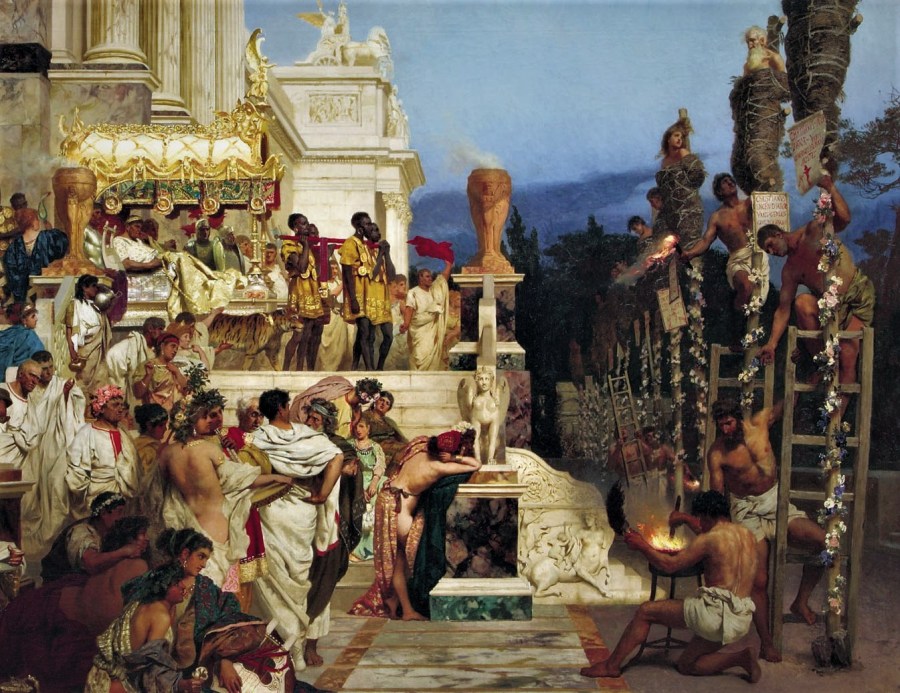
The early Gentile converts in the Roman Empire understood clearly all that was entailed in converting to a new religion.
The societies of the ancient world were theocratic… the ancient Mesopotamian kings were regarded as chosen servants and regents of the gods, and the Egyptian pharaohs were thought to be directly descended from the sun god…ruling it through them. In both Egypt and Mesopotamia, as well as among other ancient peoples, kings also…intermediaries between men and the gods.
Even the “republican” rulers of Rome had reverted to the old ways of becoming sons of the god Apollo.
“These words spake YHVH’s Savior, and lifted up his eyes to heaven, and said…
- I have glorified thee on the earth:
- I have finished the work which thou gavest me to do…
- have manifested thy name / attributes unto the men which thou gavest me out of the world…
- That they all may be one; as thou, Father, art in me, and I in thee, that they also may be one [family, nation, gens] in us:” (John 17)
Being One Family meant
- adoption into the God of Israel’s kingdom / nation / gens proven by
- submission to the new Father God which automatically
- removed them from their former inclusion in a Roman or heathen nation,
Believers in YHVH’s Savior could no longer bow down to or serve other gods or their designated drivers like Caesar.
The reverse condition is also true. The Israelites who
- rejected the God of Israel’s designated representative Priest-King
- were removed from their inclusion in the nation of Israel.
- “they are not all Israel, which are of Israel” (Romans 9:6)
- “God hath not cast away his people.” (Romans 11:1-2)
- “in Christ Jesus neither circumcision availeth any thing, nor uncircumcision, but a new creature. And as many as walk according to this rule, peace be on them, and mercy, and upon the Israel of God.” (Galatians 6:15-16)
- “this is the covenant that I will make with the house of Israel after those days, saith the Lord; I will put my laws into their mind, and write them in their hearts: and I will be to them a God, and they shall be to me a people:” (Hebrews 8:10)
Hopefully we citizens of humanistic democracies are beginning to understand that an accurate understanding and application of being a member of God’s theocratic kingdom has to start with understanding ancient ways.
Clans pose a challenge to state development in ways that are often difficult for Westerners to appreciate...throughout history, from medieval Iceland and Scotland to modern-day Libya and Yemen, where clans function as basic units of social organization, they claim to have the legitimate authority to administer justice for their members by using their own force.
Because religion is inevitably a fundamental identifier of a nation / clan.
…it was until quite recently fashionable among political scientists to believe that the religious factor had ceased to have much impact at all—whether in the direction of conflict or consensus—on the contemporary politics of the western democracies…If religion itself had not dissolved away in the cold light of Reason, as Enlightenment thinkers had once expected, it was surely much more marginal for the modern European with an essentially secular and materialist approach to life and politics. After 1945 in particular, the political agenda seemed to revolve almost entirely around the humdrum business of ‘who gets what, when, how’…
In the 1960’s, however…a number of studies led political scientists to re-examine the orthodox assumptions about the secularity and materialism of politics in the liberal democracies…a seminal survey of…the characteristic structures of western party systems…showed that not only had religion…been of prime importance in the foundation of the European party systems in the late nineteenth century…but that the effects of this impact had been extended into the most recent period…
these claims were not of course incompatible with the deeply rooted assumption that the religious factor was in some way archaic—a survival from some earlier era…the outcome of events as distant as the Reformation and the French Revolution…however…examination of the social bases of political parties led…to the surprising conclusion that…’religious divisions, not class, are the main social basis for parties in the Western world today.’..since then a number of publications have been concerned with the question of assessing and accounting for the strenth of the religious factor in the politics of the liberal democracies….
the impact of religion could in fact increase as ‘political Christians’ engage themselves for and against the ‘new politics’ of peace, environmental, development and other issues.
In Libya, Moammar Gadhafi put clan loyalty at the heart of his revolutionary ideology, seeking to forge a stateless state, guarded by his leadership but organized around decentralized local institutions and clans, which he viewed as the natural basis of the social order.
As did Jesus when he forged his New Testament church.
In Yemen, the Saleh regime’s highest priority has been to buy at any price the loyalty of the more powerful clans.
In the Palestinian Authority, Yasser Arafat implemented a series of policies in the wake of the Oslo Accords that took power away from the university-educated leaders of the first intifada and strengthened the power of clan elders, which he could control directly through patronage.
As did Jesus Christ in the wake of the new covenant, where the nation that lost power is not the entire group of Israelites, but the rulers of the tribe of Judah and the new nation / clan is the group that identifies with him and he empowers with his Spirit, the Christ-ians.
When during the second intifada Israel destroyed numerous local government institutions, such as police stations and courts, the clans Arafat had strengthened rushed to fill the vacuum.
As did churches after 9/11. This should be the biblical response to men’s hearts failing for fear.
These cases are part of a more general dynamic, which varies in intensity throughout the region. The 2004 Arab Human Development Report calls it “clannism.”
How can modern democracies be built in the face of push-back from clans?…in addition to encouraging trade and economic development
America’s economic dependence on Consumerism is contrary to biblical “Love not the world, neither the things that are in the world. If any man love the world, the love of the Father is not in him. For all that is in the world, the lust of the flesh, and the lust of the eyes, and the pride of life, is not of the Father, but is of the world.” (I John 2:15-16)]
the United States should do what it can to help reformers in the region strengthen the identity and power of the intellectual and professional classes, among whom personal identity is most powerfully peeled away from the social core of kinship.
This may explain why Paul notes that:
“ye see your calling, brethren, how that not many wise men after the flesh, not many mighty, not many noble, are called: But God hath chosen the foolish things of the world to confound the wise; and God hath chosen the weak things of the world to confound the things which are mighty;” (I Corinthians 1:26-27)


 Kingdom Come