Mortal females are essential to any hybridization program because an egg cell uniquely equipped for the single function of generating a new individual. Recent scientific experience with cloning has taught us that only the egg cell is programmed to accept and process DNA that is different from its own.

Additionally, only the egg cell maintains possession of mitochondria, the power generators essential for energizing the division of the single cell into billions of newly differentiated and incredibly organized cells. Sperm cells’ mitochondria are in the tail to provide mobility, and are discarded at the end of the ride once the fuselage delivers the chromosomes to the egg.
Only a mortal female’s egg cell is capable of accepting a single microscopic cell into her uterus that through a process involving constant turnover of cells, i.e. death and regeneration, develop into billions of different, highly specialized cells coordinated to work together seamlessly in a new organism.

This is one reason why Messiah is called “the seed of the woman.” Women are essential for the natality that makes new beginnings possible.
This scientific background validates the Genesis account and all its supporting records of angel/human hybridization.
- Ancient legends around the world
- Ancient pagan religious practices like hieros gamos – sexual intercourse between a divine being and a human. While this was – and is – thought to be exploited by humans for their own benefit, it is more credible to track this practice back to a time when it was a reality for the gods’ benefit.
- Paleontology
- Archeology
-
Gobekli Tepe just north of the landing site of the fallen angels on Mount Hermon in Lebanon and one of Cain’s first settlements contains the oldest depiction of a woman giving birth.
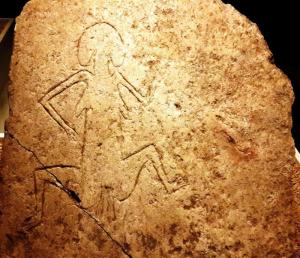
The oldest idol of a mother “goddess”, so defined because she gave birth to a “god”, was unearthed in Gobekli Tepe’s neighboring residential area of Catalhoyuk. Texts dating from 1500-1190 BCE found in the royal archives of the ancient Hittite Capital of Hattusha name KUBABA and depict her, like the Catalhoyuk Mother Goddess and the first Semiramis in Babylon, sitting on a throne under which reclines a lion.
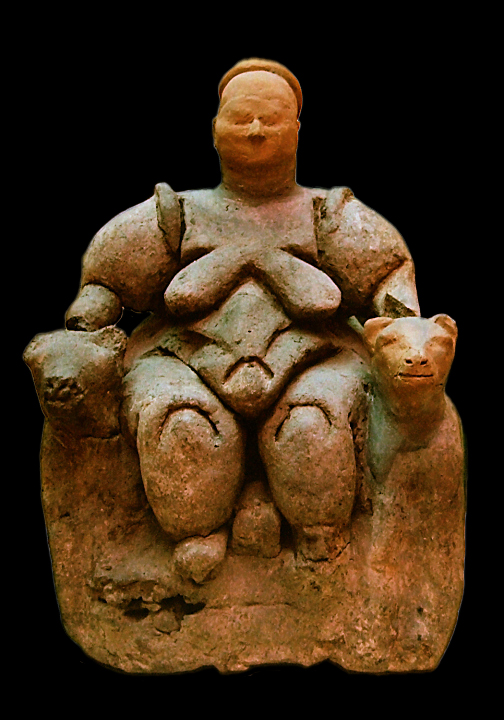
Multiple figurines unearthed at other ancient settlements in Anatolia indicate a female-oriented fertility cult.

Interesting that these figurines show the cone heads associated with divinity.
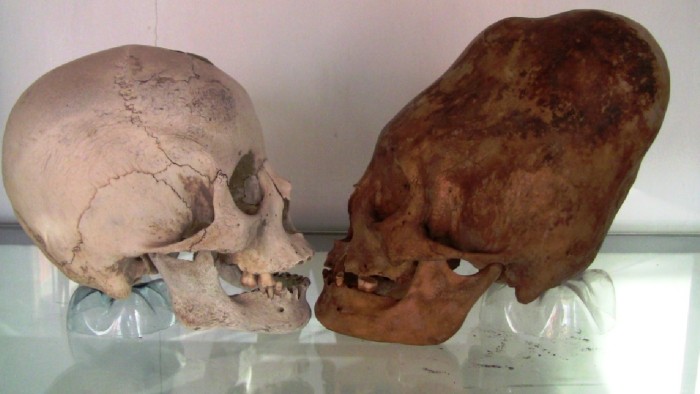
The earliest suggested examples are Neanderthals and the Proto-Neolithic Homo sapiens from Shanidar Cave in Iraq. Research by Chech, Grove, Thorne, and Trinkaus concluded: “artificial cranial deformation cannot be inferred for the specimen”.
In other words, these elongated skulls were formed naturally from birth.
In 1928 Peruvian archaeologist, Julio Tello discovered a massive and elaborate graveyard containing tombs filled with the remains of individuals with the largest elongated skulls found anywhere in the world.
These have come to be known as the ‘ Paracas skulls ’. In total, Tello found more than 300 of these elongated skulls, some of which date back around 3,000 years. (Always bear in mind that humanist disciplines avoid biblical validation whenever possible, especially with highly unreliable dates.)
In the Paracas skulls, the position and size of the foramen magnum is completely different than a normal human being. This is not cradle headboard, this is genetic.
Other genetic indicators in some of the Paracas skulls are a very pronounced zygomatic arch (cheekbone), different eye sockets and, most significantly, no sagittal suture.
In a normal human skull, there should be a suture which goes from the frontal plate … clear over the dome of the skull separating the parietal plates – the two separate plates – and connecting with the occipital plate in the rear.
Samples of hair and bone powder were taken from three of the Paracas elongated skulls, including one infant, plus a sample from a Peruvian skull that had been in the US for 75 years.
One of the four hair samples couldn’t be sequenced, the remaining three hair samples all showed a male Haplogroup found in Europe, while the bone powder from the most elongated skull tested came back as originating in what is now Syria. This can be aligned with the “most elongated” being the oldest specimen at the beginning of history, with migration westward to Europe accounting for elapsed time with corresponding diminished angelic genetic expression.
Unlike the male DNA, no female specific DNA was extracted from the nucleus, the control center found in every type of cell controlling the entire body. Only the DNA found in the mitochondria, the energy-producing machinery found in every cell, was found.
After the collapse of the Hittite Empire c. 1200 BC the Phrygians established a kingdom in Central Anatolia, transforming Kubaba into the Phrygian Cybele [hard “C” like Kibbles].
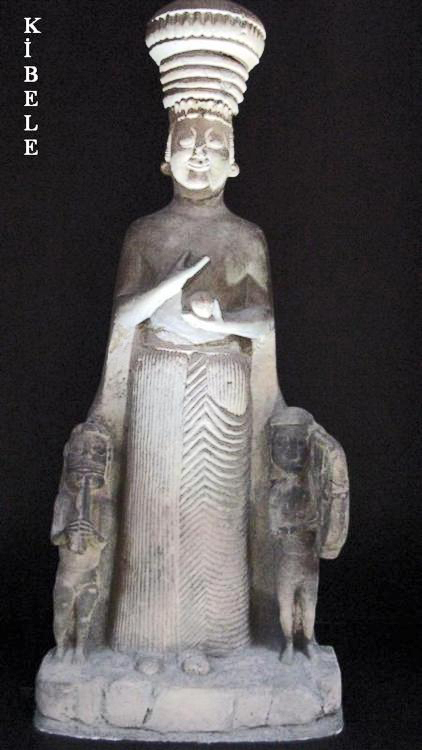
Note the headdress either mimicking or disguising the lack of a cone head.
Cybele’s cult worship screams out how her followers opened themselves to spirit possession by ecstatic / drugged all night orgies with music, especially drumming, dancing, singing, and shouting.
There is strong evidence that the Hittite Kubaba and Phrygian Cybele is the same goddess as Hekate of Caria, on the western coast of Anatolia by another language and modified culture.
Hesiod’s Greek Theogony in the 8th century BC describes Hekate (pronounced He-ka-tee of Caria as a goddess of great honour with domains in sky, earth, and sea, consistent with the three elements of human, spirit gods, and hybrids. As such she was portrayed as three figures.
And again, this goddess was subsequently culturally modified.
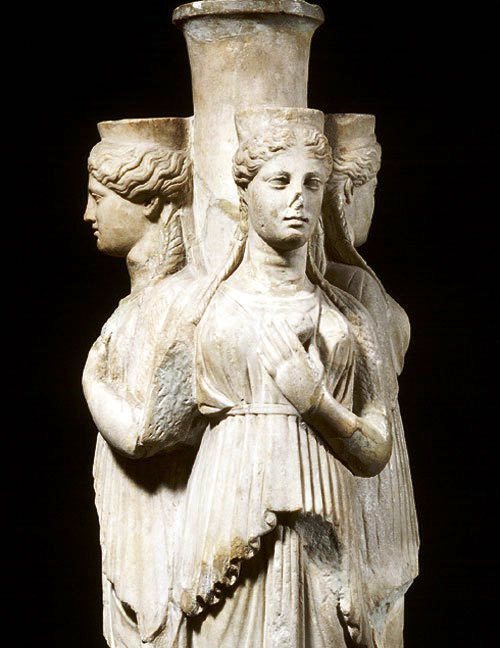
ARTEMIS ELEUTHERA of Troy
Homer’s Iliad on the Trojan War refers to Apollo’s twin sister, Artemis, as the mother-goddess of the Anatolian coastal region of Lycia – part of the Trojan confederacy – and the protector goddess of its primary city of Myra. “Eleuthera” means “freedom”, by which we can justifiably infer “liberation”, as in an early women’s lib movement, clearly sexual vs domestic.
ARTEMIS / DIANA of Greece’s colony at Ephesus
In the 10th century BC a city on the coast of what is now Turkey was seized and renamed Ephesus by Greek colonists. In its day Ephesus was famous for the nearby Temple of Artemis (completed around 550 BC), even today designated one of the Seven Wonders of the Ancient World.[8] Test holes have confirmed that the site of her temple in Ephesus was occupied as early as the Bronze Age its goddess was venerated in an archaic style consistent with Cybele. Shrines and venerated objects found in her temple demonstrate her continuity with classical mother goddesses.
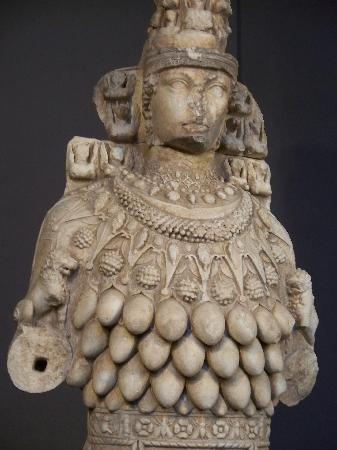
“A certain man named Demetrius, a silversmith…called together with the workmen of like occupation, and said, Sirs,…ye see and hear, that not alone at Ephesus, but almost throughout all Asia, this Paul hath persuaded and turned away much people, saying that they be no gods, which are made with hands: So that not only this our craft is in danger to be set at nought; but also that the temple of the great goddess Diana should be despised, and her magnificence should be destroyed, whom all Asia [Minor / Anatolia] and the world worshippeth.” (Acts 19:24-28)
About two hundred years later, after suffering much persecution for such intolerant monotheism, Christians were overjoyed when Emperor Constantine legitimized Christianity. He went so far as to replaced paganism-suffused Rome in Italy with a newly built Christian capitol in Asia. A generation later in 380 Emperor Theodosius / God’s Gift made monotheistic Christianity the official state religion.
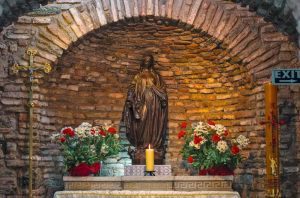
Worship of the Christian Virgin Mary became prominent in Ephesus, and continues to this day.


 Kingdom Come