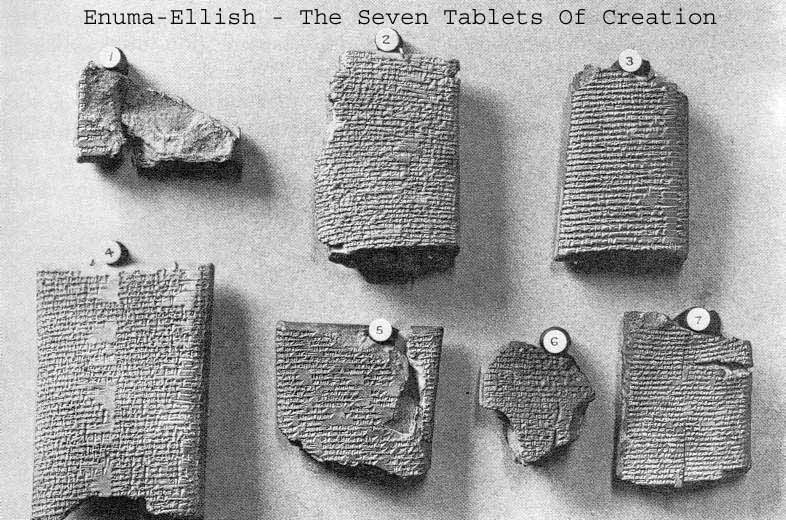
Dating back to at least 2900 BC, Sumerian is a language isolate, meaning it has no demonstrable relationship with any other languages. Because Sumerian is already so complex at this stage of “human evolution”, Assyriologists such as Samuel Noah Kramer, famous for his life’s work of deciphering cuneiform tablets, believe that the earliest language of civilization during the Ubaid period, biblically during Adam’s lifetime, has never been uncovered.
The obvious explanation is that the humanists refuse to accept the ancient origin of the Torah because of its focus on YHVH.
“Now, my son Mathusala, all these things I speak unto thee, and write for thee. To thee I have revealed all, and have given thee books of everything. Preserve, my son Mathusala, the books written by thy father; that thou mayest transmit them to future generations.” (Enoch 81)
“Oh that my words were now written! oh that they were…graven with an iron pen and lead in the rock for ever! For I know that my redeemer liveth, and that he shall stand at the latter day upon the earth…And though after my skin worms destroy this body, yet in my flesh shall I see God:” (Job 19:23-65)
How did Job, who lived after the flood but before Moses compiled what we know as the book of Genesis, know of YHVH’s promise of the Seed of the Woman who would redeem mankind and bring about resurrection of the body to reverse the curse of death? Why is he contrasting his spoken words with those that are “graven with an iron pen and lead in the rock”?
Because he is referencing the word of God, written in stone that endures forever so it is available to all humanity forever!
The Enuma Elish, the Sumerian creation tablets, parallel the Torah’s creation account to such an extent that any objective investigator would acknowledge their origination in the same time period.
For the Sumerians, their Tablet(s) of Destiny(ies) embodied the ultimate power and control over all that was, is, and will be. Only a select few, the high priests and chosen oracles, possessed the knowledge and divine favor to interpret the cryptic symbols and pronouncements etched on the tablets. The belief that the gods could control the fate of individuals and nations instilled a deep fear of the consequences of defying the will of the gods as reported by their human priest-kings.
Marduk’s heavily designed overcoat and hat reproduces the motifs of the Tablet of Destinies, worn on as a breastplate.  This is clearly the equivalent of the Israelite High Priest’s Breastplate of Righteousness and ephod of judgment,
“And thou shalt make the breastplate of judgment with cunning work...And thou shalt put in the breastplate of judgment
the judgment of the children of Israel upon his heart before the LORD continually.” (Exodus 28:15-30)
We can think of the Urim and Thumim as a binary computer code, through which the decision of the hyper dimensional divinity was conveyed to his four dimensional mediator and thence to the masses.
Yes or no? Right or wrong? In terms of criminal justice, this is more like Guilty or Innocent?
’Ur-îm אוּרִים֙ is the plural of ur / אוּרִ, as in the city Ur אוּר of the Chaldees, world famous – undoubtedly named – for its flames – the fiery furnace, carried down through the centuries. Jasher’s account of the Hebrew Abram being judged by Nimrod’s court matches the Babylonian sentencing of the three Hebrews for the transgression of “having despised our gods, he must therefore be burned to death, for this is the law in this matter.“
The exact same word also translates as “the fire(s)” in a sacred context in Isaiah’s prophecies of judgment.
“Turn ye unto him / the LORD from whom the children of Israel have deeply revolted…. WHOSE fire is in Zion, and HIS furnace in Jerusalem.” (Isaiah 31)
T(h)umm-im / tamim translates as “blameless” or “perfect”, In Semitic languages such as Arabic this is still used commonly as a name.
“Noah was a just man and perfect / tamim in his generations, and Noah walked with God.” (Genesis 6:9)
As we read the following psalms, we’d be wrong to assume that David came up with this imagery all on his own for the first time. Check it out in a concordance for yourself.
This sounds like something Noah or Shem wrote down for posterity.
“The LORD / YHVH is my rock…The sorrows of death compassed me, and the floods of ungodly men made me afraid…In my distress I called upon the LORD / Creator and cried unto my God / Power: he heard my voice out of his temple…
Then the earth shook and trembled; the foundations also of the hills moved and were shaken [tectonic activity]...Then the channels of waters were seen, and the foundations of the world [volcanoes and earthquakes]…he took me, he drew me out of many waters…The LORD rewarded me according to my righteousness…I have not wickedly departed from my God…blessed be MY rock; and let the God of my salvation be exalted…Great deliverance giveth he to his king; and sheweth mercy to his anointed [Melchizedek Priest-King].” (Psalm 18)
“Who is God / El / Power, save the LORD / Who [among the gods] is a rock / enduring among inferior substances like baked clay, save our God?…
- Strangers [in context, strange gods] shall fade away…
- [But] The LORD liveth [i.e., is forever!];
- and blessed be my rock;
- and exalted be the God of the rock of my salvation.” (II Samuel 22:32, 46-47)
~ 2600 – ~ 2181 BCE: Egypt’s Old Kingdom spans the Flood
The Pyramid Texts, the earliest known corpus (academic for “literary body”) of ancient Egyptian religious texts, were carved onto the subterranean walls and sarcophagi of pyramids at Saqqara. The oldest of the texts have been dated to c. 2400–2300 BC., the era immediately preceding Noah’s Flood. Consistent with the Hebrew scriptures report of this era, anthropologists also date Classical Sumerian cuneiform texts, reflecting the fallen angels’ reign on earth, as ending at this same time.