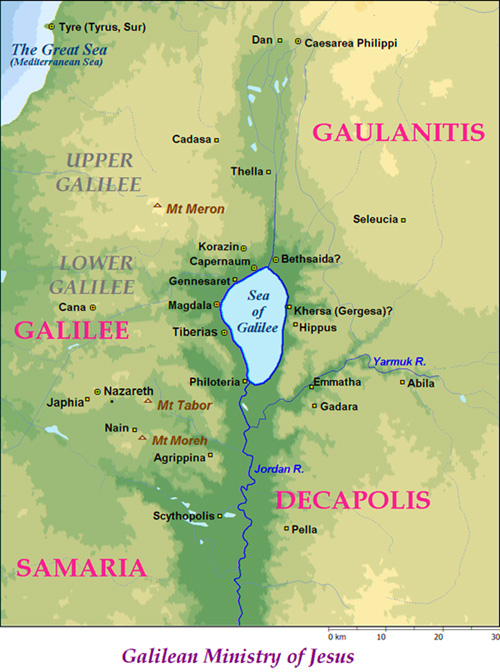
“the king of Assyria brought men from [various conquered nations therefore various gods]…and placed them in the cities of Samaria instead of the children of Israel…
Then one of the priests whom they had carried away from Samaria came and dwelt in Bethel, and taught them how they should fear the LORD. So they feared the LORD…AND..made gods of their own, and put them in the houses of the high places which the Samaritans had made…
Unto this day they do after the former manners…neither do …after the law and commandment which the LORD commanded the children of Jacob, whom he named Israel;” (II Kings 17:20-32)
The Jews avoided the Samaritans like the plague, but Jesus didn’t. His treatment of sinners is remarkable for being the complete opposite of contemporary Christianity which rails against behavior that the unregenerate people have absolutely have no spiritual ability to take control over, and excuses leaders whose sin they – supposedly – have the spiritual power to resist.
“[Jesus] left Judaea, and departed again into Galilee [of the Gentiles] – aha! There’s a clue!]. And he must needs go through Samaria…There cometh a woman of Samaria to draw water: Jesus saith unto her, Give me to drink.
- the woman of Samaria unto him, How is it that thou, being a Jew, askest drink of me, which am a woman of Samaria? for the Jews have no dealings with the Samaritans.
- Jesus answered and said unto her, If thou knewest the gift of God [versus the self-assigned prerogatives of the Jews]
- and who it is that saith to thee, Give me to drink;
- thou wouldest have [known to have] asked of him, and he would have given thee living water…
- The woman [still, reasonably so, distrustful and truculent] saith unto him, Our fathers worshipped in this mountain; and / but ye [Jews] say, that in Jerusalem is the place where men ought to worship.
This Samaritan woman’s attitude is assuredly defensive, so probably hostile, but at least she’s engaging with Jesus, not just throwing him a finger which she was assuredly in the habit of doing to men who jeered at her and made lewd gestures and called out provocations as she walked through town.
There was a reason she was alone at the well, an worn-out woman still doing the back-breaking manual labor of hauling up water in stone jars all by herself. She had “had five husbands; and he whom thou now hast is  not thy husband:”, undoubtedly some abusive drunk who allowed her, at a minimum, the barest basic protection of a locked enclosure at night, even if it was with the pigs.
If you’re a Game of Thrones fan, her parallel is Reek sleeping in the dog cage.
In response, Jesus doesn’t rehash who did what and who is right and who is wrong. He stays on point, in the moment.
-
- Jesus saith unto her, Woman,
I am 100% not being sacrilegious when I insist that what this woman who was despised and rejected of men heard in the totality of verbiage, rhythm, rate, prosody and cadence when this gentle man with the kindest eyes she had ever looked into called her “Woman” can only be expressed through Peter and Gordon’s love song “Woman”.
She was used to being called “Bitch!, Slut!, Whore!” but not “Woman, Wife, even My lady“.
If you can’t figure out this transactional analysis from this perspective then you’ve never been in her sandals, beaten down physically, emotionally, sexually and socially for years.
I promise you, this one word took her breath away.
-
- “believe ME – Not those arrogant men who abuse you in every way! Believe ME!!“
- the hour cometh, when ye shall neither in this mountain, nor yet at Jerusalem, worship the Father…
- and now is!!, when the true worshippers shall worship the Father in spirit and in truth: for the Father seeketh such to worship him. Like you! Desperate, appreciative, grateful!!
- God is a Spirit: and they that worship him must worship him in spirit and in truth. Not in the proper clothes and social setting!!
- The woman [voice choked with struggling to hold back sobs of upwelling suppressed emotion] saith unto him, I know [intellectually] that Messias cometh, which is called Christ: when he is come, he will tell us all [these] things. [Unspoken question – Are you? Messias?]
- Jesus saith unto her, [Yes] I that speak unto thee am he.
Why on earth should she believe this man’s grandiose, possibly psychotic, or at the least game-playing claim to be The Messiah, out of the many claimants at the time?
And not only her, “many of the Samaritans of that city believed on him.”
Why?
“for the saying of the woman, which testified, He told me all that ever I did.
And her life consisted of sins after sins after sins!!
But this righteous man didn’t condemn her. He gave her a way out.
So when the Samaritans were come unto him, they besought him that he would tarry with them: and he abode there two days. And many more believed because of his own word; And said unto the woman, Now we believe, not because of thy saying: for we have heard him ourselves, and know that this is indeed the Christ, the Saviour of the world.”
They understood that the Christ would save them from their sins!
The woman from her fornications and the men from their abuses of power over women and children and minorities and all vulnerable persons in their community.
He wasn’t promising to save them from the Roman overlords and their taxes, which is what the other messiahs were preaching.
And Jesus convinced this lowest of the low persons in that rural backwater town that he WAS there to save her from her sins when he GAVE that woman FORGIVENESS ON THE SPOT.
Not in some future judgment day. In the moment – forgiveness as paying the price for her isolation from society
- by associating with her,
- by bringing himself to a position even lower than hers by asking her to meet HIS need,
- by elevating her to the highest position possible in his milieu by continuing to make her the center of his attention when his royal court returned to wait on his every command.
“And upon this came his disciples, and marveled that he talked with the woman [treated her as a social / spiritual equal]: yet no man [interrupted him or] said, What seekest thou? or, Why talkest thou with her?” (John 4)
Because they didn’t want to bring down Jesus’ condemnation on their heads as they had seen happen in other like cases.
“a woman in the city, which was a sinner, when she knew that Jesus sat at meat in the Pharisee’s house, brought an alabaster box of ointment, And stood at his feet behind him weeping, and began to wash his feet with tears, and did wipe them with the hairs of her head, and kissed his feet, and anointed them with the ointment.
Now when the Pharisee which had bidden him saw it, he spake within himself, saying, This man, if he were a prophet, would have known…she is a sinner. And Jesus answering [undoubtedly responding to the look of disgust on his face] said unto him…There was a certain creditor which had two debtors: the one owed five hundred pence, and the other fifty. And when they had nothing to pay, he frankly forgave them both. Tell me therefore, which of them will love him most? Simon answered and said, I suppose that he, to whom he forgave most. And he said unto him, Thou hast rightly judged…Her sins, which are many, are forgiven; for she loved much: but to whom little is forgiven, the same loveth little. And he said unto her, Thy sins are forgiven.
And they that sat at meat with him began to say within themselves, Who is this that forgiveth sins also? And he said to the woman, Thy faith [in me as Messiah per scripture] hath saved thee; go in peace.” (Luke 7:36-50)