Islamic history, particularly during the time of the Prophet Muhammad (PBUH) and the early Caliphates, is characterized by a series of military conflicts. These wars were not merely about territorial conquest but also about preserving faith, promoting justice, and protecting the nascent Muslim community from external threats.
After the death of Prophet Muhammad (PBUH) in 632 CE, Islam expanded territorially using its militant army and proxies with extraordinary speed, forging a political empire from Spain to India within a century.
Religious conversions among conquered populations unfolded gradually—over centuries—through incentives. Arabic became the language of governance, commerce, law, and study (scholarship), displacing local languages and literary traditions. As Muslim communities grew, intermarriage, business partnerships, friendships, and social acceptance all flowed more easily through Muslim networks, while non-Muslim communities became progressively isolated therefore disadvantaged.
Sociologically, we must recognize that Christianity could have followed the same pathway to dominance. It just didn’t.
Most of all, Islam treats Christianity as pagan, which it is.
Therefore an evil to be vanquished exactly as Moses was commanded by YHVH to wipe out the evil infesting the land promised to the people of YHVH.
- The formalization of the Trinity heavily mirrors ancient polytheistic triads. a framework that slowly integrated into early Church theology during the Roman period. Islam categorically rejects the division of the divine. You can explore more on whether do Christianity and Islam believe in the same God to understand the fundamental differences in theology.
- The Roman Empire strategically merged pagan festivals with Christian observances. The celebration of December 25th originally honored the winter solstice and the Unconquered Sun before the Church designated it as the birth of Jesus.
- As polytheistic populations converted, they often transferred their devotion from regional gods to Christian martyrs, maintaining the practice of praying to intermediaries.
- The concept of a dying and rising divine figure existed long before Jesus Christ, featuring prominently in the widespread ancient cults of Mithras and Osiris. As the Christianity spread through the Roman Empire, missionaries integrated these familiar mythological motifs to make the new religion acceptable to pagan audiences.
- Imperial authorities rededicated polytheistic shrines to Christian saints, maintaining the geographic centers of ancient idol worship. The Pan-theon – note, still called this – in Rome transitioned directly from a massive temple honoring All-gods to a church dedicated to Mary and the martyrs. Islam views the physical and spiritual purification of worship as absolutely essential. A deep dive into is Jesus the Messiah in the Quran reveals how the final Islamic revelation purified his legacy from these imperial Roman adaptations.
The Roman concept of religion had never been that of an exclusive obligatory moral loyalty to an unseen and highly spiritual Being. Instead, a good relationship between man and the gods was based on good citizenship within the theocratic government. The Christian theology of war developed from naturally from its link to Roman citizenship.
In 1095 the Roman government joined with the Church to whip up support for participants in the First Crusade – a joint military-religious pilgrimage to retake Jerusalem from the Muslims. The Church continued to sanction geo-political Crusades in the West, such as against the Moors in the Iberian Peninsula–the Reconquista–which ended in 1492 with the consolidation of the nation of Spain under Isabella and Ferdinand, following with Spain’s military takeover of the lands of the New World with the enslavement or extermination of native populations.
Left unchecked, Rome’s version of Christianity would have destroyed the world.
Enter what is, from a biblical perspective, one of many sitings of the Assyrian Rod of Judgment.
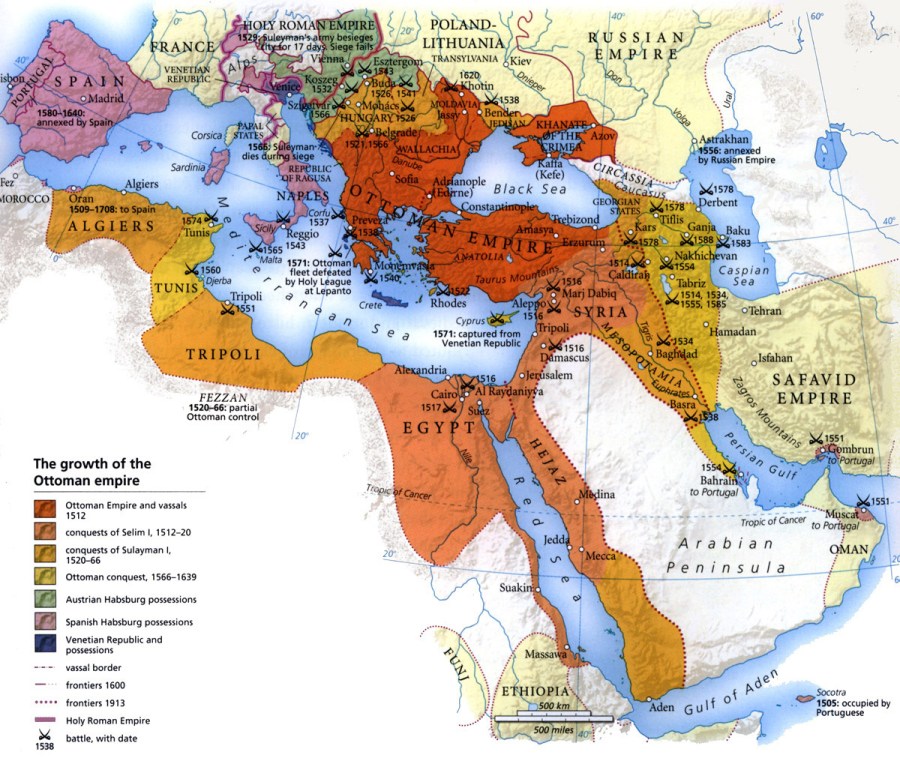
In 1299 the Turkoman tribal leader Osman I, founded what became the Ottoman Empire, historically also known as the Turkish Empire based in northwestern Anatolia, modern Turkey, and ruling the Islamic nations. After taking over the eastern branch of the Roman, AKA the Byzantine Empire with the conquest of Constantinople in 1453, and West Asia, the empire continued to expand into the Mediterranean / Western territories of the Roman empire, becoming a transcontinental empire that spanned much of Southeast Europe, and North Africa and controlling parts of southeastern Central Europe.
If we take Daniel’s prophecy at face value, the continued existence of the two legs of the fourth as the Western Civilization’s empire can be tracked throughout history despite name, location, and culture changes.
In 1806, Emperor Francis II submitted to Emperor Napoleon of France who declared “I am a true Roman Emperor; I am of the best race of the Caesars.” 1812.
The 2nd German Reich followed Napoleon’s defeat at Waterloo by the combined forces of the British and Prussian armies, beginning in 1871 with the unification of Germany under the Prussian Chanceloor, Otto von Bismarck. The Second Reich was marked by a strong military national identity, culminating in WWI, during which Germany allied with the Ottoman Empire to provide Germany with safe passage into the neighbouring British colonies.
After the fall of the Ottoman Empire in World War I back to the Western Powers, French diplomat François Georges-Picot and British diplomat Mark Sykes secretly agreed on its division into French and British zones of influence in the Sykes-Picot Agreement of 1916. These divisions were based on rationing natural resources between the two European powers with a complete disregard for the mix of diverse – and separated populations – guaranteeing unresolved conflicts to this day.
From 1820 until its collapse during WWII, the British Empire dominated the Middle East. Britain’s initial interest in the Gulf region was driven by its stake in the British East India Company (EIC) – one of the largest and most powerful commercial entities to have ever existed. To protect its trade routes, the EIC developed from simply economic domination to political rule in collaboration with local leaders, enforced by its own standing army and navy. Throughout the nineteenth century the British signed a number of bilateral treaties with rulers of individual Arab sheikhdoms.
After the fall of the Ottoman Empire in World War I, French diplomat François Georges-Picot and British diplomat Mark Sykes secretly agreed on its division into French and British zones of influencein the Sykes-Picot Agreement of 1916. These divisions were based on rationing natural resources between the two European powers with a complete disregard for the mix of diverse – and separated populations – guaranteeing unresolved conflicts to this day.
In January 2020 when Iraq voted to ask the U.S. and its coalition members to withdraw all of their troops from the country, U.S. President Donald Trump initially refused to withdraw, but finally began withdrawing March 2020.
Today it’s the American Commander in Chief who is the “Defender of the Christian Faith. Former American President George W. Bush referred to the “crusades” to describe his “war against terrorism”,