This post picks up from the post The Trojan War.
Aeneas, a prince of the citadel of Troy in Asia Minor, designated a hero, i.e. a hybrid carrying the genes of a pre-flood demigod, and possessed by a god’s spirit, rightly traced through a female goddess. Aphrodite / Venus is the same as the Sumerian Inanna, carried through the flood by Noah’s wife and daughters-in-law, After Troy was destroyed, Aeneas, now a refugee, traveled into the frontiers of civilization seeking a new homeland, ending up in what became Italy.
~ 753 BC –Rhea, daughter of a rustic king, being royalty is undoubtedly a hybrid herself, is impregnated by a hybrid carrier of the spirit of the god of war, Assyrian Asshur / Roman Mars and gives birth to the twins Romulus and Remus.
~ 750 BC – After killing his rival brother, Romulus founds his eponymous capitol city of Rome. In what was a common practice at that time, he expanded his tribe by the Rape of the Sabine Women.
~ 509 BC – overthrow of the autocratic Roman kings by the early res publica: rule by representatives chosen by citizens entitled to vote.
~ 450 BC – Fulfilling the Daniel’s view of the last beast with 10 horns overriding individual freedom, the Decemviri / Commission of 10 men prepared 10 tables of law based on Athenian law, which established the foundation for all subsequent Roman / European law up to current times,
~ 168 BC the Roman army begins its 600-year struggle for world domination by first absorbing the Greek islands, then the headland of Anatolia/ modern Turkey.
64 BC Republican Rome ended from Julius Caesar’s determination to ride his military achievements into kingship. His military and political partner, Pompey, considered by historians to be a military genius, opposed Caesar’s ambitions, certainly because he had his own, and civil war exploded into world war across the Roman Empire’s entire extent in Italy, Illyria, Greece, Egypt, Africa, Hispania, modern Albania, but when Caesar won the Battle of Pharsalus in Greece was won by Caesar, Pompey’s army disintegrated, Pompey fled to Egypt, where he was assassinated upon arrival.
But not before Pompey incorporated Babylon as the eastern-most boundary of the Roman Empire.
Caesar, now the victor, moved on from Greece to Asia Minor / Turkey before attacking North Africa, where he defeated another adversary Metellus Scipio which prompted Cato the Younger and Metellus Scipio to commit suicide shortly after Caesar’s victory. In the following year, Caesar defeated the last of Pompey’s army in Spain.
With no-one willing to argue the point, Caesar was then made dictator perpetuo / dictator for life”) by the Senate in 44 BC. Despite being assassinated by the opposition shortly thereafter, Rome’s republican government was finished.
Caesar’s grand-nephew and adopted son and heir Octavian teams up with Caesar’s military general Marc Antony, strategizing to complete his transformation of the chaotic and ineffectual Republic into an efficient and powerful Dictatorship, split the over-extended empire into West ruled by Octavian and East ruled by Marc Antony.
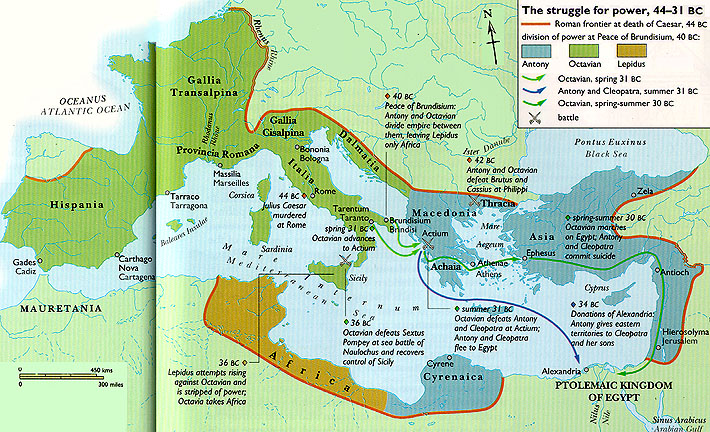
27 BC After 14 years of world war by these two rival staff claimants Caesar’s Chosen Heir Octavian wins the contest and is duly elected to the offices of consul and censor and granted permanent privileges as princeps senatus (leader of the Senate) and the religious office of pontifex maximus (chief priest), and takes “Imperator!” / Victorious General as a permanent part of his formal name, which transmogrified into “emperor”.
Next Octavian took on a plethora of titles which collectively allowed Octavian an extraordinary concentration of what had been separate powers and offices in the Republic. The most interesting was the title of Augustus / godly, bestowed by a vote of the Senate, and after his death he was in fact included in the Roman pantheon.
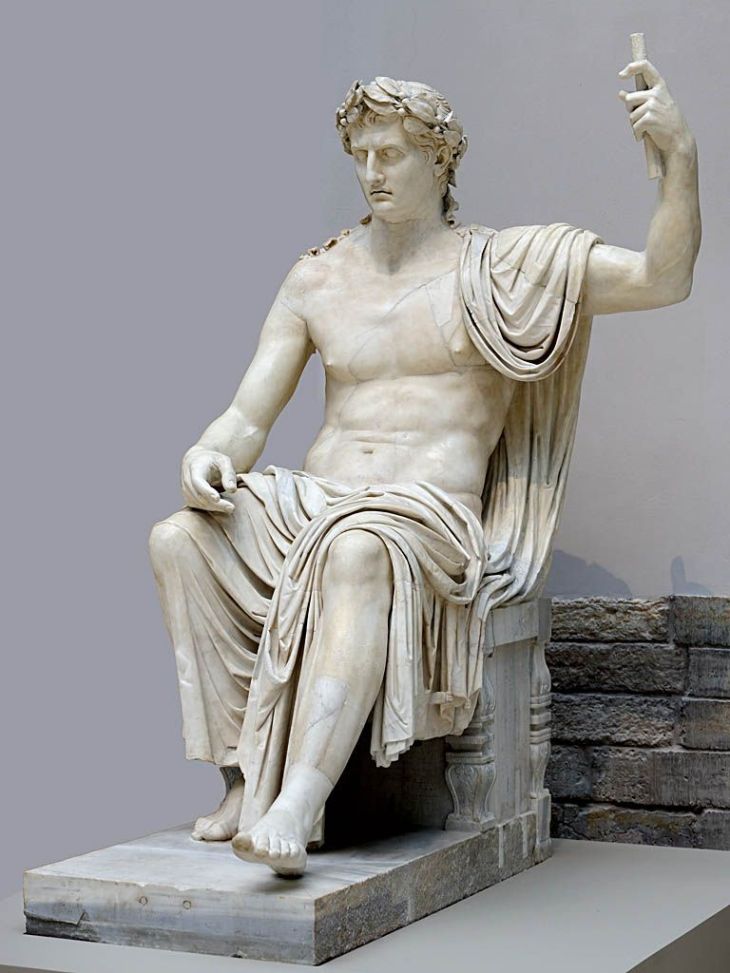
Augustus also had bestowed upon himself the title Pater Patriae, meaning “Father of the Country. which, in Roman culture, wielded absolute power over the members of his family, even to killing them for dishonoring the family. Think The Godfather.
66 AD The Roman Emperor Nero, having inherited all the privileges bestowed on Augustus, visited Greece where, after being allowed to waive the rules against non-Greek participation and honored with a victory in every contest (think coveted Nobel Peace Prize), he returned the favor by changing the Greek status from conquered peoples to citizens in a new One World Government.
166 AD Trajan incorporates Babylon into the Roman Empire, profoundly influencing Rome’s religion by syncretizing several Babylonian deities into their pantheon, incorporating celebrations and adapting rituals, and adopting Babylonian advanced astrology in zodiac signs and divination methods.
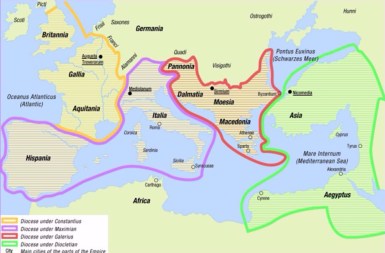
285 AD The Crisis of the 3rd century was a fifty-years period during which the Empire nearly collapsed from invasion, civil war, plague, and economic depression, resulting in the first division of governance of the Roman Empire – not the empire itself – via the Tetrarchy, or Four [Under-]Rulers, equivalent to State Governors, by Emperor Diocletian, the notorious persecutor of Christians.
You know the Christians were expecting Christ’s return at any moment back then.
313 the emperor Constantine I saved the day when he granted religious toleration and freedom for persecuted Christians.
324 AD – Constantine the Great centralizes the seat of Roman government to the bridge between East and West, naming the new Roman capitol after himself as Apollo / the Constant One.
380 the emperor Theodosius I elevated Christianity even higher when he published the Edict of Thessalonica making Nicene Christianity the state church of the Roman Empire. This matches a key identifier of the fourth empire that imposes an apostate religious orthodoxy. “And he shall speak great words against the most High, and shall wear out the saints of the most High, and think to change times and laws: ” (Daniel 7:25) Providing for repression against “heretics”, this is the first known secular law which includes a clear definition of national religious orthodoxy. The Edict of Thessalonica was subsequently incorporated into the Theodosian Code and was the milestone of the official Christianization of the Roman Empire, Barbarian tribes eager to become friends with benefits with Rome were required to enforce nation-wide conversion to Christianity as a stipulation of Rome making an alliance or accepting surrender.

Rome’s Christianity was simply a veneer over a hybrid paganism. Since Odin sacrificed himself on a tree like Jesus, the Northmen’s Odin and son Thor were easily exchanged for YHVH and his son Jesus, especially as Rome’s version of Christianity was not so much focused on scriptural turning from sin to righteousness as it was similar to paganism’s making deals with the spirits for current benefits, going back to Constantine’s rise to power.
382 Gratian, acknowledging the importance of the Christianization of the Roman empire, surrendered his imperial role of Pontifex Maximus to Pope Siricius.
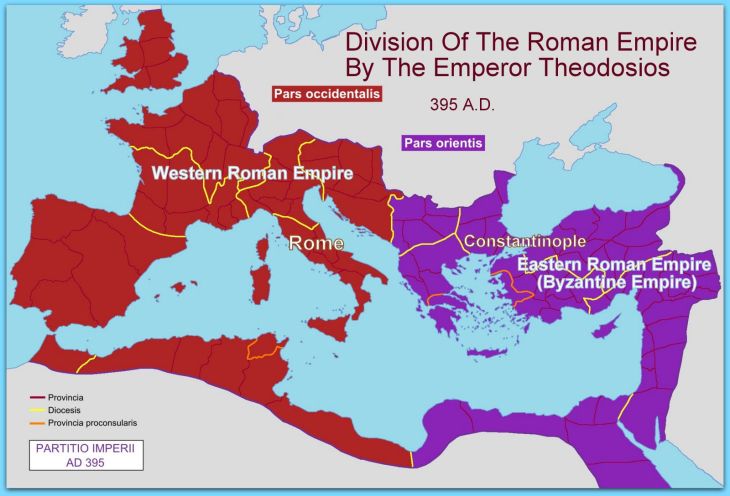
385 As an administrative expediency for improved communications and control in chaotic wartime the Roman Empire split the governance into two geographically separated imperial courts, but remained a single polity. The terms Western Roman Empire and Eastern Roman Empire were coined in modern times, not used at that time.
But aren’t these divisions fulfilling the “two legs” imagery of Nebuchadnezzar’s image? Think about it. The image is divided into four parts from head to toes. In order for “two legs” of the fourth empire to have prophetic meaning the The second and third empires sectioning into three parts – chest and arms & belly and thighs – would have to be interpretive of three-partite empires, which no-one attempts to determine historio-geo-politically.
The bipart fourth empire interpretation is forcing the prophecy into a preconception, while the same interpretation inexcusably skips completely over the Assyrian Empire, despite “the Assyrian” being a key player in history and the end time in order to fit in both the Greek and Roman Empires.
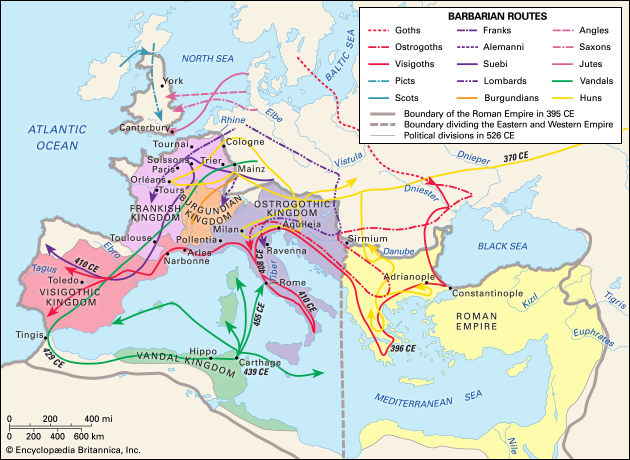
476 By convention, the Western Roman Empire is deemed to have ended when the barbarian Odoacer deposed the sitting ruler Romulus Augustus, but in fact Odoacer submitted himself to the current Eastern Emperor, Julius Nepos, and later the Eastern emperor Zeno, as his sovereign. Odoacer wisely restrained his ambitions to only being crowned King of one state in the Empire. Exactly like Herod, who had been King of Judea. Zeno accepted his submission, conferred upon Odoacer the title of Patrician and granted him legal authority to govern Italy “in the name of “Rome” / current capitol at Constantinople.
Odoacer settled so many Germanic tribes into Roman territories, granting them Roman citizenship, that he and his successors were henceforth called “King of the Germans.” Now there’s a clue.
527-565 Emperor Justinian in Constantinople devoted his reign to restoring Roman rule to all its old expanse, much of which had been seized by Germanic tribes fleeing the Hun invasion of their northern European homelands. The Code of Justinian systematized the confused accretion of Roman laws and remained in force for a thousand years, becoming the foundation of all modern European and Neo-European (American, Canadian, Australian) legal / i.e. political systems.
800 on Christmas Day Pope Leo III elevated King Charlemagne / Charles the Great of the Franks from an underling to the “Roman emperor of the West” in return for political protection, while the eastern leg of the Empire was still ruling from Byzantium. Charlemagne moved his capitol from Rome to Aachen, Germany to more effectively turn its attention north into the Balkan Peninsula where Border provinces passed back and forth like Alsace-Lorraine or the Polish Corridor would in nineteenth- and twentieth-century Europe.” still evident in the name of the country of Romania and current conflicts between western European-oriented Ukraine and eastern Russia.
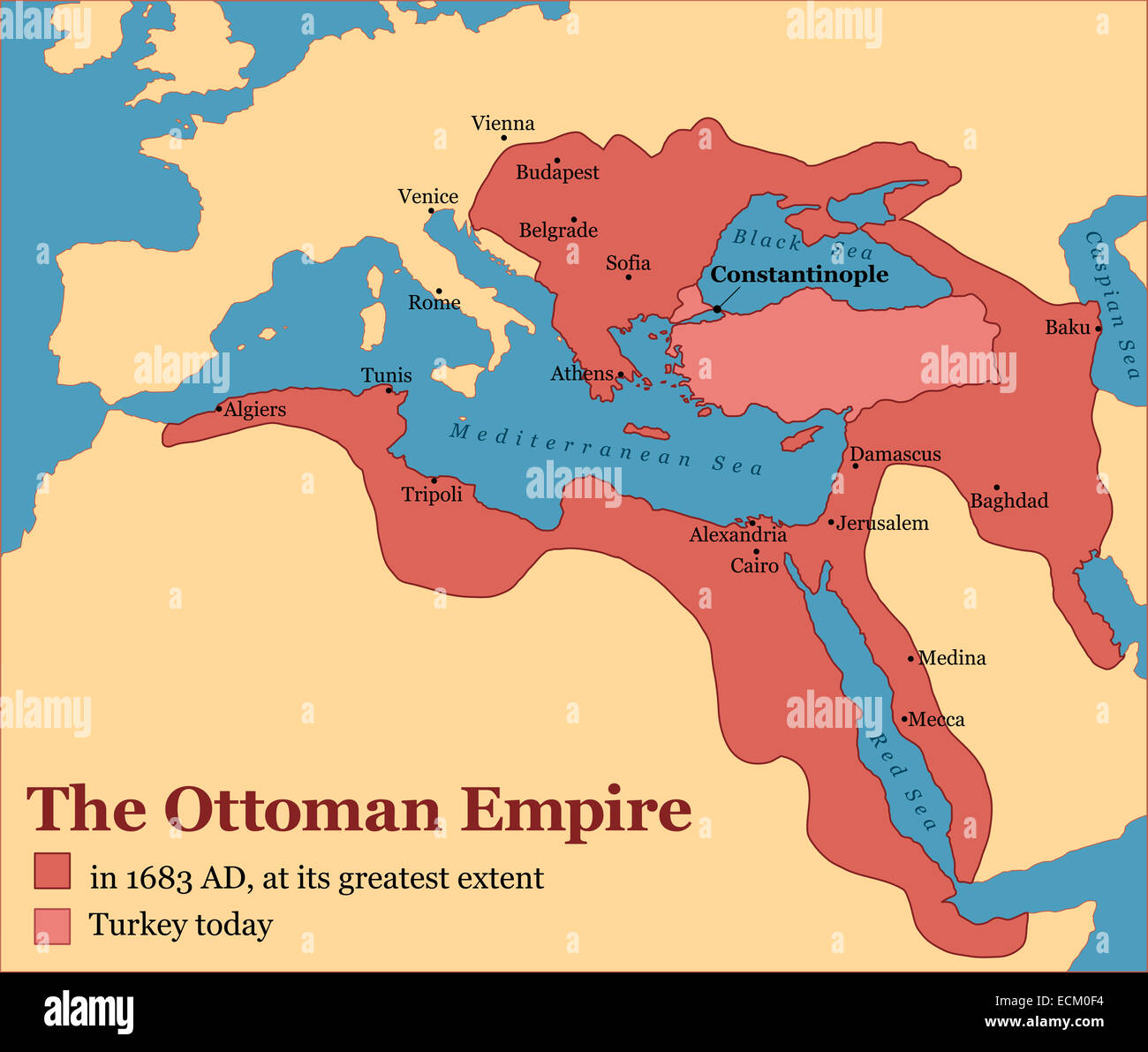
in 1081 Rome’s eastern-most territory of Anatolia / Turkey was conquered by the Seljuk Turk Empire. As with the names of the other political entities incorporated into the Turkish Empire, the name remained Rome / Rum, and its ruler – as conqueror – claimed the title of the Sultan of Rum / Rome.
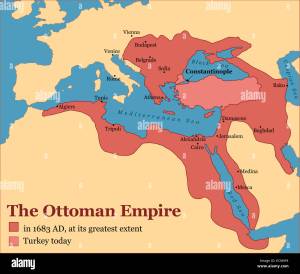
During the 15th century the Ottoman Empire, based in in Anatolia, grew to be one of the most powerful states in the world, encompassing portions of the Middle East now occupied by Iraq, Syria, Israel, and Egypt; North Africa as far west as Algeria; and large parts of the Arabian Peninsula. most of southeastern Europe including present-day Hungary, the Balkan region, Greece, and parts of Ukraine;sup to the very gates of Vienna, which was until 1806 the seat of the Holy Roman Empire and then the capital of the Austro-Hungarian Empire. Sultan Süleyman I the Magnificent (1520–66) rivaled the power and prestige of his European counterparts Francis I of France and Charles V of England, and the Ottoman army was the foremost military power in Europe, which fortunately for Europe, was preoccupied with their Eastern nations. It was a decayed and decadent empire when it was defeated in WWI by the Europeans at which time the territory was taken over by the Turkish Republic and various successor states in southeastern Europe and the Middle East.
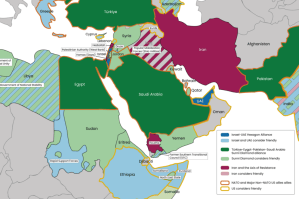
Europe has a complex history with its Middle Eastern and North African (MENA) neighbors. While Europe’s historical relationship with its MENA neighbors is largely built on colonialism, since 1995 the EU states that its MENA neighbors represent the intersection of “strategic” or “practical” concerns. The Barcelona Declaration was signed in 1995 and institutionalized the partnership between the EU and its southern Mediterranean neighbors.