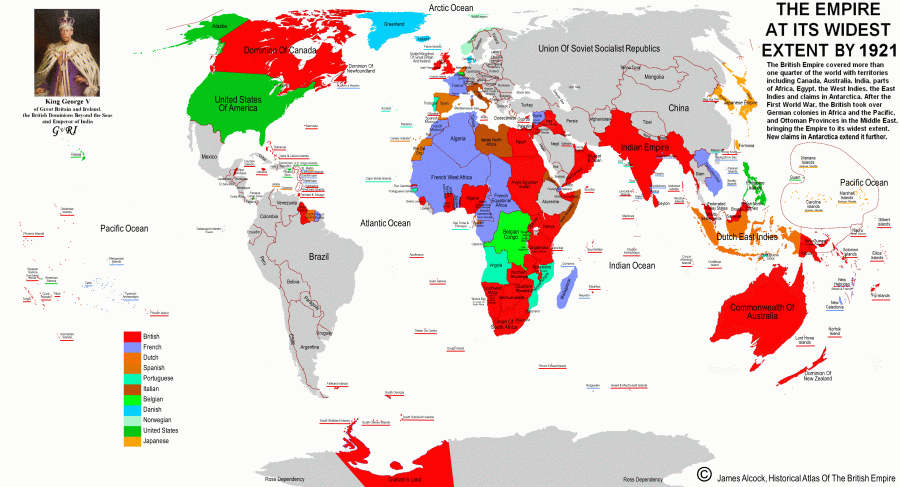
More than anything else [Hitler] dreamed of an alliance with Saxon England.
A nation, he believed, that was made up of and run by people of “excellent Germanic stock”… Hitler proclaimed that, “the English nation will have to be considered the most valuable ally in the world”. He added, “England was a natural ally for Germany and an enemy of France”, plus the latter’s communist friends in Russia, no doubt…he asserted that the English are, “our brothers, why fight our brothers?”.
Then Lloyd George came out with a quite remarkable comment. Although everyone was aware of Hitler’s antisemitism from his autobiography and in the 1930’s the Nazis’ treatment of the Jews…the ex-British premier reminded his audience that, “we must not forget the pogroms in Russia and in other European countries”. It was as if he was saying that maltreatment of the Jews happens, and has happened in communist Russia, so why attack Germany for doing the same?
Tacit British support for Germany continued under the veil of appeasement. During the Spanish Civil War…Britain wanted Franco and his fascists to take control of Spain rather than see it fall into the hands of…communists who would be controlled by Moscow…
So after looking at how friendly the British and German governments were in the 1930’s, why was there no Anglo-Nazi Pact?
One man who inadvertently undermined everything that Hitler wanted from an Anglo-German alliance…Joachim von Ribbentrop…German Ambassador to Britain in August, 1936. He single-handedly destroyed any hope of a rapprochement between the two countries in a number of ways. He insisted on giving an outrageous fascist salute when meeting King George VI [the reigning monarch of the, albeit undercover, Roman Empire and superior to Germany’s hopeful] and seemed astonished that the king did not reply in the same manner. At most meetings with British ministers he argued that Germany must be given back the colonies she lost after the First World War. [Despite the massive losses suffered by England fighting against Germany in WWI.]
Josef Stalin…and the politburo in Moscow certainly believed that an alliance between the two powers was in the cards…as late as 1940 [when] Prime Minister Winston Churchill suggested that Britain should defend Finland against the advancing Red Army.
For his entire life Stalin never trusted the British.
Is it possible that when Churchill – among whose many American connections was his mother – successfully led the British people to sacrifice all they had to fight, rather than join, Germany, that the Nazis looked instead to their military-industrial associates in America for an alliance?
More likely than not.
One of the key reasons for the strength of the special relationship in the Second World War was the close personal connection between Churchill and President Franklin Roosevelt. They have often been associated with the development of the Anglo-US special relationship, and it was during this period that the political relationship between the two countries thrived. The two leaders met in person eleven times throughout the war and exchanged over 1,700 letters and telegrams. Although they would not always agree, this close personal relationship provided the strong base on which the political one could endure…
In December 1940, Churchill warned Roosevelt that the British were no longer able to pay for supplies…Instead, the United States would “lend” the supplies to the British, deferring payment. When payment eventually did take place…payment would primarily take the form of…the creation of a liberalized international economic order in the postwar world.
That’s a very tactful way of stating that America would plunder Britain of all its wealth and political power.
Lend-lease aid in the form of war materials, industrial machinery and commodities, and foodstuffs amounted to $18.6 billion.
Countries officially listed as having been “declared eligible” for lend-lease aid from the United States are the following;: Argentina, Australia, Belgium, Bolivia, Brazil, Canada, Chile, China, Colombia, Costa Rica, Cuba, Czechoslovakia, Dominican Republic, Ecuador, Egypt, El Salvador, Ethiopia, Fighting France, French North and West Africa, Greece, Guatemala, Haiti, Honduras, Iceland, India, Iran, Iraq, Liberia, Luxembourg, Mexico, Netherlands, New Zealand, Nicaragua, Norway, Panama, Paraguay, Peru, Philippines, Poland, Saudi Arabia, South Africa Turkey, United Kingdom, U. S. S. R., Uruguay, Venezuela, Yugoslavia…
“Before authorizing lend-lease, the Congress expressly requested and received assurances that…if England could not pay dollars for petroleum furnished to her, and was unable to meet her petroleum needs from resources she controls in Asia, South America and the East Indies…she should…pay for the petroleum obtained from us by transferring to us her ownership in an equivalent value of foreign petroleum reserves...The committee made a similar proposal for gaining access to British and Dutch rubber resources after the war…acquiring rights in the British-owned resources of nickel, copper, tin and iron in countries outside of England, and to the right to receive manganese from Russia after the war in return for lend-lease articles furnished to it now…”
Five combined boards, exclusively British and American, established during 1942, participate in and issue directives on allocations of material to all countries.
The first comprehensive report on reverse lend-lease was made by President Roosevelt on Nov. 11, 1943, in the form of a review of the reciprocal aid received from the British Commonwealth up to June 30 of [1942].
The total of $1,174.9 million included
- $871 million from the United Kingdom,
- $196 million from Australia,
- $51 million from New Zealand,
- and $58.9 million from India.
It was estimated that reverse lend-lease from the British Commonwealth had reached a rate of $1,250 million annually.
Former Lend-Lease Administrator Stettinius noted that, perversely, the United Kingdom’s contributions in food, quarters, installations and shipping for American soldiers were paid for by the UK through the Lend-Lease Act.
Without question, America took over the British Empire through the Lend-Lease Act, a “milestone in the history of US foreign relations”.
President Roosevelt then consolidated the total transfer of Britain’s wealth to America by destroying ailing Britain’s last hope for reconstruction after the war and consigning her to abject poverty.
On February 14, 1945, months before the war ended on September 2, 1945, Franklin D. Roosevelt met with Abdul Aziz ibn Saud. internationally considered a key Arab leader. Their meeting was secret because FDR had pledged to England’s Winston Churchill that the United States would not intervene in territory controlled by the British. Laying a foundation for U.S.-Saudi relations that would ensure U.S. access to Saudi oil reserves, the agreement has survived seven Saudi kings and twelve US presidents.
Note – that is protection of the Saudi regime, not of the country, even against internal revolt by the people of the country. So much for the protector of democracy.
It is all for access to Saudi oil reserves.
The supremely successful Lend-Lease Act public policy resulted in America, while riding in as a Savior wearing a white hat:
- gaining access to Britain’s global network of military bases,
- underwriting America’s transformation into a military-industrial complex, with, as President Eisenhower warned, “the disastrous rise of misplaced power,”
- Apparent defeat of the Nazi Third Reich with limited loss of American soldiers’ lives, thereby defeating the powerful isolationist politicians at home and winning the majority of Americans to his conviction that Americans can, and must, save the world for democracy,
- Entrance into the war, swooping in at the last minute to claim as spoils of war Germany’s top secret, highly advanced weapons technology,
- “The creation of a new international economic order in the postwar world.”
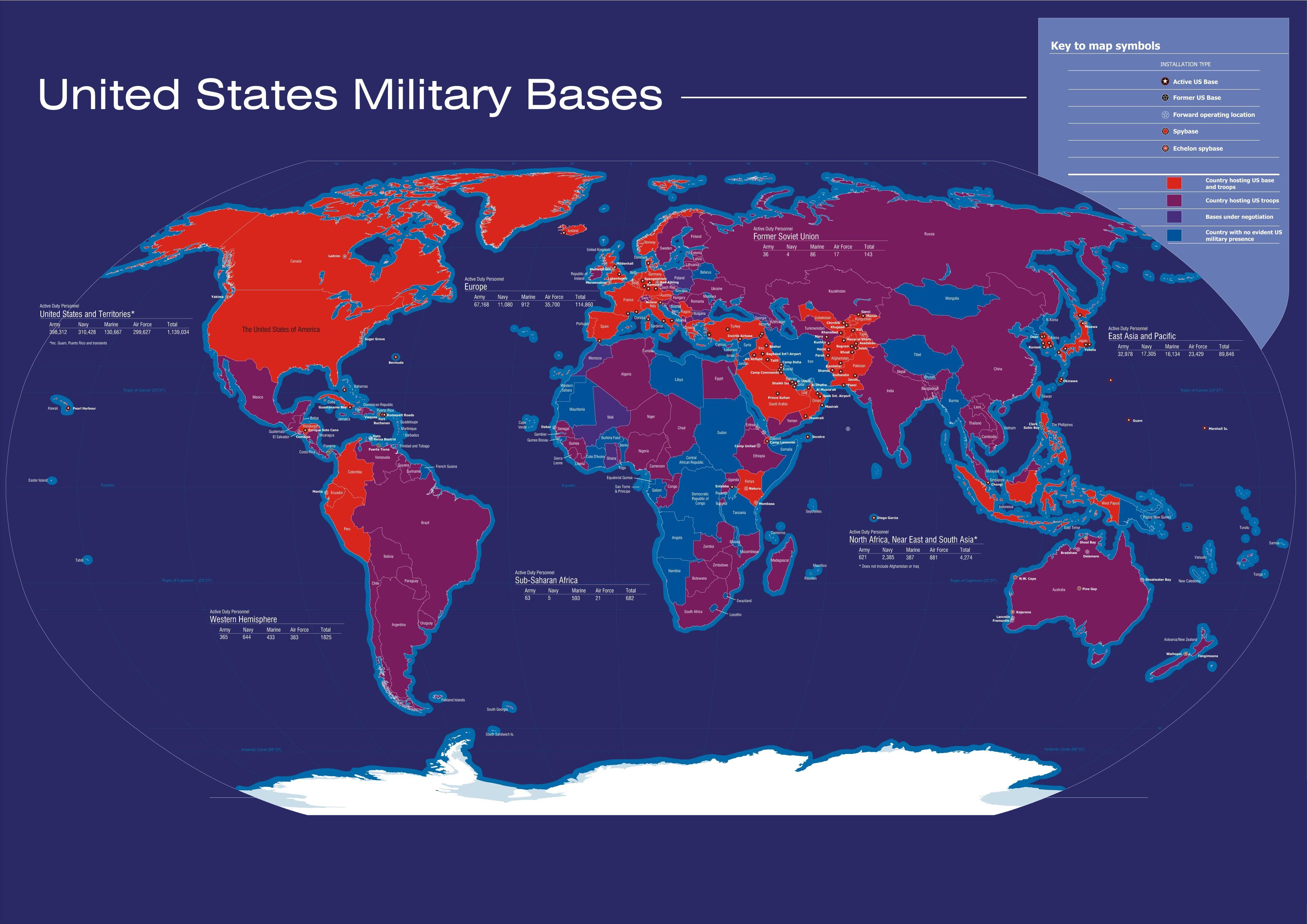
Senate opposition to the Lend-Lease Act correctly foresaw that the bill would “...give the president power to carry on a kind of undeclared war all over the world.”
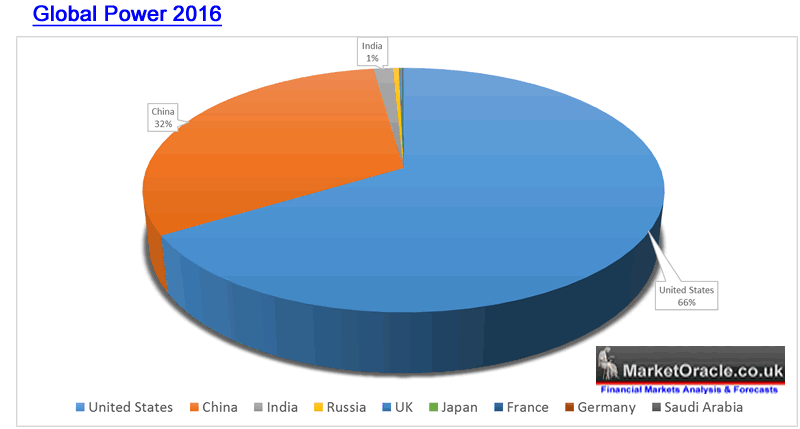
Former US President Harry Truman was the first world leader to recognise Israel when it was created in 1948. The Religious Right in America delude themselves into thinking this is for righteousness’ sake.It doesn’t have anything to do with religion. It’s all about politics. The Northern half of the Fourth Empire needs a unimpeachable ally in a part of the world with constantly shifting alliances and nationalistic fervor to break away from imperial control.
The United States recognized the Government of Transjordan and the Government of Israel on the same day, 31 January 1949 and the Jordanian Nationality Law was amended to grant every Palestinian Jordanian citizenship. Can we not recognize the deals behind the scenes?
At least can we not recognize who has taken the British Empire’s place as Daniel’s Fourth Empire?
The Middle East, with its oil reserves and strategic waterways (think the Suez Canal and Strait of Hormuz) is a key battleground for superpower hegemonic influence. The US has taken over from severely weakened European powers as the primary western power broker in the Middle East.
“in his [the king of the north’s] estate [i.e., as his successor but not precisely his heir] shall stand up [become the victor] a vile person, to whom they shall not give the honour [military victory] of the kingdom: but he shall come in peaceably, and obtain the kingdom by flatteries…yea, also the prince of the covenant. And after the league made with him he shall work deceitfully:
- for he shall…enter peaceably even upon the fattest places of the province…
- and [then] he shall scatter among them the prey, and spoil, and riches...
- he shall forecast his devices against the strong holds, even for a time..
- [then] he shall go forth with great fury to destroy, and utterly to make away many.” (Daniel 11:21-24, 44)


 Kingdom Come