The first biblical mention of the “Assyrian” is As(s)hur, Noah’s grandson, son of Shem. younger brother to Arphaxad / Sargon.
Although Sargon was the ruler of the first known empire, he is not the prototype emperor. No doubt being so early in the game with no mentor he wasn’t very good at it. The Chronicle of Early Kings documents that Sargon had ruled only about 50 years when Nimrod seized his fledgling empire with the help of “all the lands / peoples” including Ashur, who had chosen confederacy with Cousin Nimrod in building the Babylonian empire instead of joining his brother’s Akkadian empire. Quite likely this demonstrates Ashur’s ability to coldly calculate his best odds, over any sense of obligation, a feature of every successful emperor.
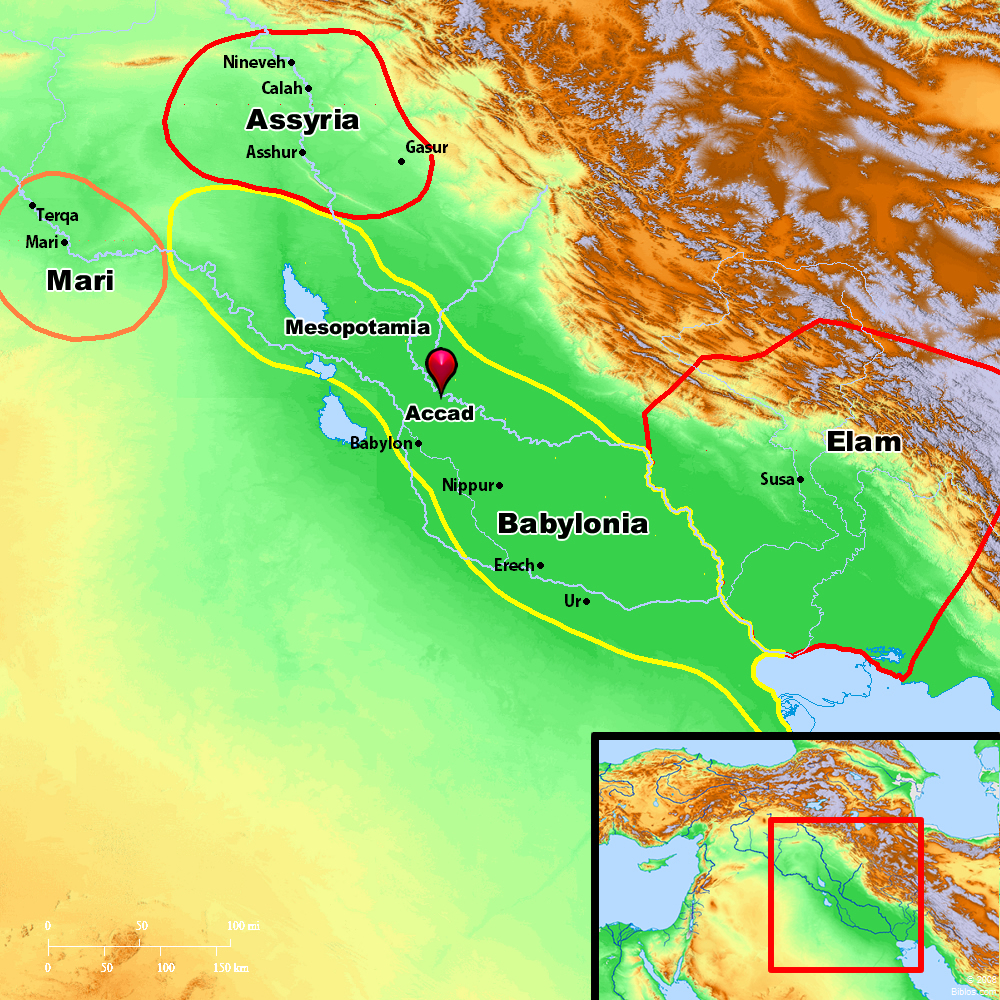
Arphaxad / Sargon and Ashur were not hybrids. As detailed in the relevant post, their generation, like Ham’s sons Canaan and Cush, fathered the first generation of post-flood hybrids. Detail in relevant post.
They were, however, alternately and essentially, voluntarily demon possessed, as documented in a temple inscription made during the biblical Ashur’s lifespan as “the king Erishum / e-ri-šu / “He hath desired – I will!” built the temple of Ashur on the site” in c. 1900/1905 BCE.

Line-drawing of a seal of Erishum with the seated figure believed to be the god Ashur, and Erishum being led towards him.
The Assyrian version of the Sumerian Enūma Eliš identifies Ashur as the primordial deity Ansar who came into being “when heaven and underworld had not been created” and even elevates Ansar in the Assyrian pantheon above Anu / Ani the Creator. From a biblical perspective, this is obviously Lucifer, “I will be like the most High!”
It was believed that Ashur actively intervened in battle, providing assistance and guidance to the Assyrian warriors and had chosen them as his people and bestowed upon them the divine right to rule over other nations. Clearly that ideology is flagrant Luciferian rivalry with YHVH’s Chosen People, the Hebrews, led by Melchizedek.
Ashur was not acting as an architect or urban planner when he “built cities” for Nimrod. According to the United Nations World Urbanization Prospects 2025, since 1950 when just 20% of humanity was urban, now roughly 45% of people worldwide live in cities and another 36% in towns due to economic development brought by population growth and migration patterns.
Ashur was a conqueror like his chosen god Ashur / the Seed of the Serpent Lucifer / predecessor oppressor Cain. He was corralling subjugated peoples as an enslaved workforce to enrich the elite.
Following the overthrow of Sargon’s Akkadian empire and the collapse of Nimrod’s temple-tower at Babylon “Out of that land went forth Asshur and builded Nineveh, and the city Rehoboth, and Calah, And Resen.” (Genesis 10:11-12). Archeological records show that he also built the city of Ashur, named as the center of the god’s worship, along with Bad-tibiara, Larak, Sippar, and Shuruppak, and Eridu.

Historically, the Assyrian Empire is considered the greatest of the ancient Mesopotamian empires because the most successful because the most vicious the most Satanic.
“O Assyrian, the rod of mine anger…
- I will send him against an hypocritical nation…against the people of my wrath…
- And it shall come to pass in that day, / era of judgment that the remnant of Israel, and such as are escaped of the house of Jacob, shall no more again stay / rely upon him that smote them; but shall stay / rely upon the LORD, the Holy One of Israel, in truth.
- The remnant shall return, even the remnant of Jacob, unto the mighty God.” (Isaiah 10:5-6, 20-21)
Ashur-uballit I (r. c. 1363–1328 BC) conquered an increasingly large stretch of territory in Mesopotamia, Anatolia / Turkey and the Levant / Israel, Palestine, Lebanon, Syria, forming the Middle Assyrian Empire, under whose leadership Assyrian military prowess became the best in the world, for a time even occupying powerful Babylonia in the south.
Assyrian expansionism and power reached its peak under Tiglath-Pileser III in the 8th century BC and the subsequent Sargonid dynasty of kings, so-called because they identified themselves with the first known emperor, Sargon the Great of the Akkadian Empire. This demonstrates that the same demonic spirit – by name of Ashur or any other title – also indwelt the original Sargon – therefore the future iterations as well, as the same spirit of “the Assyrian.”
Sargon II (722-705 BCE) was able to bring the empire to its greatest height.
His son Sennacherib (705-681 BCE) campaigned widely and ruthlessly, conquering Israel, Judah, and the Greek provinces in Anatolia [eastern Turkey]. His sack of Jerusalem is detailed on a cuneiform block describing Sennacherib’s capture of 46 cities. Part of his account is, however, is denied by II Kings 18-19, where it is documented that Sennacherib’s army was driven from the field. The internal reliability of the Judean kings’ scribes documenting the many times they were abandoned by their God to the destruction of their enemies, and the well-known spin put on embarrassing failures by politicians of any era, certainly gives the biblical account the credibility in this contested report.
Sennacherib drove his army against Babylon, sacked it, and looted the temples…after which [two of his] sons… assassinated him.
Hmm. This too is recorded in II Kings, chapter 19, but the historian failed to mention that.
His son Esarhaddon (681-669 BCE) took the throne, and one of his first projects was to rebuild Babylon – again repeating the actions of Akkadian Sargon the Great. He issued an official proclamation which claimed that Babylon had been destroyed by the will of the gods owing to the city’s wickedness and lack of respect for the divine.
Hmm. This too is recorded in the biblical record. Hundreds of times.
The last great historical Assyrian king, Ashurbanipal (668-627 BCE) was the most literate of the Assyrian rulers and is probably best known in the modern day for the vast library he collected at his palace at Nineveh.
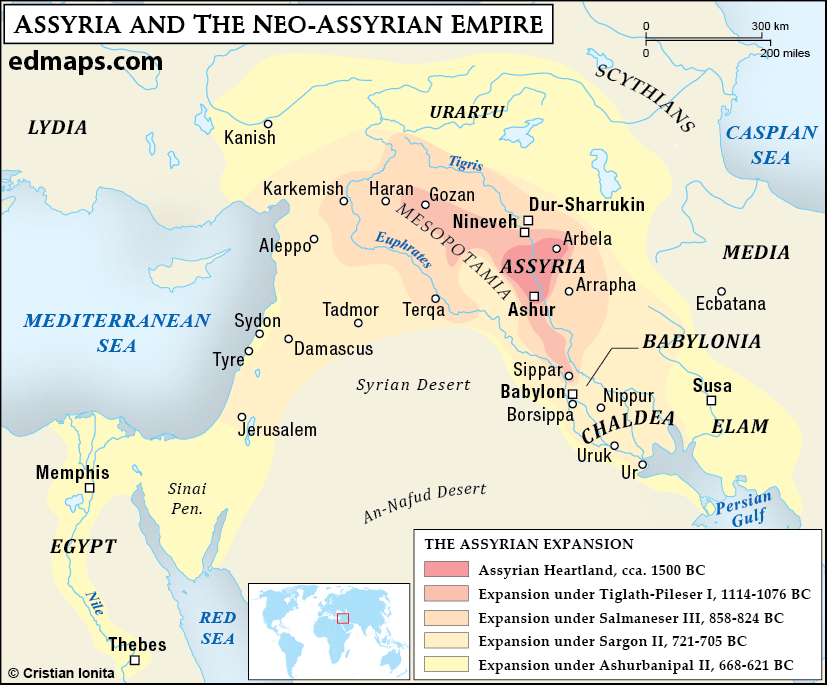
Sargon II and his three immediate successors Sennacherib (r. 705–681 BC), Esar-haddon (r. 681–669 BC) and Ashur-banipal (r. 669–631 BC), are generally regarded as three of the greatest Assyrian monarchs. Under their direction the Neo-Assyrian Empire stretched from Egypt, Libya and Arabian Peninsula the south to the Caucasus in the north, and Persia in the east to Cyprus in the west and Babylonia was recaptured.
Ashurbanipal (r. 668-627 BCE, AKA Assur-banipal) was the last of the great kings of Assyria. His name means “the god Ashur is creator of an heir.” This defines “the Assyrian” as the same as Mari-utu, “My Son The New Thing”, a hybrid god-man rivaling the YHVH’s Seed of the Woman.
In 612 BCE Nineveh was sacked and burned by a coalition of Babylonians, Persians, Medes, and Scythians, among others. The destruction of the palace brought the flaming walls down on the library of Ashurbanipal and, although far from the intention, preserved the great library, and the history of the Assyrians, by baking hard and burying the clay tablet books. The destruction of the great Assyrian cities was so complete that, within two generations of the empire’s fall, no one knew where the cities had been. The ruins of Nineveh lay buried for the next 2,000 years.
Tiglath Pileser III introduced Aramaic to replace Akkadian as the lingua franca of the empire to regions as near as Israel and as far as Greece. Older documents collected by kings such as Ashurbanipal were translated from Akkadian into Aramaic. This allowed later scholars to translate Akkadian writings and then decode Sumerian cuneiform.
The result was that thousands of years of history and culture were preserved for future generations.
In 605 BCE at a historical turning point in the power dynamics of ancient Near East, the Assyrian Empire and its ally Egypt were crushed at the Battle of Carchemish.
Their destruction is detailed in the Bible.
“The word of the LORD which came to Jeremiah the prophet against the Gentiles…against the army of Pharaohnecho king of Egypt, which was by the river Euphrates in Carchemish, which Nebuchadrezzar king of Babylon smote in the fourth year of Jehoiakim the son of Josiah king of Judah…
For this is the [prophetically a preview of the ultimate] day of the LORD God of hosts, a day of vengeance, that he may avenge him of his adversaries...Behold, I will punish the multitude of No, and Pharaoh, and Egypt, with their gods, and their kings; even Pharaoh, and all them that trust in him: And I will deliver them into the hand of…Nebuchadrezzar king of Babylon…
But! fear not thou, O my servant Jacob, and be not dismayed, O Israel: for, behold, I will save thee” (Jeremiah 46)
We do realize that “my servant” and “Prince of El” are the key identifiers of those who are saved, right? To be specific, the ungodly nation of Israel under wicked leaders are NOT PROMISED SALVATION SIMPLY BECAUSE OF THEIR NATIONALITY!
“Know ye not, that to whom ye yield yourselves servants to obey, his servants ye are to whom ye obey; whether of sin unto death, or of obedience unto righteousness?” (Romans 6:16)
The whole point in reviewing Assyria’s history is to recognize its use as an instrument of destruction against wicked Israel.
In modern terms, “Assyria” can be identified with northern Iraq, northeast Syria, and southeast Turkey, with areas of northwest Iran. Can we not recognize current Mesopotamian warfare recycling biblical prophecy?
“The word of the LORD that came to Micah the Morasthite in the days of ___ …Hear, all…earth…let the LORD God be witness against you…for the sins of the house of Israel…the LORD cometh forth out of his place, and will come down, and tread upon the high places of the earth.
Woe to them that devise iniquity, and work evil upon their beds! when the morning is light, they practise it, because it is in the power of their hand. And they covet fields, and take them by violence; and houses, and take them away: so they oppress a man and his house, even a man and his heritage – Gaza in our day.
Therefore thus saith the LORD; Behold, against this family do I devise an evil…In that day shall one take up a parable against you, and lament with a doleful lamentation, and say, We be utterly spoiled…
Thus saith the LORD concerning the prophets that make my people err, that bite with their teeth, and cry, Peace…and prepare war against him….
They build up Zion with blood, and Jerusalem with iniquity. The heads thereof judge for reward, and the priests thereof teach for hire, and the prophets thereof divine for money: yet will…say, Is not the LORD among us? none evil can come upon us.
Therefore shall Zion for your sake be plowed as a field, and Jerusalem shall become heaps.” (Micah 1-3)


 Kingdom Come