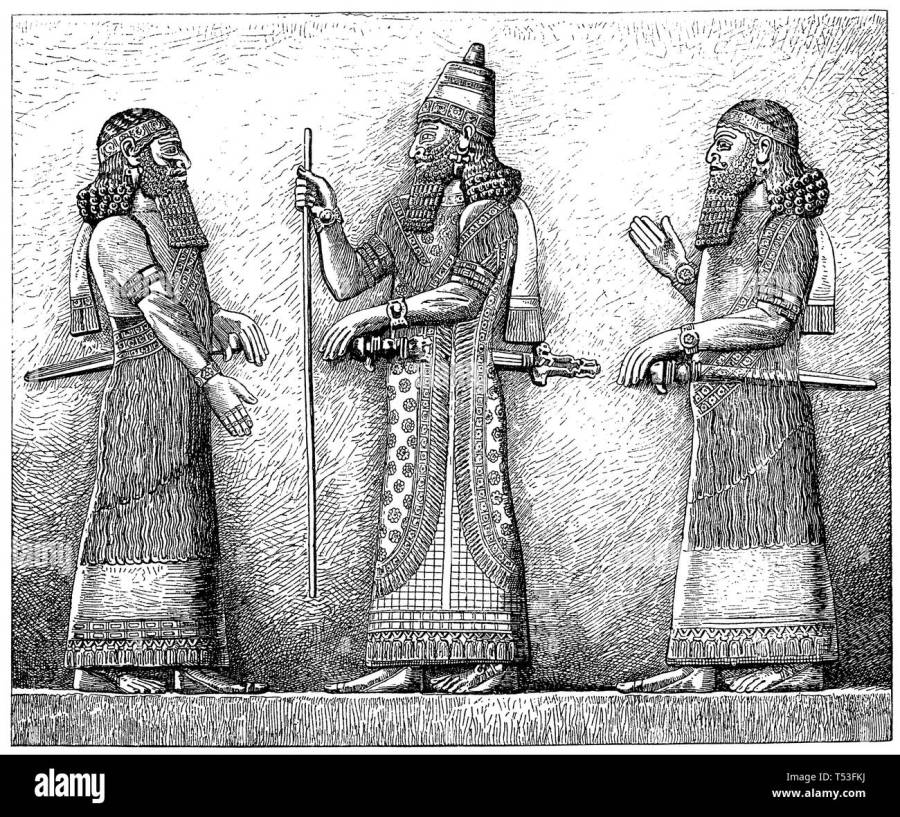
The name of Shem’s son Arph-axad is composed of two parts: “arpha” meaning “I shall fail” and “xad” meaning “gathering of the people”. As the name given to him by his father – not at birth – but to memorialize his notorious attributes, this is transparently a warning that his son would fail to defeat Melchizedek. We find this same warning prophecies some years later announced by Melchizedek Jacob / Israel.
“The sceptre shall not depart from [the current Melchizedekian designate] Judah, nor a lawgiver from between his feet, until Shiloh come; and unto HIM shall the gathering of the people be.” Genesis 49:10)
In flagrant defiance to his father (Luciferianism all over again!) Arphaxad dropped the “fail” part of his name and claimed HIS empire was the “gathering of the people”.
We can confidently identify Sargon of Akkad (r. 2334 – 2279 BCE) as Shem’s son Arph-axad because the similarities in Semitic languages, in conjunction with timelines and exploits, prove that “Axad” is one and the same as the founder of the city-state of Akkad and the Akkadian language.
Kin to both Hebrew and Sumerian languages, Akkadian served as the rival to YHVH’s language carried through the flood in Holy Scripture by righteous Melchizedek Noah and his successors. Given the wealth of documents unearthed by archeologists, none of which parallel the Hebrew records of Genesis, we must conclude that Hebrew is YHVH’s language for humanity.
Jews refer to Hebrew as lashon hakodesh, the sacred language (Berakhot 13a, Sotah 49b), in part because it is the language of the Jewish Bible, and also because, according to the Jewish scriptures, Hebrew played a key role in the creation of the world. In Genesis 1, God creates the world by speaking Hebrew.
This does not invalidate Josephus’ alternate interpretation of the meaning of the name Arpha-chshad as a combination of “extent, border; and כשד, Chesed / Kesed, the Hebrew word for Chaldeans (pronounced with a hard K, like “school” is also valid.
“Behold the land of the Chaldeans / Kasdim, this people was not till the Assyrian / Assur, Arphaxad’s brother founded it for them that dwell in the wilderness: they set up the towers thereof, they raised up the palaces thereof…Babylon, the glory of kingdoms, the beauty of the Chaldees’ excellency.” (Isaiah 23:13,19)
The earliest known mention of Babylon is as a small town, appearing on a clay tablet from 2217–2193 BC, consistent with Sargon’s early empire-building with the assistance of his architect brother Ashur. Arphaxad’s much younger cousin Nimrod seized Babel when his star ascended while aging Sargon’s fell.
The Legend of Sargon of Akkad describes the king’s humble origins and rise to power. Mesopotamian naru literature is characterized by a formal self-introduction of the writer by his name and titles and a narrative in the first person, like the autobiographies written by American Presidents.
The entire body of “naru literature” consists of only a small group of inscriptions in the name of famous god-kings of a bygone, i.e. pre-flood, age. In his autobiography, however, Sargon, went completely against the standards by aligning himself with a human father.
From a biblical perspective, Sargon clearly describes the conditions immediately following the Flood when the gods were no longer directly accessible, and explains how he still managed to attain to demi-god status without a god father – since Noah and Shem were reknown as being indwelt by the God YHVH – by joining himself to an indwelling evil spirit from his mother.
- Sharru-ukin, translated into Hebrew as “Sargon”
- this new title means “legitimate, true king”, clearly challenging Melchizedek Shem
- the mighty king, king of Agade / Akkad, am I.
- My mother was a changeling / secret hybrid,
- diverging from usual paternal dynastic qualification to maternal to identify himself with the Earth Mother Goddess,
- my father [Shem] I knew not meaning he rejected identity with YHVH’s Melchizedek, instead identifying with his uncle Ham who promoted the Adversary’s Seed of the Serpent.
- The brother(s) / clan of my father loved the hills
- i.e. did not fight but fled to “The high hills are a refuge” (Psalm 104:18]
- My changeling [secretly hybrid] mother conceived me, in secret she bore me. She set me in a basket of rushes, with bitumen she sealed
- This parallel to saving Moses from Pharoah’s orders to drown the enemy’s potential soldier is patently part of the ancient practice of infanticide of unwanted or problematic children with birth defects – not a rare prototype for the Hebrews to plagiarize in the story of Moses.
- Since his father Shem is famous as the righteous heir to his father Noah as Melchizedek, this allows Arphaxad to claim he inherited hybrid traits instead from his mother, who would have to have been an unnamed sister or cousin to Shem, whether true or not.
- Akki, the drawer of water lifted me out…[took me] as his son (and) reared me…
- Ishtar granted me (her) love
- signifies sexual union with a goddess / hybrid female to breed hybrids.
Another autobiography of Sargon is found on a tablet of the Old Babylonian period recovered at Nippur on the pedestal of a statue erected in the temple of Enlil / Divine Lord of the Earth / Adam.
- king of Akkad (city-state named after himself meaning “gathered together the people”.
- mashkim / overseer of Inanna / mother of all living / Earth Goddess Mother of hybrids
- guda / anointed of Anu / Creator therefore Messiah / Christ (in reality the antichrist)
- en-si / lord of [all] the land [granted dominion of creation]
- governor of [the line of] Enlil / Adam / Melchizedek
- king of Kish – Melchizedek’s capitol establishing his authority
Notice the prominence of Inanna, listed second to himself, what today we call “consort”.
As “overseer of Inanna” the fruitful goddess of the earth, teeming with fertility, the ancient Mesopotamian goddess of war, love, and fertility, Sargon is controlling all the aspects of the pre-flood demi-god procreation program of demi-gods carried by this woman in giant genetics in her ovum.
The worship of Inanna at the Eanna temple in Uruk played a crucial role in her cult. Archeologists consider Uruk / Erech to be “the first city in world history” in terms of a seattlement with a population meeting the criteria for the definition of a city, It was to this city that worshippers flocked to unite with the deity through sexual passion with her priestesses both female and transgender, and in her festivals of consecrated orgies. Exactly like San Fransisco, considered the Gay Capital of the World.
Significantly, Sargon’s kingdom began with the rebuilding of the pre-Flood metropolis of Uruk. which, by the final phase of the pre-Flood Ubaid period was the largest urban area in the world with 40,000 residents behind walls and another 80,000–90,000 people living in its environs.
From an archeological perspective, “The [post-flood] Uruk period saw the emergence of urban life full civilization of the Early Dynastic period.” As detailed in the previous posts regarding “civilization” is the enslavement of the masses by the few wealthy elite by concentrating them in cities and developing not only a military but industrial complex to finance it. Sargon is reported to have supported a court, i.e. standing army, of 5,400 men who “ate bread daily before him”. This is a credible number in an exponentially expanding population over Sargon’s extended lifetime.
Sargon then conquered Ur and E-Ninmar and “laid waste” the territory from Lagash to the sea, and from there went on to conquer and destroy Umma, and he collected tribute from Mari and Elam. He triumphed over 34 cities in total. Ships from Meluhha, Magan and Dilmun rode at anchor in his capital of Akkad on the Tigris River. Submitting himself to the Levantine god Dagan in exchange for his support in his territory, Sargon conquered territories of Upper Mesopotamia and the Levant, including Mari, Yarmuti (Jarmuth?) and Ibla “up to the Cedar Forest (the Amanus) and up to the Silver Mountain (Aladagh?)”, ruling from the “upper sea” (Mediterranean) to the “lower sea” (Persian Gulf).

The speed with which Sargon changed society can be matched to how quickly Shaka Zulu Changed the World.
-
In 1816, Shaka Zulu began a campaign of conquest to unite all of the clans in the region under his rule.
Shaka began with a systematic reorganization of Zulu warriors under a strict code of obedience. Zulu society — much like Sparta — was entirely restructured to support the army.
In just a couple of years, his army had brutally executed, displaced or assimilated a vast territory with more than 200,000 inhabitants who became his subjects.
Besides creating a political entity in the Zulu Kingdom, Shaka’s military campaigns caused the massive displacement of people, a crisis that became part of a decades-long period of turmoil.
From the 1820s to the 1840s, those who weren’t killed or assimilated by the encroaching Zulu warriors fled, leading to a refugee crisis. Existing famines also worsened…Cannibalism may have occurred during this time, historians say.
Like Shaka Zulu’s appearance on the scene, warfare under Sargon in Mesopotamia changed from seizing property and slave labor between neighboring clans with a minimal loss of life into total destruction of the enemy on the battlefield.

The innovative tactics and military reforms of both Shaka Zulu and Sargon welded neighboring clans into a powerful empire. So it is no surprise that “for at least 1,500 years after his death, Sargon the Great was regarded as a semi-sacred figure, the patron saint of all subsequent empires in the Mesopotamian realm”.
In truth, Arphaxad / Sargon is more accurately portrayed in gory movies than in glorifying history books.



 Kingdom Come