
From The Smithsonian Institute: While people used to think that there was a single line of human species, with one evolving after the other…we now know this is not the case.
Then why is Evolution still being presented – and accepted – as a known single line of precursor species evolving into modern humans?
Fossil evidence for the human species begins with the human species.
The early fossils are not considered ancestors to Homo sapiens but are important to the study of the lineage. After the beginning of the Holocene, [consistent with the 6th day of creation] all fossils are Homo sapiens (anatomically modern humans).
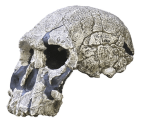
- Homo habilis was proposed to have been a human ancestor, directly evolving into Homo erectus which directly led to modern humans, but since the oldest H. habilis specimen has less ancestral traits than the younger specimens it appears this species assignment is a specious assemblage of different non-human Australopithecus and Homo fossils.
- Homo rudolfensis consisting of one skull and other partial skull aspects with no bodily remains, both its generic classification and validity are debated, with some recommending the species to actually belong to the [non-human] genus Australopithecus.
- Homo erectus– meaning “upright man”) is an extinct species of archaic human from the Pleistocene, Its specimens are among the first recognizable members of the genus Homo…spread throughout Eurasia.

- Pithecanthropus erectus / “upright apeman” / Java Man is based on a skullcap, a femur and a tooth assumed to belong together and to have lain in place for millions of years. Based on the occultic Madam Blavatsky’s revelation of a sunken – yes, that’s right, sunken – continent called Lemuria as the birthplace of humanity, competing excavators paid locals to bring them “fossils” and kept their provenance secret. Java man was only rejected by stakeholders in classical Darwinism insisting that humans must have evolved in Africa as per the subhuman evidence of Africans. And yet, “Estimated to be between 700,000 and 1,000,000 years old…it remains the type specimen for Homo erectus.
- “Sinanthropus pekinensis” (Peking Man): The first fossil, a single tooth, was discovered in 1926, with the site since becoming the most productive H. erectus site in the world. Classified as a direct human ancestor, this “scientific proof of evolution” played a vital role in the restructuring of the Chinese identity from spirituality to atheism following the Chinese Communist Revolution, Similarities between Java Man and Peking Man led to renaming both as Homo erectus in 1950, but their species designation has been a tumultuous discussion.

- Homo ergaster is believed by many to belong to H. erectus in an ongoing and unresolved dispute since it’s designation as a separate species is based on the more advanced tools used by the species in comparison to those of their ancestors. The Turkana Boy is the most complete early hominin skeleton ever found, with 108 out of a full count of 206 bones. He looks completely modern African Homo sapiens to me, and is acknowledged by anthropologists to have lived together with Homo sapiens for up to 100,000 years. Based on 6,000 years of recorded history it is sociologically impossible for a sub-species to survive for long against stronger rivals.
- H. bodoensis is now supposed to represent the immediate ancestor of modern humans, first described and introduced into the literature in October 2021. It was not based on newly discovered fossils; but rather to rearrange known hominin fossils to be interpreted as the early, immediate ancestors of anatomically modern humans (Homo sapiens) are to be grouped under the name Homo bodoensis. but does not include the last common ancestor / LCA of modern humans and Neanderthals.
- H. heidelbergensis – was classified on the basis of one – count it – one fossilized mandible. It was considered to have been the ancestor to Neanderthals, Denisovans, and modern humans until nuclear DNA analysis provided evidence that modern humans and Neanderthal existed long before H. heidelbergensis, all European H. heidelbergensis specimens were reclassified as neanderthalensis.
Homo neanderthalensis (or Homo sapiens neanderthalensis) are known from numerous fossils in Eurasia as an extinct species of their own or a subspecies of archaic homo sapiens. In the evolutionary paradigm, researchers initially depicted Neanderthals as primitive, unintelligent, and brutish, but knowledge and perception of them has markedly changed since then in the scientific community.
- Neanderthals proliferated harmful gene variants. This does not support the concept of evolution, rather the extinction of this species due to genetic variation refutes evolution.
- There is evidence of regional cultures.
- Neanderthals had high trauma rates, and about 80% died before the age of 40. This demonstrates the same inherently conflict-ridden societies among animals and humans today, also refuting Evolution’s proposition that various related species were able to survive in proximity with each other for millions of years in order for evolutionary changes to transform into new species.
- The 2010 Neanderthal genome project‘s draft report presented evidence for interbreeding between Neanderthals and modern humans. About 20% of distinctly Neanderthal gene variants survive today. Many more may have been interbred into humans but being detrimental died out with the diseased offspring. Also, a large portion of inherited Neanderthal genes appears to be non-coding DNA for which the function is as yet unknown.
- Neanderthals also appear to have interbred with Denisovans, a different group of archaic humans, in Siberia.
The Denisovans are an extinct species or subspecies of archaic human that ranged across Asia during the Lower and Middle Paleolithic, i.e. from a biblical perspective shortly after Noah’s flood, Most of what is known about them comes from DNA evidence as there are few fossils. The first identification of a Denisovan individual occurred in 2010, based on mitochondrial DNA (mtDNA) extracted from a juvenile female finger bone from the Siberian Denisova Cave in the Altai Mountains. Nuclear DNA indicates close affinities with Neanderthals. The cave was also periodically inhabited by Neanderthals.
- DNA evidence suggests they had dark skin, eyes, and hair, and had a Neanderthal-like build and facial features.
- Denisovans apparently interbred with modern humans, with the highest percentages (roughly 5%) occurring in Melanesians, Aboriginal Australians, and Filipino Negritos.
- There is also evidence of interbreeding with the Altai Neanderthal population, with about 17% of the Denisovan genome deriving from them.
- A first-generation hybrid nicknamed “Denny” was discovered with a Denisovan father and a Neanderthal mother.
- Additionally, 4% of the Denisovan genome comes from an unknown archaic human species which diverged from modern humans over one million years ago.
Homo sapiens.sapiens Anatomically modern humans
- “After 11,500 years ago all fossils shown are…anatomically modern humans, illustrating recent divergence in the formation of modern human sub-populations.” Then why did it take so long – assumedly – for previous populations to diverge? Or for new species to develop advancements in quality of life once they had supposedly evolved.
- And why isn’t the recent discovery of epigenetics – how behavior modifies the genetics passed to subsequent generations – factored into the evolutionary hypothesis? “Modern humans evolved from proto-humans, but behaviors continued to be those of their protohuman ancestors – surviving by hunting and gathering for the next 210,000 years without any advances in basic technology or quality of life.” Seriously? How can 300,000 year old behaviors be unearthed? If modern humans are primarily distinguished by intelligence how do hundreds of thousands of years of unchanged primitive behaviors demonstrate evolving intelligence?
Shall we wait for the latest report or just buy in to every change based on really limited data?
164,000 BC – After 136,000 years of hunting and gathering, modern humans make one giant leap for mankind by collecting and cooking shellfish in addition to the other hunter-gatherer foodstuffs.
I can’t make this up. This is from the Smithsonian Institution’s website “What Does It Mean To Be Human.”
120,000 BC – “The difficulty was always this incredible time lag between that occurrence and any more complex aspect of the culture other than just basic survival,”
90,000 BC – It takes 210,000 years for modern humans to invent fishing tools. Gee, you’d think they would have noticed what their cousins were doing.” Primates are well known for using tools for hunting or gathering food and water, cover for rain, and self-defense.”
In 2016 Lee Berger, Ph.D., a paleoanthropologists, was named one of the 100 Most Influential People by Time Magazine for leading the discovery and assemblage of Homo naledi, a previously-unknown species of extinct hominin discovered within the Dinaledi Chamber of the Rising Star cave system, Cradle of Humankind, South Africa.
The abundance of evidence from this assemblage supports our emerging understanding that the genus Homo encompassed a variety of evolutionary experiments (Antón et al., 2014).
These claims sound more like sales pitches than science.


 Kingdom Come