
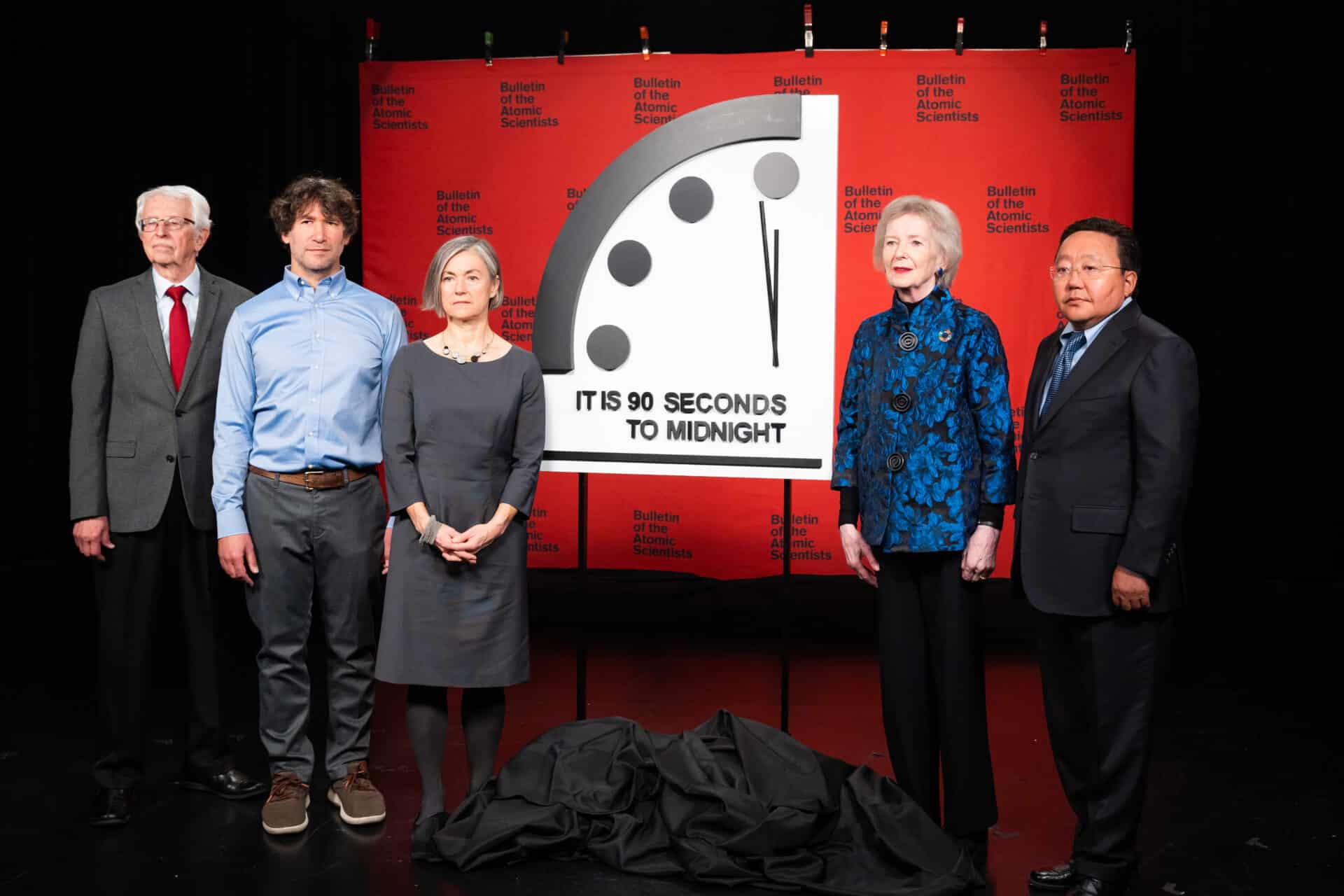
On January 2021 the Bulletin of the Atomic Scientists reported “It is 100 seconds to midnight.”
This was due to the world-wide COVID pandemic which was life-threatening itself, but what was worse was that “In 2020, online lying literally killed…deliberate attempts (sometimes by national leaders) to disseminate misinformation and disinformation…a “massive ‘infodemic’—an over-abundance of information …makes it hard for people to find trustworthy sources and reliable guidance when they need it…”
Four years later, with Donald Trump serving his second term as President of the United States under worsening conditions of disseminated misinformation and disinformation, we’ve jumped ahead.
Fact-checkers at The Washington Post documented 30,573 false or misleading claims during his first presidential term, an average of 21 per day. Commentators and fact-checkers have described Trump’s lying as unprecedented in American politics. Scholarly analysis of Trump’s X posts found significant evidence of an intent to deceive.
The Washington Post said his frequent repetition of claims he knew to be false amounted to a campaign based on disinformation. In February 2025, a public relations CEO stated that the “flood the zone” tactic (also known as the firehose of falsehood) was designed to make sure no single action or event stands out above the rest by having them occur at a rapid pace, thus preventing the public from keeping up and preventing controversy or outrage over a specific action or event.
Is The Hitchhiker’s Guide to the Galaxy your response to this very near and present existential threat?
“Protect me from knowing what I don’t need to know. Protect me from even knowing that there are things to know that I don’t know. Protect me from knowing that I decided not to know about the things that I decided not to know about. Amen.”
I know a woman who, every time she crosses a bridge on her way to work, worries that her car will plunge through the side barriers into the river. That thought doesn’t even cross my mind. I’m certain my driving skills and the bridge will hold up to the challenge.
Like me driving over a yawning chasm, most people trust in their ability to figure out the truth intuitively, without need to gather and study any data about the subject at hand.
A report published in 2021 found that 25 percent of all steel bridges in the U.S. could collapse by 2050. After waiting for that often-promised, but never-arrived support under the first Trump administration, congress passed a bipartisan Infrastructure Investment and Jobs Act, that allotted $110 billion for roads, bridges, and other transportation needs.
Under the second Trump administration, funding has been diverted to his high tech billionaire supporters and war.

By deliberate choice or default by inaction, we are forced to trust a claimed authority.
We can group authorities by philosophy, science and religion. The key difference between these three authorities is
- how they arrive at their conclusions, i.e. beliefs,
- which is driven by what they are studying.
- Philosophy, which includes psychology, is most applicable for understanding the behaviors directed by the personality, i.e. soul.
- Science is most applicable for understanding material substance, e.g. the body.
- Religion is most applicable for understanding life energy, i.e. the spirit, and any possible continuation of a life force energizing the soul / personhood after the body stops being energized.
Philosophy
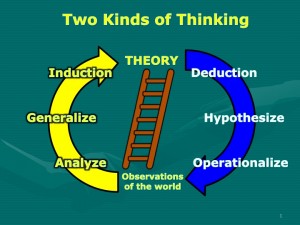
In-duction is a process where in-stances of in-dividuals’ behavior are used to form arguments and premises to develop a generalization or a conclusion that can be attributed to much more than the in-itial subjects.
Since philosophical conclusions often start with the premise that there is no God, they aren’t trustworthy for considering any spiritual empowerment in solving problems. And that’s not a rabid Christian speaking. That’s Norman Mailer. “It is, after all, near to impossible for a philosopher to explore how we are here without entertaining some notion of what the prior force might have been. Cosmic speculation is asphyxiated if existence came into being ex nihilo [out of nothing].”
While typically expressed as facts, philosophical conclusions are in reality only opinions which may be overthrown by a paradigm shift. This is dramatically evident in psychology’s ever-changing diagnostic explanations of human behaviors. Due to the limited data used by philosophers for their theses, there is a high probability of a faulty extrapolation to the larger population of other genders, cultures, age groups, etc.
In response to this major flaw in philosophy, the highly celebrated philosopher Francis Bacon devised a new rhetorical and theoretical framework to overcome, or cancel out, the thinker’s personal opinion. This skeptical and methodical approach is used by investigators who aim to avoid misleading themselves.

Science
In the reverse process of in-ductive reasoning, de-duction starts with general information to arrive at specific conclusions. The greater amount of data used in research gives the results drawn from Bacon’s scientific method greater credibility, however, this method still only derives generally accepted explanations – and only about material reality.
The biggest problem with the scientific method is its reliance on empiricism – accepting only data that comes primarily from what the body can sense. The biggest problem with the scientific method, is that it is limited to direct observation and must be validated by repeated experiments so cannot answer questions about past, future or non-repeatable events.
Because life after death isn’t accessible for observation or experimentation, the scientific method can’t give answers to the questions about its reality or condition.
It is evident that the scientific method cannot by itself answer fundamental questions about the nature of reality and many “scientific” claims are in actuality philosophical musings in which the originator
- formulates a hypothesis based on observation, then
- develops a theory via imagination,
- bolstered by assuming regularity and similarity to known conditions.
If just one assumption is wrong, then the conclusion is wrong.
Any “scientific” claim that cannot
- back up its hypothesis with observations – non-existent for past events,
- or validate its theory with known parallels,
- or present any evidence in currently known conditions
is not scientific at all but a biased personal opinion.
Anyone justifying their own rejection of a higher spiritual authority by trusting in a scientific authority falsely so-called has an eminently hazardous escape hatch from facing what may turn out to be their timeless / eternal creator God at death.
“It’s an interesting time to be making a case for philosophy in science. On the one hand, some scientists working on ideas such as string theory or the multiverse — ideas that reach far beyond our current means to test them — are forced to make a philosophical defense of research that can’t rely on traditional hypothesis testing. On the other hand, some physicists, such as Richard Feynman and Stephen Hawking, were notoriously dismissive of the value of the philosophy of science.”
“Albert Einstein (1879–1955) is well known as the most prominent physicist of the twentieth century. His contributions to twentieth-century philosophy of science, though of comparable importance, are less well known…Of special note is the manner in which Einstein’s philosophical thinking was driven by and contributed to the solution of problems first encountered in his work in physics. Equally significant are Einstein’s relations with and influence on other prominent twentieth-century philosophers of science.”
Religion
Religion contrasts with both science and philosophy in that, rather than observation, it depends on revelation for truth.
Some form of religion is found in every known culture, and it is usually practiced in a public way...
functional definitions define religion by what it does…“Religion is a system of beliefs and practices by means of which a group struggles with the ultimate problems of human life…”
With that definition, it can be seen that any purportedly scientific or philosophical teachings involving aspects of human experience that are unknowable by direct observation are, in fact, religious teachings on which people base their faith on someone’s revelation.
Like Richard Dawkins pronouncement that “God never existed.”
 “Books about evolution present overwhelming… evidence…When a science book is wrong, somebody eventually discovers the mistake and it is corrected.”
Whaaat? In the same breath you preach a dogmatic trust in science books while admitting continuous errors in scientific claims? Can you recognize the cult leader in this man?
Most of all, his claim that there is overwhelming quantities of mutually buttressed evidence for evolution is a flat out lie.
Belief in evolution is…passionately defended by the scientific establishment, despite the lack of any observable scientific evidence…This odd situation is briefly documented here by citing recent statements from leading evolutionists admitting their lack of proof…
Even doctrinaire-atheistic evolutionist Richard Dawkins admits that atheism cannot be proved to be true.
Of course we can’t prove that there isn’t a God.
Therefore, they must believe it, and that makes it a religion…
Eminent scientific philosopher and ardent Darwinian atheist Michael Ruse…
Evolution is promoted by its practitioners as more than mere science. Evolution is promulgated as…a full-fledged alternative to Christianity, with meaning and morality . . . . Evolution is a religion. This was true of evolution in the beginning, and it is true of evolution still today…
They must believe in evolution, therefore, in spite of all the evidence, not because of it….
We take the side of science in spite of the patent absurdity of some of its constructs, . . . in spite of the tolerance of the scientific community for unsubstantiated commitment to materialism. . . . we are forced by our a priori adherence to material causes to create an apparatus of investigation and set of concepts that produce material explanations, no matter how counterintuitive…for we cannot allow a Divine Foot in the door.
The author of this frank statement is Richard Lewontin of Harvard….An evolutionist reviewing a recent book by another (but more critical) evolutionist, says:
We cannot identify ancestors or “missing links,” and we cannot devise testable theories to explain how particular episodes of evolution came about. Gee is adamant that all the popular stories about how the first amphibians conquered the dry land, how the birds developed wings and feathers for flying, how the dinosaurs went extinct, and how humans evolved from apes are just products of our imagination, driven by prejudices and preconceptions.
A fascinatingly honest admission by a physicist indicates the passionate commitment of establishment scientists to naturalism. Speaking of the trust students naturally place in their highly educated college professors, he says:
And I use that trust to effectively brainwash them. . . . our teaching methods are primarily those of propaganda...We only introduce arguments and evidence that supports the currently accepted theories and omit or gloss over any evidence to the contrary…
the reader is reminded again that all quotations in the article are from doctrinaire evolutionists…The evolutionists themselves, to all intents and purposes, have shown that evolutionism is not science, but religious faith in atheism.


 Kingdom Come