John’s gospel’s overwhelmingly Gentile readership is evidenced by his use of metaphorical and euphemistic language understood by Gentiles, and the prominence of Philip, one of the 12 apostles, being mentioned by name 11 times.
Philip’s name alone identifies him as thoroughly Hellenized, undoubtedly by his parents who named their son after the famous father of the even more famous Greek warlord Alexander the Great, predecessor to the infamous Greek warlord Antiochus Epiphanes whose brutal efforts to destroy Judaism reverberate to this day. In the strongest possible repudiation of Jewish identity, this was the equivalent of Jewish holocaust survivors naming their son Adolf.
The psychological dissonance which that split personality generated may have propelled Philip into hating / rejecting his parents when he chose to follow Jesus as the Hope of Israel, but his upbringing uniquely enabled him to culturally interface with non-Jews – Greek widows, the Samaritans, the Ethiopian eunuch, and outreach in the Gentile city of Caesarea to introduce them to Jesus.
“much people that were come to the feast...certain Greeks among them…came therefore to Philip…and desired him, saying, Sir, WE would see Jesus.” (John 12)
In the brief interview he held with these curious Greeks Jesus used metaphors fundamental and consistent throughout every culture. The currently popular book series made into a television show, Wheel Of Time is a good example of the presentation of universal understanding of good and evil in the world.
“Then Jesus said unto them, Yet a little while is the light with you. Walk while ye have the light, lest darkness come upon you: for he that walketh in darkness knoweth not whither he goeth. While ye have light, believe in the light, that ye may be the children of light...I am come a light into the world, that whosoever believeth on me should not abide in darkness.“ (John 12:12-35)
Light represents and IS the force of good in the world, considered to be “from the Creator,” certainly directly connected to the growth and production of food and therefore life. The antithesis can be nothing else but the Dark which is the direct cause of death. Read “A Path Where No Man Thought: Nuclear Winter and the End of the Arms Race” by atheist Carl Sagan if you doubt this statement.
The Word / Logos was another culturally common Greek philosophical expression.
Heraclitus of Ephesus first used the word Logos around 500 BCE to describe his concept of the ultimate rationale which secretly maintained order in the universe. This was then incorporated into Judaism by the Hellenized Jewish philosopher Philo (20 BCE – c. 50 CE) was a leader in Alexandrian high society, ergo not a follower of the pauper Jesus of Nazareth who lived and died during his lifetime and whose teachings he assuredly knew. Philo’s interest was in elevating Judaism to acceptable standards of high society – think Pentecostals to Episcopalians – by forging connections between Greek Platonic philosophy and late Second Temple Judaism. For example, he maintained that the Greek-language Septuagint and the Jewish law still being developed by the rabbis of the period together served as a blueprint for the pursuit of individual enlightenment.
Philo applied the Stoic mode of allegorical interpretation to the first five books of the Bible, the Hebrew Torah, replacing belief in facts with elaborate metaphors and symbols to impose Greek philosophers’ ideas of a transcendent God without physical features or emotional qualities resembling those of human beings, and does not make special interventions into the world. Intermediary beings bridged the enormous gap between God and the material world. The Logos was the highest, symbolically called by Philo “the first-born of God”, “second god [deuteros theos]”, and the “name of God”.
As such, the Logos becomes the aspect of the divine that operates in the world through whom the world is created and sustained.
“In the beginning was the Word, and the Word was with God, and the Word was God. The same was in the beginning with God…And the Word became flesh and dwelt among us.” (John 1:1,14)
I know what I’m about to say is considered heresy, but hear me out. When we remain consistent with hermeneutical analysis of scripture as with any other document, we get a much different understanding than the pagan Greek Logos.
What John means by “word” must be determined by scripture, not a religious dogma.
“Paul called the chief of the Jews together…they departed, after that Paul had spoken one word: Be it known therefore unto you, that the salvation of God is sent unto the Gentiles, and that they will hear it.” (Acts 28:16-29)
Notice how Paul actually speaks many discrete units of communication we call words in a sentence so long it requires multiple internal punctuation marks. So the “one word” is actually a concept we must interpret through scripture.
The most obvious is found in Genesis 1, defining “word” as the implacable power of the Creator: “Be..and it was”, repeated in Paul’s pronouncement under the power of the Holy Spirit: “Is sent…and they will”.
Both accounts by YHVH and Paul under the control of the Holy Spirit must be understood as more than verbal declarations. They are “exertions of force guaranteeing the conversion of chaos to God’s order.
This is exactly what happens when a couple of my cats get into a snarling tangled chaotic fight and I vocalize rather than verbalize a loud but incoherent “Hey!”. Without me having to give specific instructions in English or Cat or lay hands on, from just the sound energy transmitted from my mouth they instantly transform into motionless, silent, orderly cats.
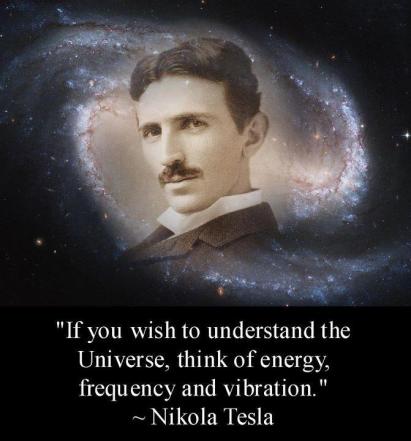
Scientifically this is called Cymatics, the study of vibrational frequencies manifested as sound and seen as form. It has been discovered that sound is an intimate aspect of all physical manifestations, from DNA to insects, plants, animals, and the entire the universe. This “sound” or “Word” is another aspect of the Force c2 =e/m, more commonly written as e=mc2.
“All things were made by him / God and without him was not any thing made that was made” (John 1:3) – establishing he only is Creator.
John is simply succinctly stating what Moses and multiple Hebrew prophets had elaborated previously.
“Thus saith God the LORD / YHVH,
- he that created the heavens, and stretched them out;
- he that spread forth the earth, and that which cometh out of it;
- he that giveth breath unto the people upon it, and spirit to them that walk therein…
I AM the LORD / YHVH: that is my name: and my glory will I not give to another, neither my praise to graven images.” (Isaiah 42:5, 8)
.John is making the clearest possible distinction between
- Israel’s God as Source of All Power, the One and Only Singularity,
- and the multitude of more-or-less powerful pagan gods accepted by the Greco-Roman culture of his day.
“In him was life.” (John 1:4)
This refers not only to the beginning but also the maintaining of life, since none of the pagan gods claimed to be creator. They did however claim to improve the quality of life for their worshipers in this world, and the quality of existence of the immortal soul after the death of the body. This was achieved either by stockpiling gifts by the wealthy in tombs, or by descendants making offerings to the gods on their behalf to alleviate the hunger and thirst the soul experienced in what yet remained, implacably, a dark Underworld.
“and the life was the light / mind / reason / soul of men. And the light shineth in darkness; and the darkness com-prehended / en-com-passed, absorbed it not” (John 1:4-5)
Again, John is referencing Moses’ account of creation as he asserts that this Singular God of Creation indeed has the power to overcome destructive forces.
“And the earth was / came to be without form, and void; and darkness was upon the [sur]face of the deep.” (Genesis 1:2)
NASA defines this as a black hole -man astronomical object with a gravitational pull so strong that nothing, not even light, can escape it. A black hole’s “surface,” called its event horizon, defines the boundary where the velocity needed to escape exceeds the speed of light, which is the speed limit of the cosmos. Matter and radiation fall in, but they can’t get out.
Chaos, (Greek: “Abyss”) in early Greek cosmology, is the name for the universe before order was imposed.
“And the Spirit of God moved upon the face of the waters. And God said, Let there be light: and there was light.” (Genesis 1:2-3)
“Who is like unto thee, O LORD, among the gods?” (Exodus 15:1-11)
And that’s the whole point that John is driving home to a Gentile audience.
There is no-one equal to the Singularity.
- “In the beginning was [already there] the Word – sound energy as force.
- and the Word was with / separate in action from God who was undiminished by his use of power
- and the Word was [simultaneously himself] God.
The same [Word/Force] was in the beginning with God.” – restated for emphasis as the key point of John’s theological argument. Both the Force of Creation and God are one being. One did not precede the other.
“And the Word was MADE flesh, and dwelt among us, (and we beheld his glory, the glory as of the only begotten of the Father,) full of grace and truth.” (John 1:14)
We can’t jump to the interpretation that Jesus = the Word. We must interpret the Apostle John’s phrase in the context of the scriptures from which he is drawing his point. “All things were MADE by him / God.“
“And God said, Let us MAKE man in our image, after our likeness: and let them have dominion.” (Genesis 1:26)
“And so it is written, The first man Adam was MADE a living soul; the last Adam was MADE a quickening spirit.” (I Corinthians 15:45)
Jesus is absolutely defined as a flesh-and-blood mortal human being, the Seed of the Woman, the last Adam.
What about Jesus’ claim that “Before Abraham was, I am.” Or “he that hath seen me hath seen the Father;” (John 14:9)? This was clarified previously when he “said also that God was his Father / absolute authority, making himself equal with God [in authority].” (John 5:17)
If Jesus began his existence as a co-equal with the Creator, a Greek-style god, he couldn’t die. And if Jesus couldn’t die, he couldn’t redeem humanity as the Seed of the Woman promised to defeat sin and death.
“These words spake Jesus, and lifted up his eyes to heaven, and said, Father, the hour is come…I have glorified thee on the earth: I have finished the work which thou gavest me to do. And now, O Father, glorify thou me with thine own self with the glory [of dominion over the earth] which I [in my prototype perfect human parents] had with thee before the world was [degenerated by sin as it now is].” (John 17:1-22)
Jesus only became completely one with the Singularity after the glory – dominion over sin and death – proven through his resurrection.
“God…Hath in these last days spoken unto us by his Son, whom he hath appointed heir of all things WHEN he had by himself purged our sins, sat down on the right hand of the Majesty on high…he hath by inheritance obtained a more excellent name…my Son, this day [of resurrection] have I begotten thee / declared thee my heir.” (Hebrews 1:1-5)


 Kingdom Come