
The Problem: By the mid 19th century it was obvious that Earth was much older than 6000 years,
It was not obvious.
There is no evidence for this claim. It was asserted out of the rejection of biblical moral authority as the article itself admits. “After all, if the Earth were too young for there to have been time for evolution, the evolution debate would be over.”
Initially, three lines of evidence for long ages of earth’s existence were pursued.
Each failed
- Hutton attempted to estimate age based on the application of observed rates of sedimentation to the known thickness of the sedimentary rock column, achieving an approximation of 36 million years. This was based on three false assumptions that 1) sedimentation occurs at a constant rate over time, 2) no compression has occurred in lower levels of sedimentary rock, and 3) no erosion or disruption of sedimentary layers has occurred in the 36 million years that have passed.
- Ocean salinity: In 1889 John Joly, acting on suggestion of Edmund Halley, attempted estimate based on the salinity of the ocean. He calculated the amount of salt [currently] being transported into the oceans by rivers and compared this to the salinity of sea water [assuming it was initially fresh water], obtaining an age of 90 million years. Joly missed that salt is removed from the oceans by various processes.
- Thermodynamics: Sir William Thomson, Lord Kelvin, during the late 19th century, assumed that the Earth had originally been molten then, using average melting point of rocks and the laws of thermodynamics, determined that the Earth would completely solidify within 20 million years. At the time the process of radioactive decay inside the earth generating new heat had not been discovered.
The Rift Valley of eastern Africa and Asia (sometimes called the Great Rift Valley [GRV] or East African Rift system [EAR or EARS]) is an enormous geological split in the crust of the earth,thousands of kilometers long, up to 125 miles (200 kilometers) wide, and between a few hundred to thousands of meters deep…and visible from space.
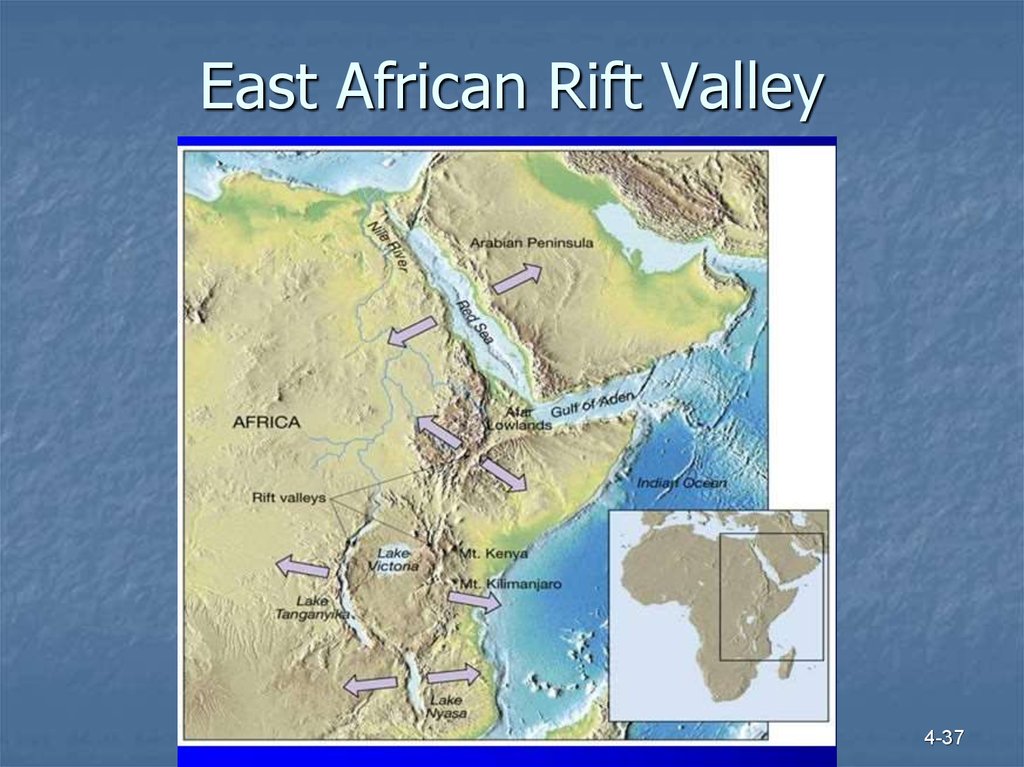
How many volcanoes are in the East African Rift Valley?
More than 100 young volcanoes – that have had activity within about 10,000 years.
So nothing in the Great Rift Valley can be honestly claimed to have lain in position for millions of years. The bottom literally dropped out no more than 10,000 years ago.
How fast is Africa splitting apart?
The Arabian plate is moving away from Africa at a rate of about 1 inch per year, while the two African plates are separating between half an inch to 0.2 inches per year…
The rapid uplift of these resistant rocks creates a high range…often exhibits large folds in which the rocks appear to have flowed instead of having been bent. Folds of this sort have formed at depths where the rocks were hot and soft before they reached the relatively cold surface of the Earth.
Despite this area of the world providing unequivocal evidence of catastrophism the Evolutionists who flock to this area for fossils ignore this and instead apply the extravagantly and unsubstantiated slow Uniformitarianism’s time frame – so they can shore up Evolution’s need for long periods of time for its biological processes.
This area is a ridge of sedimentary rock where researchers have found more than 10,000 fossils, both human and other hominins, since 1968. These fossils aid the scientific investigation of human evolution.

Lake Turkana has a geologic history that favored the preservation of fossils…dominated by an active volcano. Fossils unearthed in the Tulu Bor flood plain sediments, which blanket the basin near Mount Kulal, are embedded in tuff, or hardened volcanic ash.
All lakes, rivers, and streams carry sediment such as soil, sand, and volcanic matter…This process…slowly added layers…Over time the sediment solidified into rock. Bones of ancient humans, our hominin ancestors, and other animal species were buried in the sediment, and eventually became fossilized and preserved in the rocks.
But fossils are NOT formed “slowly, over time, eventually, while buried in the sediment” for the obvious reason that organic matter – including bones – quickly decomposes when exposed to the elements.
Fossils can only be formed by catastrophic processes that immediately prevent deterioration by suddenly covering the organic material.
So, bait and switch.
Scientists have been attempting to date them precisely by using the chemical fingerprints of volcanic ash layers found above and below the sediments in which the fossils were found.
The radioactive dating method is highly unreliable in itself.
In the early 1950s, scientists established theories for using the decay of radioactive potassium (40K) to argon (40Ar) as a clock for dating certain types of rocks…Of the eight assumptions [made about conditions affecting the material], none can be considered to rigorously hold in all situations. Therefore, dating by this method is at best a hypothesis…it is certainly not a scientific fact!
in southern Africa, hominid fossils are almost always found in caves like Rising Star. Here, there are no convenient volcanic layers. Instead, the bones are typically embedded within breccia—a concrete-like mixture of gravel, sand, and other junk that accumulated in the floor of the cave. These blocks might still be surrounded by informative layers called flowstones—sheets of calcite formed when water drips down the walls and floors of a cave. The water carries soluble uranium, which remains in the flowstone and decays over time into thorium and lead. Again, the levels of these elements reveal the age of the layer…
Strike that for the same reason as the K-A unreliability – assuming uniformity of levels of atmospheric and geological elements which is known not to be the case, especially over the millions of years required for the conceptual process of evolution.
All of these dating processes rest on Uniformitarian assumptions that there has been only a gentle dispersion of mass ranging as small as atoms to mountains over millions of years, which, as demonstrated above, is insupportable. Especially during volcanic explosions! Common sense, people!
Evolution’s arbitrary designation of dating procedures to conform to its uniformitarianism belief system proves that it is based strictly on belief against the evidence.
National Geographic’s educational material is nothing but indoctrinational.
[S]cientists at Britain’s University of Bristol developed a lab-based process using 1) clay, 2) pressure and 3) heat in which fresh specimens can be converted into “synthetic” fossils within approximately one day.
Volcanic activity is the source for making “natural” fossils in a short period of time.
[T]he fossil beds of northern China are famous—both for their exceptional preservation and for their incredible diversity…
Now researchers say the living beings were likely killed by a series of volcanic eruptions…The ash entombed and preserved them, much like the doomed victims of Pompeii. (See also “Pompeiians Flash-Heated to Death—No Time to Suffocate.”)…
The fossils at Pompeii were formed as the cast type, in which the only the three dimensional shape is preserved. The rock quickly hardens around the body which quickly desiccates “ashes to ashes, dust to dust”. The fossils beds of northern China include the bodily form created by the additional factor of 4) water transportation which replaces decaying organic matter with minerals.
Exactly like petrified wood.
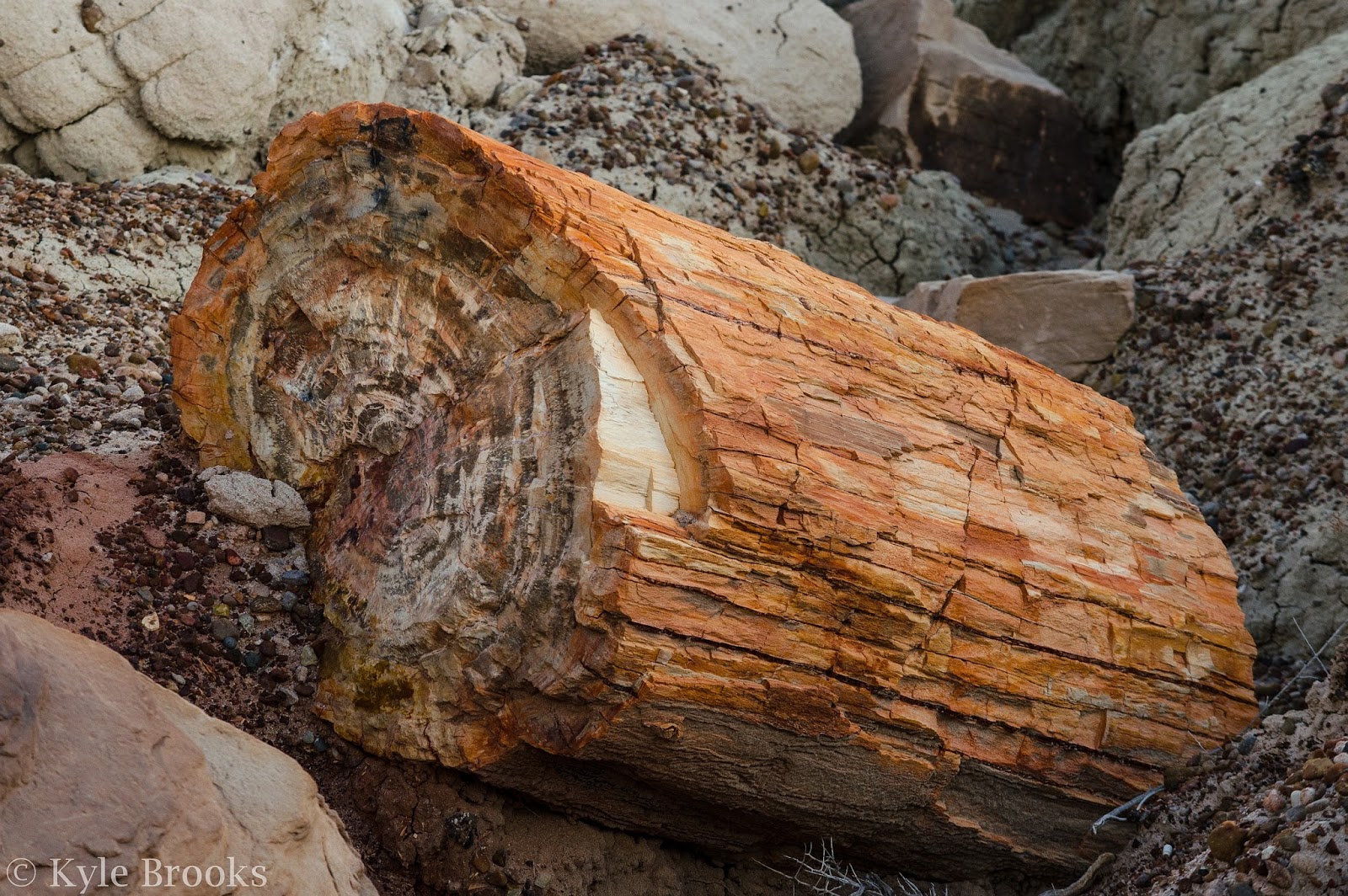
The Petrified Forest National Park
Why is this location special? Mostly because of extremely favorable conditions that allowed to preserve the wood…Huge trees – up to 200 feet tall and 9 feet in diameter…
The area was also volcanically active,..
Floods or eruptions, as opposed to minor regular events such as normal accumulation of sediment over time, allow wood and specimens to get covered rapidly without oxygen. This swift burial protected some of the freshly fallen trees from major damage by oxygen and insects. The dissolved ash was replacing [the organic material] with silica. Other minerals, iron, and manganese were also mixed in, which gave the resulting rock a palette of colors…
petrified wood is not rare. It is found in many fossil beds, in volcanic deposits, sedimentary rocks, and various other formations. At times, it can be exposed after severe storms washing now underwater forests ashore. It can be exposed during digs that clear off ancient volcanic ash and mud…
How long can a dead body remain soaking in water to “slowly” replace organic matter with minerals?
In tropical waters such as the Arabian sea, it’s a different story…Putrefaction and scavenging creatures will dismember the corpse in a week or two and the bones will sink to the seabed. There they may be slowly buried by marine silt or broken down further over months or years, depending on the acidity of the water.
This disproves the evolutionary claim that “millions of years” passes to form fossils. Not only is it not a requirement, it can’t even be a possibility.
The evidence is that fossils were formed rapidly through a world-wide process including
- volcanic activity providing heat and mineral-rich ash,
- tectonic activity accompanying the volcanic activity providing pressure, and
- massive amounts of water providing both pressure and injection of mineral.
The reality is that even National Geographic frankly states that all dating methods are highly unreliable. “Ask an archaeologist how old the site they’re excavating is, and they may not have an answer.“


 Kingdom Come
