-
“How art thou fallen from heaven, O Lucifer, son of the morning! how art thou cut down to the ground, which didst weaken the nations!…Yet thou shalt be brought down to hell, to the sides of the pit.” (Isaiah 14:12-15)
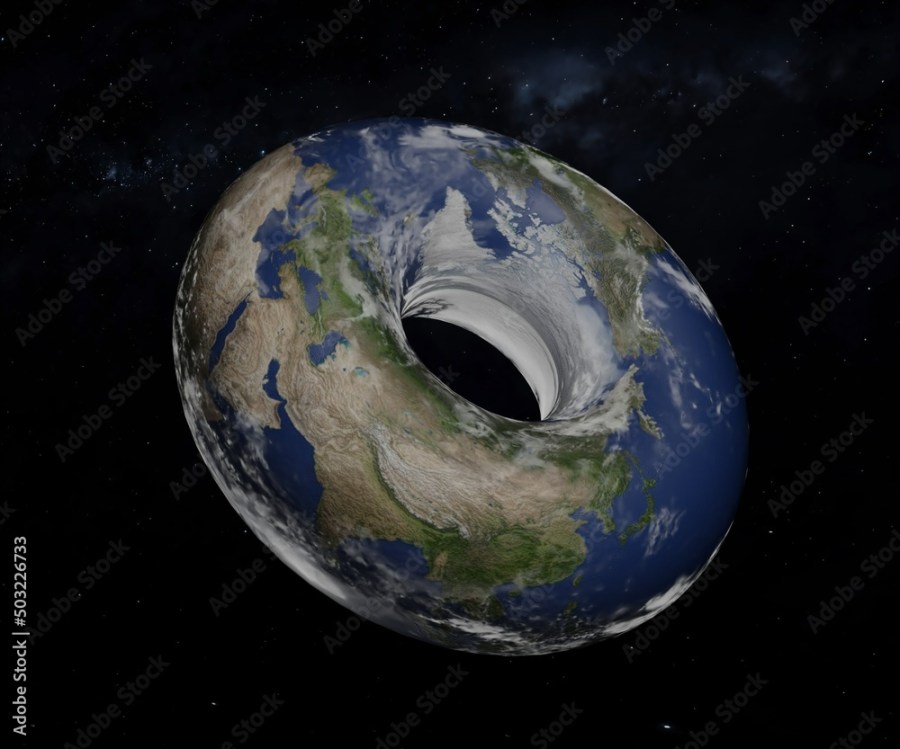
A planet in the shape of a type of oblate spheroid, a toroid, informally called a donut because it has a hole in the middle, is possible. “However, there is no firm theoretical understanding as to how toroidal planets could form naturally.”
This explanation is obviously denying Creation, but covering up scientific evidence as well.
“Since the work of Safronov (1972), planet formation has been understood to be a bottom-up process whose initial phases…[are] disks.” That’s another word for “spheroid”, of which a toroid is one type.
-
“The idea of a toroidal Earth was first mooted in 2008, in a post on the messageboards of the Flat Earth Society. That in itself should have been enough to tell people that it wasn’t a serious suggestion.”
Ahh, using mockery as a weapon when the so-called intelligentsia have no facts.
In fact, even when they do, many sources continue to frankly deceive the general public.
Published 2025 after it was publically admitted that the earth is a flatted spheroid: From the offset, we need to state that no, of course Earth isn’t donut-shaped. That can be proved in all manner of ways [name three], but the best and most obvious evidence is pictures of Earth taken from space, and it is patently, undeniably round, as this image captured during the Apollo 17 mission clearly shows. Credit: NASA
-
September 2024: Scientists have uncovered a vast donut-shaped structure which runs in a ring around the edge of the liquid outer core and could be responsible for driving our planet’s protective magnetic field.
Without saying as much, it appears to the informed reader that the ignorant claim that there must be a iron-rich core at the center of earth to account for earth’s magnetic field despite the obvious source being the recently discovered Van Allen Belts, we must logically attribute this donut-shaped structure to a toroidal earth.
-
- for the precious things of heaven…
- and for the deep / tehom / abyss that coucheth beneath.” (Deuteronomy 33:13)
-
The ancient heraldic use – ergo in the context of war banners – couchant (“lying down with the head up”), and in the late 15th century referencing a crouching beast of prey, expands the understanding of this word as meaning “lie hidden”.
The 66 citations in the Hebrew Old Testament is the unimpeachable source for the New Testament’s Greek translation of this place as ἄβυσσον (abysson), “the abode of devils.”
“Canst thou by searching find out God?
- as high as heaven; what canst thou do?
- deeper than hell / Sheol;“(Job 11:7-8)
-
-
“Who shall ascend into heaven?
- (that is, to bring Christ down from above:)
- Or, Who shall descend into the deep? (that is, to bring up Christ again from the dead.)” (Romans 10:6-7)
-
-
- The writings directed to the Gentile converts – Luke’s gospel, Paul’s ministry documented in Acts, and Peter’s letters – did not need explanation because their audience understood them. Ancient Hindu records refer to the underworld as Patala, ruled by the king of the underworld Ahiravan. Buddhists believe in Naraka. In Thracian and Dacian legends, it is said that there are caverns occupied by an ancient god called Zalmoxis. In Celtic mythology there is a legend of a cave called “Cruachan“, also known as “Ireland’s gate to Hell”.
-
-
-
- Tartarus = In Greek mythology, Tartarus was a “place of punishment under the earth, to which, for example, the Titans were sent.”
- Hades = ᾍδης “(from 1 /A “not” and idein/eidō, “see”) – properly, the “unseen place,” hell, the (invisible) realm of pure energy disembodied souls in fiery torment for those who rejected a relationship with the giver of life. “Christ also hath once suffered for sins…he went and preached unto the spirits in prison;” (I Peter 3:17-19) Whom God hath raised up…David speaketh concerning him…thou wilt not leave my soul in hell / hades.” (Acts 2:22-36)
- When we understand where exactly it was that Jesus knew he was going to as part of suffering the penalty of sin for all humanity, his experience on the cross pales in comparison, and we should be shocked into awareness of what exactly he suffered to save our souls from our own justly earned wrath of God.
- sheol: שְׁאוֹל (Hebrew) underworld to which people descend at death to Rest In Peace.
- I will go down into sheol / the grave unto my son” (Genesis 37:35) Consistent with the First Law of Thermodynamics which states that energy can only transformed from one form to another, the grounding of souls at the loss of the body converts active kinetic energy to inactive potential.
- Bottomless pit / the deep = ἄβυσσος, the abyss, unfathomable depth. “And I saw an angel come down from heaven…And he laid hold on the dragon, that old serpent, which is the Devil, and Satan, and bound him a thousand years, And cast him into the bottomless pit,” (Revelation 20:1-2)
- This condition of entrapment and inactivity is well portrayed in Netflix’s adaptation of Neil Gaiman’s The Sandman. When the Immortal Sandman was separated from his sources of power he reverts to a horrible state of inactive energy yet still sensate in a glass bubble.
- “And the fifth angel sounded, and I saw a star fall from heaven unto the earth: and to him was given the key of the bottomless pit. And he opened the bottomless pit; and there…came out of the smoke locusts upon the earth: and unto them was given power / authority, irresistible control, as the scorpions of the earth have power.” (Revelation 9:1-3)
-
-
-
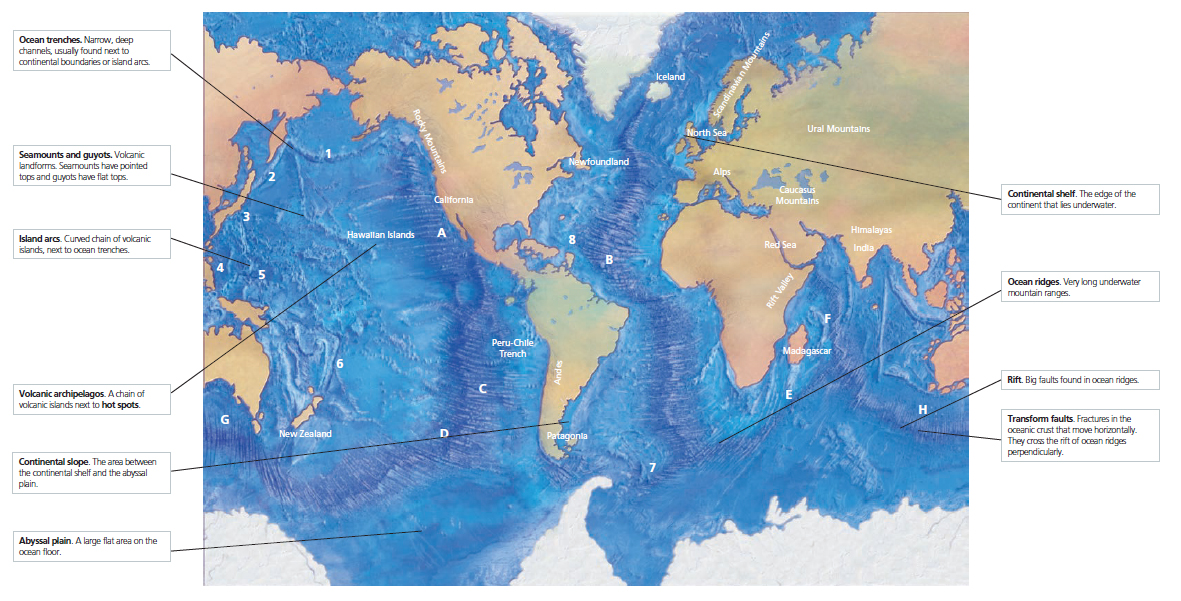
The abyssal zone covers 85% of the total ocean’s surface, and 60% of the total earth’s surface, poorly indicated on this topographical map.
We know this rectangular map doesn’t accurately reflect the shape of earth, but if we conform the actual geography into a three-dimensional oblate spheroid, joining the deepest parts of earth at the center, that would make a toroid with the floors of the abyss forming the wall of the inner hole of the donut, measuring only 60% of the exterior surface area.
-
-
-
-
-
-
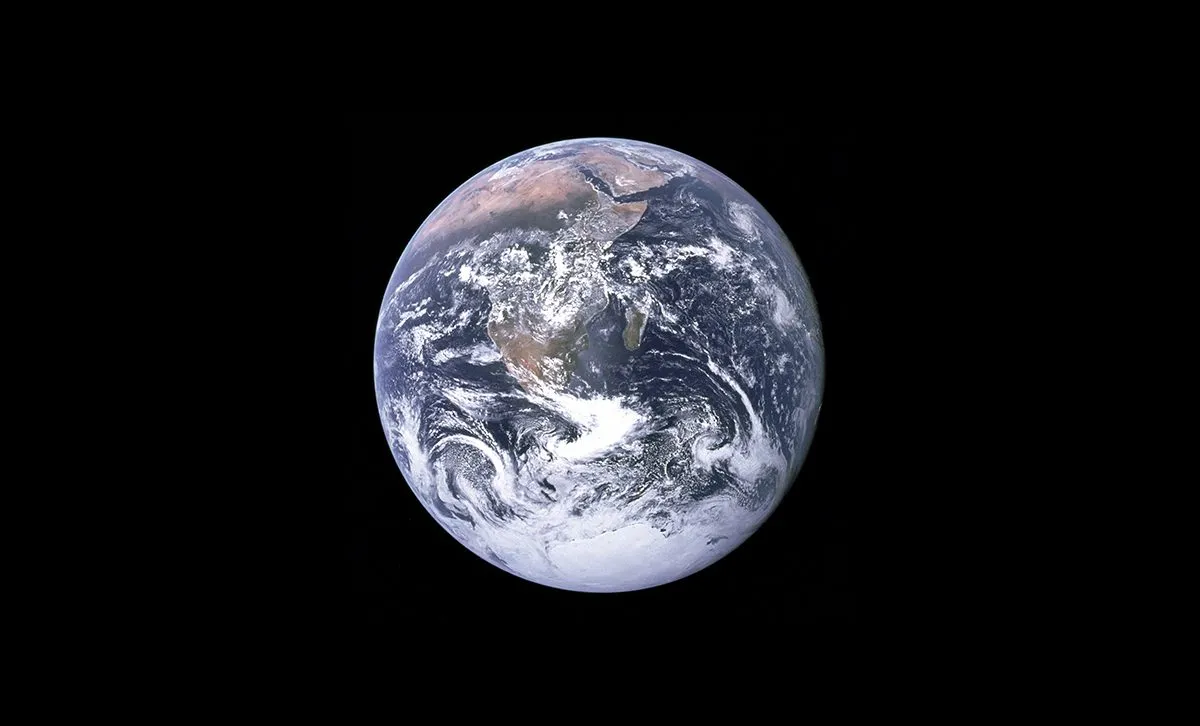
[Hastily backtracking] Of course, Earth isn’t entirely round. It’s not a sphere, it’s an oblate spheroid – a sphere that’s been flattened slightly at the top and bottom.
Seriously? Using false evidence to prove a point, then admitting it’s false without acknowledging that if earth is in fact an oblate spheroid it could be a type that is also a toroid with a narrow, perhaps invisible, hole..
It would be thicker at the outer edges, i.e. allow much more room for the habitable continents, than it is towards the hole in the donut. It would have an inner and outer equa-tor, i.e. lateral conditions circling the maximum and minimum circumferences being “equal”. The magnetic poles would still be at the top and bottom with each pole being a very narrow ring on the donut’s uppermost and lowermost surfaces, as opposed to a specific point as it is on Earth.

And so we find that scientific evidence supports the biblical account of hell on earth.
“Blessed of the LORD be his land,

 Kingdom Come