
Imagine Adam’s horror when he saw his wife after she was affected by her substance use. The above image of before and after methamphetamine use gives an idea of what Adam might have seen, what God certainly sees, and what ministers in God’s kingdom can ask God to open their eyes to see – the nature of everyone who is spiritually the “walking dead”, mindlessly straining to lay hold on an illusory source of life.
“and gave also unto her husband with her; and he did eat.” (Genesis 3:6)
When God asks Mr. Adam for an explanation for his action, he is often accused of blame-shifting to his wife.
“The woman whom thou gavest to be with me, she gave me of the tree.” (Genesis 3:12)
Plotted as it was by the Adversary, Adam’s act of eating the fruit was certainly condemned by “the accuser of the brethren” – and legalistic religionists – but it condemned by God?
A good ending has certain elements…the character has achieved their main goal.
- Resolution: An ending must always wrap up and resolve the central conflict you laid out in the beginning of the novel.
- In this case, the central conflict is the fallen angels’ determination to pillage and destroy what they envied but could not have.
- Transformation: A story’s ending should bring a powerful close to your character development.
- In this case, Ha-Adam, The Human develops from an innocent being to a warrior capable of facing off against the most powerful adversary in the universe.
- Suspense: A story’s ending is intensified when there’s a moment when the main character might not succeed. That last-minute tension makes the ending more satisfying when the main character overcomes their obstacles.
- That tension is recounted right after the cloned human, the woman, chooses to disconnect from the Singularity’s source of life to engage with the Adversary. Is all lost?!
- Surprise: Readers follow a character’s story to be entertained. Satisfying endings have an element of surprise. Predictable endings will make a great story fall flat. There are plot twists and clues and predictions up to the last Revelation of the mystery – Surprise! How did the protagonist win in the face of apparent defeat?!
-
The fruit law given to the first humans is not a moral law, simply a law of nature – “If you eat the fruit, you die.” No different from “if you drink poison, you die.” Death was a consequence, an unstoppable chain reaction of physical effects, but eating the fruit wasn’t the sin.
-
Eating the fruit in order to become spiritually independent of God was the sin.
“Adam was not deceived, but the woman being deceived was in the transgression.” (I Timothy 2:14)
The Reader’s Digest Condensed Version would write that “Adam was not…in the transgression.”
-
Understanding what is means to have dominion is the key to understanding a hermeneutical version of Adam’s action. Humans are not animals with instincts, or military grunts with orders or robots with preprogrammed responses to circumstances.
Turns out the priority commandment documented in scripture up to this point is found in the preceding chapter.
“because she was taken out of Man therefore shall a man leave his father and his mother, and shall cleave unto his wife: and they shall be one flesh.” (Genesis 2:23-24)
“Have ye not read, that he which made them at the beginning…said, For this cause [because humans are the penultimate full image and likeness of God] shall a man leave father and mother, and shall cleave to his wife: and they twain shall be one flesh [like the Singularity has no divisions]? What therefore God hath joined together, let not man put asunder.” (Matthew 19:4-6)
And so Adam simply obeys God’s word to leave his father and mother – which in his case is God – and instead cleave to his wife, and not put her asunder.
- The woman whom thou gavest to be with me – The woman you entrusted to my care, for whom I am responsible
- she gave me of the tree – she already had it and was doomed
- and I did eat – I couldn’t leave her alone, we are one flesh.
The Lord of the Rings brings to life a host of biblical concepts, including this one in which an immortal being chooses mortality.
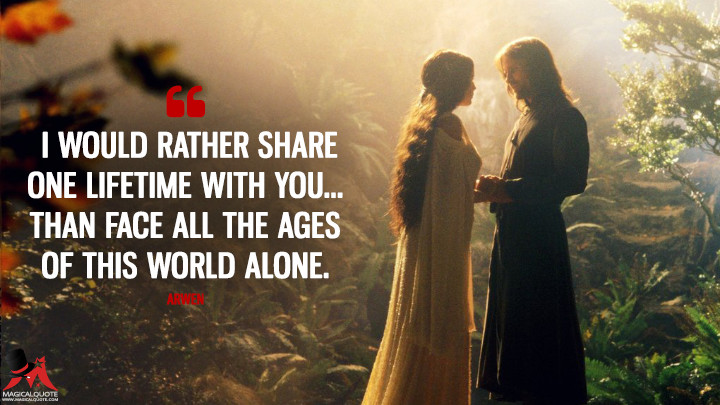
When God created humans with freedom of action he only created the potential to love – identify fully with another.
Can we not see that by uniting with the Woman in death, Adam acted as God had – giving life, by connecting her to himself instead of leaving her in isolation under the Adversary’s solel control.
It was by the action of giving his life to his wife that the first human son of God developed his greatest likeness to God, grand-slamming anything the brilliant spirit son of God Lucifer had to show in competition.
“love is of God; and every one that loveth is born of God, and knoweth [is one mind with] God… If we love one another, God dwelleth in us, and his love is perfected in us.” (I John 4:7, 12)
The following dogma, claimed as uniquely Christian, is just as fully applicable to the first mortal human.
“Greater love hath no man that this, that a man lay down his life for his friends [intimate acquaintances]…God commendeth his love toward us, in that, while we were yet sinners [like the woman in the Garden of Eden], The Promised One / Christ died for us [like Adam for his wife].” (John 15:13, Romans 5:7-8)
The consequence of Adam uniting to his sinful wife is that she was therefore united with him in his righteous relationship with the Father. This is why “Adam…is the figure of him that was to come [the Savior].” (Romans 5:14)
Without having any catechism or religious upbringing in an assembly of believers, Adam nailed it on his first test.
That should send chills down your spine. This fragile, childishly innocent human countered the most powerful, evil monster in the universe in his first move, simply by choosing to act according to the word of God, even to apparent failure, to death! – instead of leaning on his own understand or acting on his own self interests.
Adam could not have proven his likeness to God without having the opportunity to love the Woman AFTER she needed to be sacrificially loved.
Adam’s ultimate likeness to God – and the revelation to all creation of God’s own love – was perfected when Adam took the initiative to act out of consideration for his wife’s welfare instead of his own.
“Who his own self bare our sins in his own body on the tree, that we, being dead to sins, should live unto righteousness:” (I Peter 2:24)
This first act of a human Son of God voluntarily sacrificing his life is absolutely fundamental to Christianity and can be recognized as such when we put Adam’s name in the actions quoted by Paul.
“Husbands, love your wives, even as Christ / The Chosen One / Ha-Adam the Human instead of Lucifer also loved the church / fellowship, and gave himself for her, that he might take away the corruption caused by her action, wiped clean of decay by the power of the word that gave life in the first place, that he might present her to himself a glorious wife restored to perfection.
For this cause Adam separated himself from his heavenly Father, and joined himself to his wife by eating the fruit and experiencing death with her, so they could continue to be united, have the same flesh. This is a great mystery, that is revealed as the story progresses.” (Ephesians 5:25-32)
As you read the following New Testament passage, consider where Paul got his material.
“we ourselves also [like the Woman] were sometimes foolish, disobedient, deceived, serving divers lusts and pleasures.”
“But after that the kindness and love of God [and Adam made in his likeness] our Saviour toward [sinful hu]man appeared”
That describes Adam exactly, “Who, being in the form of God, thought it not robbery to be equal with God:” (Philippians 2:6) showing up at the tree of the knowledge of good and evil with, not only a horrified and shocked look on his face, but pity and compassion.
Love is not a good feeling. It is not feeling attracted to another. It is, in fact, the opposite of lust.
Love is identifying oneself with another through commitment, determination to stay even when things go from bad to worse, willingness to suffer and sacrifice. Every loving parent should grasp this intuitively. We choose to have children, disrupting and even risking our lives, spending our money on them instead of us, because we want to experience unity with them. We choose to stay married for the sake of the children’s welfare rather than leave to find fulfillment of personal desires.
“for he [the LORD and Adam] hath said, I will never leave thee, nor forsake thee. So that WE may boldly say, The Lord is MY helper, and I will not fear…YHVH’s Savior – the same yesterday, and to day, and for ever.” (Hebrews 13:4-8)
What Adam’s commitment to his marriage partner made possible for her was that, when she chose likewise to identify herself with Adam, she was able to be restored to a relationship with God for eternal life.
“Good Master, what good thing shall I do, that I may have eternal life?… Jesus said unto him, If thou wilt be perfect, go and sell that thou hast, and give to the poor, and thou shalt have treasure in heaven: and come and follow me. But when the young man heard that saying, he went away sorrowful: for he had great possessions.” (Matthew 19:16-23)
When Adam willingly gave up everything including his life to give companionship / i.e. life to his utterly impoverished wife, he demonstrated what it means to seek first the kingdom of God and his righteousness (Matthew 6:33)
Alfie is a 1966 a box office success, receiving critical acclaim becoming an influential part of British cinema. It tells the story of a young man who leads a self-centred life, using women only for his personal advantage, for sex and for domestic purposes. In the end, he discovers that what he thought was power was in fact loneliness. The title song questions “What’s it all about, Alfie?” and answers that “there is something even unbelievers can believe in.” Love.
Only humans spiritually connected to God can demonstrate what love is all about.
-


 Kingdom Come