
“avoiding profane and vain babblings, and oppositions of science falsely so called: Which some professing have erred concerning the faith.” (I Timothy 6:20-21)
The first major change in scientific thought was in the field of biology. Linnaeus, the Swedish biologist, had proposed the first successful taxonomy of all species of plants and animals. This taxonomy abandoned the theory of the chain of being that claimed that all living creatures formed an unbroken scale of complexity and nobility, terminating with the most complex and noble of all, humanity. Instead, Linnaeus showed that life could be divided into separate categories, each divergent from the others.
How does this make sense? Evolution is the theory of a chain of complexity, so Linnaeus’ “abandonment” of this idea cannot support Evolution.
The truth is that Linnaeus was not abandoning anything but building on Aristotle’s (384–322 BC) existing classification of animal species in his History of Animals, while his pupil Theophrastus (c. 371–c. 287 BC) wrote a parallel work, the Historia Plantarum, on plants.
Linnaeus’ work is considered the beginning of modern botanical and zoological taxonomy – system of assigning names to plants and animals in an orderly classification based on their presumed natural relationships.

Linnaeus was a devout Christian who believed that “The study of nature would reveal the Divine Order of God’s creation, and it was the naturalist’s task to construct a ‘natural classification’ that would reveal this Order in the universe.”
His classification system is consistent with the biblical account of plants being created in all their varieties, then fish and fowl in all their varieties, then earth animals in all their varieties.
The second major change in scientific thought was in the field of geology.
Traditional geologists held that the catastrophes described in the Bible, such as Noah’s flood, had actually taken place and caused many of the signs of geological change that could be seen. This view was known as catastrophism. An alternative to catastrophism was the view called uniformitarianism. Proponents of uniformitarianism argued that the world’s current geological state was the result of uniform forces working slowly over long periods of time.
Uniformitarianism was one of the foundations of evolutionary thought [apparently despite its self-contradiction] because it provided a geological analogy for biological change: both were the result of gradual forces working over extremely long time periods.
In 1830 Lyell published Principles of Geology promoting uniformitarianism.
Charles Lyell’s Principles of Geology was met with a lot of criticism when it was first published.
-
-
-
-
-
-
Lyell was pulling from a theoretical idea instead of pulling from empirical evidence to explain what was occurring in the geological world…evidence is needed to support an idea, and the evidence of geologic events points to a catastrophic events.
Another argument Lyell faced was that in 1812, Baron Georges Cuvier and his colleagues found intermittent patterns of sudden fossil disappearance in the geologic record. Now known as mass extinction, Cuvier explained these sudden changes in the geologic record with catastrophic forces.
Lyell responded by stating that the geologic record was “grossly imperfect” and that observations cannot be trusted if they go against “the plan of Nature”. His plan, that is, of Evolution.
To this day, Lyell’s Principles of Geology is the foundation of modern geology.
-
-
That’s simply incredible. Literally
Today, we hold
- uniformitarianism to be true
- and know that great disasters such as earthquakes, asteroids, volcanoes, and floods are also part of the regular cycle of the earth.
The third major change in scientific thought was in the field of time.
-
-
-
-
-
-
Charles Lyell’s Principles of Geology introduced a “new explanation of time” based on philosophical musings, and he was accordingly elected as a member to the American Philosophical Society. His “eloquence…convinced a wide range of readers of the significance of Deep time” required for the new idea of uniformitarianism shaping geology, as well as the new idea of evolution.
When in 1859 Charles Darwin published Origin of Species he wrote “He who can read Sir Charles Lyell’s grand work…yet does not admit how incomprehensibly vast have been the past periods of time, may at once close this volume. “
-
-
-
-
-
-
Good advice. Lots of scientific advances in understanding time had already been made before Darwin supported his theory of Evolution, and even more in the 200 years since.
In 1850 the French physicist Sadi Carnot had already established the second law of thermodynamics: entropy (the amount of disorder) must always increase.
-
-
If time = increased chaos, how can Darwinian Evolution claim that vast eons of time increased the organization of first atoms, then molecules, then cells, then organisms, then plant and animals and finally the highly organized ecosystem we have today?
It can’t.
-
-
The discovery of the natural radioactive decay of uranium in 1896 by Henry Becquerel, the French physicist, opened new vistas in science. In 1905, the British physicist Lord Rutherford–after defining the structure of the atom– made the first clear suggestion for using radioactivity as a tool for measuring geologic time directly.
 A chemical element consists of atoms with a specific number of protons in their nuclei but with variations in the number of neutrons. Atoms of the same element with differing number of neutrons are called isotopes.
Radioactive decay is a spontaneous process in which an isotope loses particles from its nucleus to form a daughter isotope…Some isotopes decay slowly, and several of these are used as geologic clocks.
Dating rocks by these radioactive timekeepers is simple in theory, but the laboratory procedures are complex. The numbers of parent and daughter isotopes in each specimen are determined by various kinds of analytical methods.
Furthermore, only certain types of rocks, chiefly the igneous which crystallize from volcanic magma, can be dated directly by radiometric methods.
 Sedimentary rocks such as sandstone, limestone, and shale are dated by association with igneous rocks, as shown by a hypothetical example. The layers of sedimentary rocks below the volcanic ash bed are obviously older than the ash, and all the layers above the ash are younger.
But how much older or younger?
Many points on the time scale are being revised as the behavior of isotopes in the Earth’s crust is more clearly understood.
The fact is that radioactive isotopic evaluation is NOT the basis for establishing the age of the earth.
Geologists use fossils to determine the age of the rock layer that it was found in. We know that if a fossil once lived on Earth 260 million years ago, the layer that it was fossilized in must be at least 260 million years old. Geologists can then determine that layers around the world that contain that same fossil must be 260 million years old.
The first life appeared about 3.2 billion years ago in the form of algae, a simple single celled plant. Scientists know that life on Earth has changed over time and that the life has become increasingly more complex. Scientists also know that these changes didn’t occur over night, sometimes it took millions of years for these plants and animals to evolve.
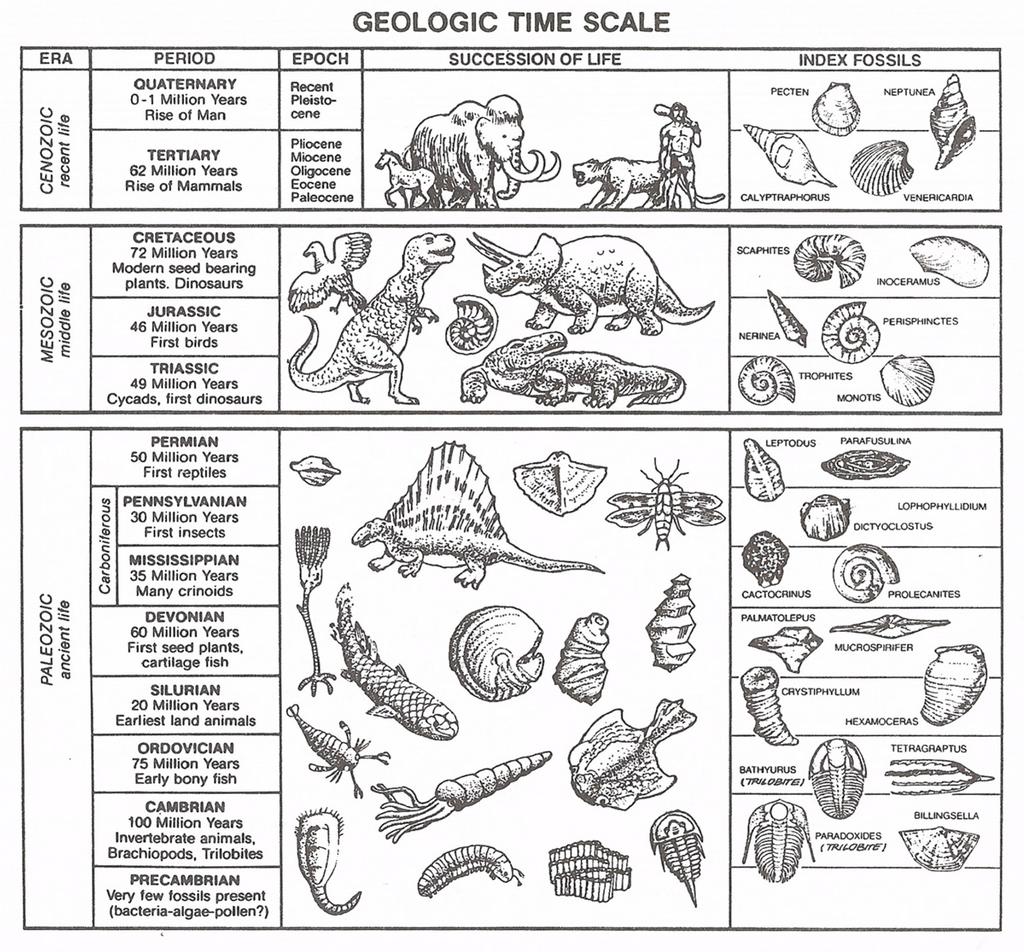
How do they know?
How did the remains of massive sea creatures end up at an altitude of 9,186 feet (2,800 meters) when according to Lyell it took millions of years for the African tectonic plate to push up against the European tectonic plate into the mountains atop which these fossils are found?
Just how much do fossils support evolution’s claims?
Fossils are rare since the conditions have to be right for them to form.
“The fossil record is clearly incomplete, and it is clearly biased by many factors…
So, is the fossil record more like 1 or 50 percent of reality? Benton doesn’t know. And his new paper suggests no else does either.
This lack of discovery should have eliminated evolution as a scientific consideration.
It is a philosophy, or to be more precise, a religion.
At the same time that geological uniformitarianism was supplanting catastrophism and biological evolution was replacing creation, the most esteemed academic circles in Germany and England were applying a new method of biblical analysis called Higher Criticism. Influenced by prevailing Renaissance Enlightenment goals to free society from the heavy hand of theological conviction, it eliminated divine origin to the Bible, reducing it to human history and philosophizing. By the end of the nineteenth century the Higher Critics had been embraced by influential figures in the media, universities and seminaries, becoming known as modernists or liberals who accepted evolution as the only alternative to biblical creation.
It is not chance that the wealthy class who controlled academia, the sciences and politics joined forces at this time to eliminate biblical mores. Germany and England were building empires by wiping out native inhabitants of colonial conquests and exploiting the lower classes at home.
Currently, academia and science are clinging to uniformitarianism and biological macroevolution despite an enormous amount of information that has been collected supporting catastrophism and intelligent design.


 Kingdom Come