
The FACT is that science acknowledges what the Bible documents, that one mother and one father parented all human beings alive today. As detailed in the previous post, Eve has been tracked through mitochondrial DNA passed down the generations only in the mother’s egg cell. Adam has been tracked through the male-only Y chromosome on which geneticists have isolated distinct human Y-chromosome DNA haplogroups / differences due to mutations.
According to extensive DNA-sequencing analysis of the Y chromosome, “Every time human DNA is passed from one generation to the next it accumulates 100–200 new mutations.”
However, by arbitrarily applying a low calculation that the human Y-chromosome accumulates only 1-2 mutations per generation, Adam is estimated to have lived roughly 236,000 years ago.
When we apply the scientifically known factor of 100-200 mutations per generation, we arrive at the calculation of only 2,000 -4,000 years since the Most Common Ancestor. This is consistent with the biblical account of the creation of mankind in 4,000 BC and Noah having inherited Adam’s unmutated DNA about 2350 BC.
The mutations found in world-wide male Y-chromosomes have been categorized into “haplo-groups” of mutations unique to – never shared by – each haplogroup, labeled groups A-T.
Can we not recognize the entrenched bias in Evolution ignoring all scientific research fundamentals?
The equally entrenched racism by the elites inventing Evolution at the time colonial Europeans were cruelly enslaving non-whites is also flagrantly exhibited in the study’s use of apes to date the stages of human evolution from non-whites to whites.
The ancestral state of a Y-SNP marker is usually determined by comparison to a chimpanzee DNA sequence for the same marker (Underhill et al. 2000).
According to other genetic studies, at one time in the past humanity experienced a “population bottleneck…a sharp reduction in the size of a population due to environmental events such as…flood…[M]ost Eurasian men (living outside Africa)… can be traced back to four ancestors.”
Those are quotes from genetics studies, not fundamentalist Creationists.
The timing of the genetic bottleneck determined by the genetics study is consistent with the biblical time of Noah’s flood, and marks Noah, only “the seventh from Adam” who was “perfect in his generations” i.e. genetic ancestry, as carrying the original human’s created perfect genetics.
- Noah…begat three sons,
- Shem
- Ham
- Japheth (Genesis 6:9-10)
However, the investigators doggedly deny the validity of the historical biblical account, which is much too recent in time for the Evolutionary model.
This is simply in keeping with the study’s internal unreliability and external invalidation by scientific knowledge and establishes the unscientific nature of their conclusions in ranking the Y Haplogroups over vast stretches of time.
Chronological development of haplogroups
| Haplogroup | Possible time of origin | Possible place of origin | Possible MRCA |
|---|---|---|---|
| A00 | 235,900 or 275,000 years ago | Africa | 235,900 years ago |
| BT | 130,700 years ago | Africa | 88,000 years ago |
| CT | 88,000 or 101-100,000 years ago | Africa | 68,500 years ago |
| E | 65,200, 69,000, or 73,000 years ago | East Africa or Asia | 53,100 years ago |
| F | 65,900 years ago | Eurasia | 48,800 years ago |
| G | 48,500 years ago | Middle East | 26,200 years ago |
| IJ | 47,200 years ago | Middle East | 42,900 years ago |
| K | 47,200 years ago | Asia | 45,400 years ago |
| P | 45,400 years ago | Asia | 31,900 years ago |
| J | 42,900 years ago | Middle East | 31,600 years ago |
| I | 42,900 years ago | Europe | 27,500 years ago |
| E-M215 (E1b1b) | 42,300 years ago | East Africa | 34,800 years ago |
| E-V38 (E1b1a) | 42,300 years ago | East Africa | 40,100 years ago |
| N | 36,800 years ago | Asia | 22,100 years ago |
| E1b1b-M35 | 34,800 years ago | East Africa | 24,100 years ago |
| R | 31,900 years ago | Asia | 28,200 years ago |
| J-M267 (J1) | 31,600 years ago | Middle East | 18,500 years ago |
| J-M172 (J2) | 31,600 years ago | Middle East | 27,800 years ago |
| R-M173 (R1) | 28,200 years ago | Asia | 22,800 years ago |
| I-M253 (I1) | 27,500 years ago | Europe | 4,600 years ago |
| I-M438 (I2) | 27,500 years ago | Europe | 21,800 years ago |
| R-M420 (R1a) | 22,800 years ago | Eurasia | 18,300 years ago |
| R-M343 (R1b) | 22,800 years ago | Eurasia | 20,400 years ago |
| I2-L460 (I2a) | 21,800 years ago | Europe | 21,100 years ago |
| I2a-P37 | 21,100 years ago | Europe | 18,500 years ago |
| E1b1b-M78 | 19,800 years ago | Northeast Africa | 13,400 years ago |
| I2a-M423 | 18,500 years ago | Europe | 13,500 years ago |
| I2a-M223 | 17,400 years ago | Europe | 12,100 years ago |
| N1c-M178 | 14,200 years ago | Asia | 11,900 years ago |
| R1a-M17 | 14,100 years ago | Eastern Europe | 8,500 years ago |
| R1b-M269 | 13,300 years ago | Eastern Europe | 6,400 years ago |
| E1b1b-V12 | 11,800 years ago | North Africa | 9,900 years ago |
| E-U175 (E1b1a8) | 9,200 years ago | East Africa | 8,500 years ago |
| E1b1b-V13 | 8,100 years ago | Southern Europe | 4,800 years ago |
| E-M191 (E1b1a7) | 7,400 years ago | East Africa | 6,400 years ago |
| E-U174 (E1b1a-U174) | 6,400 years ago | East Africa | 5,300 years ago |
| R1b-L151 | 5,800 years ago | Eastern Europe | 4,800 years ago |
| R1a-Z280 | 5,000 years ago | Eastern Europe | 4,600 years ago |
| R1a-M458 | 4,700 years ago | Eastern Europe | 4,700 years ago |
The most informative element of the time chart should be glaringly obvious, and it’s not even the pervasive use of the modifier “possible”.
It is the fundamental irrationality and mind-boggling claim that a current population exists that has remained stable, without any mutations, for 16,500-9,600 generations, directly contradicting
- the basic definition of Evolution as constantly occurring mutations,
- and their own study defining all the rest of the groups through constantly occurring mutations
- so the total span of time between each group’s genetic stability is enormous while during this same time mutations were ongoing and forming other haplogroups.
Just a couple of examples:
- Haplogroups A & B are considered direct descendants of Y-chromosomal Adam, originating from 275,000 to 130,000 years ago. They continue to the present in Africa as the Khoisan populations in the southwest and Nilotic populations toward the northeast in the Nile Valley.
- Haplogroup C possibly originated 100,000 years ago in Africa currently found – in the exact same condition but far from each other in Asia, Oceania, and North America, where despite being exposed to diverse environmentally exclusive mutagens were not affected by them.
- Haplogroup D possibly originated 70,000 years ago in Africa currently found in Tibet, Nigeria, and the Middle East. How did members of this group manage to live among other groups in the populous Fertile Crescent (get the pun?) for 70,000 years without other haplogroups genetics’ jumping into their gene pool?
Advances in knowledge of genetic mutations acquired through infection, currently widely available in our COVID-obsessed era since 2020, have not been applied to the human Y-chromosome haplogroups genetic analyses.
Viruses as environmental mutagenic factors
Viruses are essentially just small bits of genetic information encapsulated in a protein membrane. Lacking all the components of a cell, which even single-celled organisms have in order to metabolize food (mass) into energy, they inject themselves into a cell and highjack its life processes. Think terrorists who highjack a plane to achieve their goals.
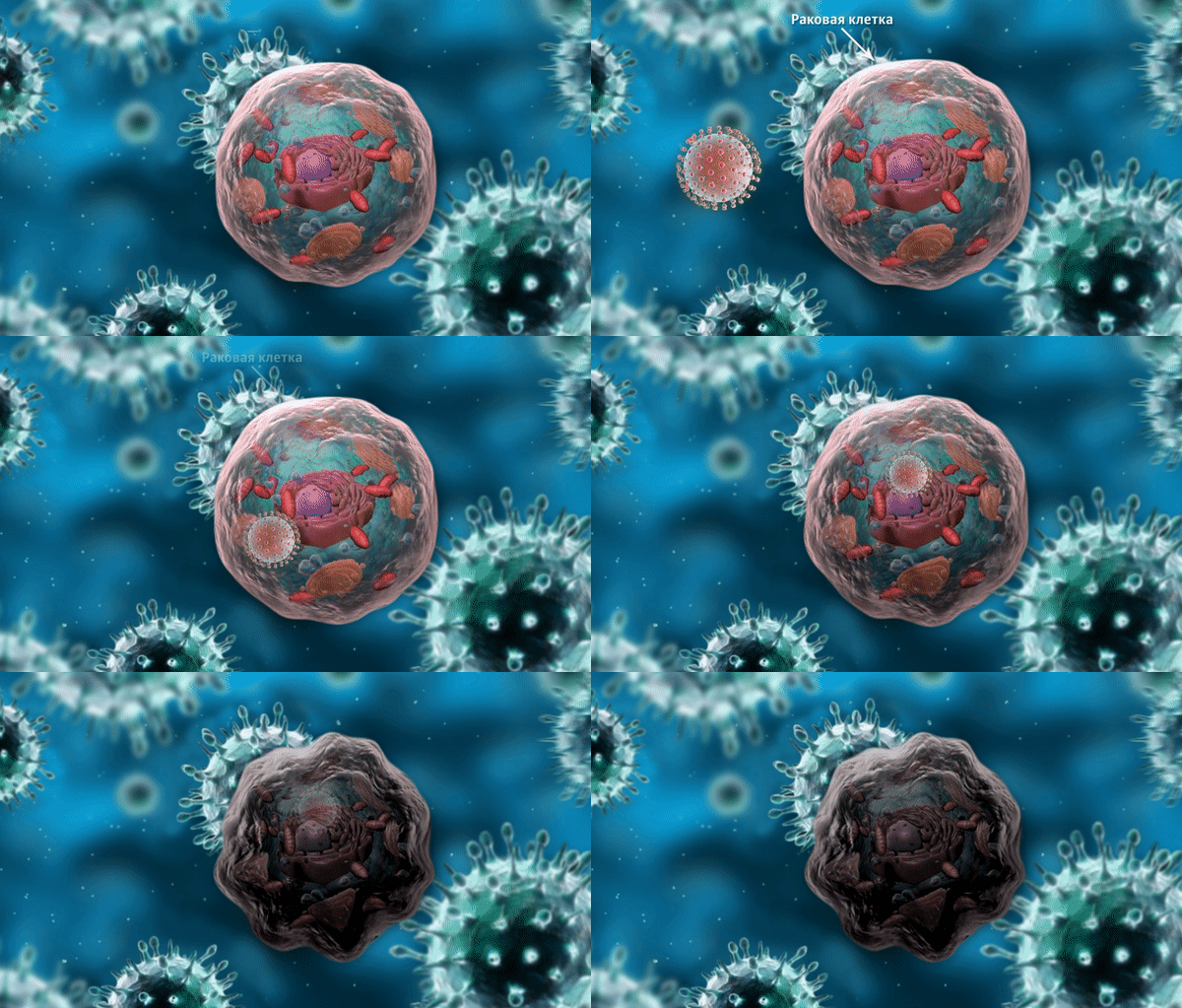
The virus’ purpose is to reproduce, which is achieved by shedding their protective membrane and inserting their genetic material into the hosts’. The viral DNA or RNA is malignant because it is capable of overriding the hosts’ self-sustaining genetic instructions in order to manufacture more of itself instead.
Most viruses are not fatal to their hosts, so its genetic information, now embedded in the hosts’ genetics, is passed down to the hosts’ offspring as changes / mutations in the purely human genetics.
[Researchers] focused only on changes along stretches of DNA with the APOBEC3G protein’s favorite sequence targets…found about 37,000 mutations occurring in 10,000 clusters that they think were caused by these proteins.
We already know that 60 per cent of known infectious diseases in humans and 75 per cent of all emerging infectious diseases are zoo-notic [originate in animals]. Ebola, SARS, the Zika virus and bird flu all came to people by way of animals…
The report—produced in partnership with universities, research institutions, UN agencies and the secretariats of several multilateral environmental agreements— identifies key anthropo- genic [originating in humans] drivers / reasons for the emergence of zoonoses [animal-derived diseases].
- increasing human demand for animal protein;
- agricultural intensification into wilderness;
- increased use and exploitation of wildlife;
- increased utilization of natural resources from urbanization, land use change and extractive industries.
This defines the historic actions of people groups migrating into unsettled territories after the breakup of Pangea into more diverse ecosystems.
-
The more-or-less pristine condition of the Khoisan mitochondrial DNA is scientifically explained by
- early isolation from the rest of the world’s population,
- stable environment over the course of their history
- and reduced exposure to viruses in southern Africa’s hot, dry climate.
First, he shows that agricultural societies developed immunities to deadly diseases like smallpox. Constant proximity to domesticated animals, combined with increased population density, meant that new germs were constantly circulating in agricultural societies. As a result, these societies became resistant to many epidemics—those who couldn’t survive died off, while those with [infection-created genetic mutation] immunities survived and passed on their [genetic mutation] immunities to their offspring.
We know for certain that individuals and groups have traveled and migrated around the world. 1) Known geographical dispersion, rather than 2) unproven extremely long priods of time for some groups but not, for undetermined reasons, other groups, gives us the credible explanation for the development of disparate Y-chromosome haploid groups.
- A parallel timeline of genetic mutations occurring simultaneously in all the groups all of descendants from one set of parents.
- Differentiation by geographical and ecological features of altitude, percentage and type of water sources, soil conditions, environment, climate factors of temperature and degree of exposure to the sun’s radiation; access to health-inducing and toxic plants and microbes.
- Different species of animals in the different locations inducing different zoonoses.
Population migration, not time, is the cause of mutations creating distinct population groups.
Due to population migration distinct lineages of MDT are associated with major global groups including African, European, Native American/Asian, & Oceanic/Aboriginal Australian.

The burning question of “Who was Cain’s wife?” with the scoffing deduction that “she had to be his sister which is contrary to Mosaic law therefore the Bible is inconsistent therefore unreliable” turns out to be a non-issue.
The prohibition against reproducing with close relatives was put into place thousands of years after genetic mutations increased the likelihood of passing on defective genetic expression to offspring of a closely matched genetic set of parents.


 Kingdom Come