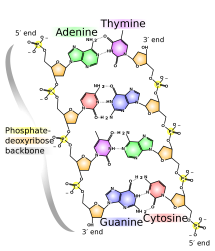
 In 1944 DNA was identified as the structure of inheritance. As complex as that process is, it was determined to consist of just four different molecules. And then these four always combine in the same two base pairs – C with G and A with T.
Compare this to digital computers which perform calculations using the simplest binary code of 0-1.
As with computers, the two DNA base pairs can be lined up in an infinite variety of sequences and lengths to form genes. All living things are distinguished by the number and arrangements of the same two base pairs of molecules.
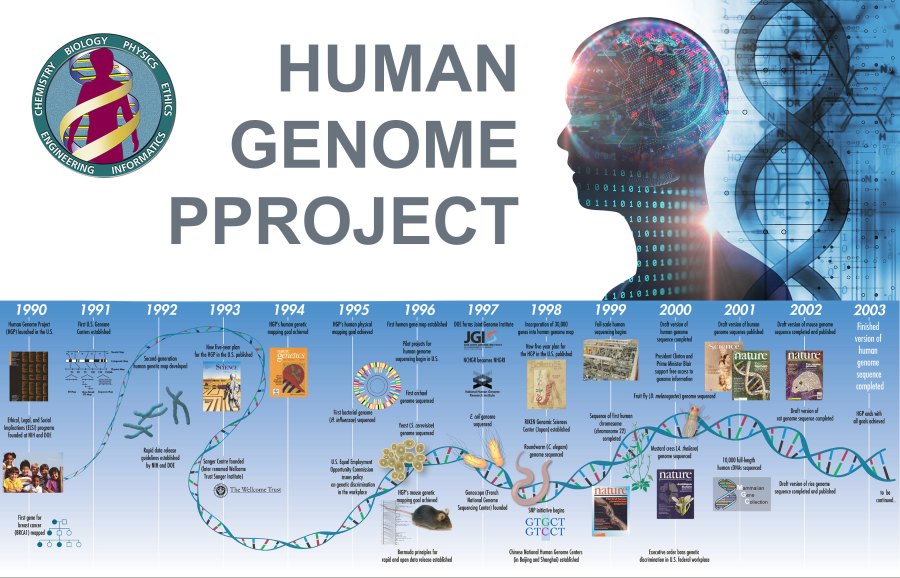
It took the advent of highly functioning computers in the 1990’s to unravel and catalogue the complete sequence of human DNA in The Human Genome Project.
In 2003 a rough draft of the human genome, i.e. complete set of genes to build and operate a human being, was discovered to consist of over 3 billion of the two base pairs forming 20,000-25,000 genes on 23 pairs of chromosomes that with their uniformity, variations and combinations together assemble a human being who is the same, but different, from all other human beings.
-
Darwinists immediately claimed that the HGP provided scientific evidence for evolution because “humans are 99 percent identical to chimps.”
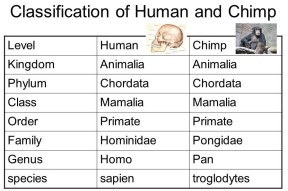
However, further analysis of the data proved that there is only about 95% genetic similarity between humans and chimps, which is large distinction. Humans and chimps aren’t even in the same family. In Evolution’s own assessment, our differences separate us into the primate order, which, with 300 different species, is the third most diverse order of mammals.
Comparative genomics studies the complete genomes of different species commonly used as surrogates in studying human biology, finding that the percentage of DNA shared with other living things is about
- 98% in pigs, the largest match, not apes
- 85% with mice
- 84% with dogs
- 70% with slugs
- 60% with chickens
- 60% with bananas
- 50% with trees
- 44% with honeybees
Darwinians fail to admit that a % difference in genes turns out to be a negligible amount of the total % difference in genome, or total DNA.
Ten years on from the finishing of the human reference genome sequence, it remains unclear what fraction of the human genome confers function, where this sequence resides, and how much is shared with other mammalian species before splitting off in the remote past via random mutations generating evolution.
Protein-coding sequences, which are what we mostly mean when we say “genes,” occupy only a little over 1% of the human genome. So humans are only 95% the same as only 1% of the ape genome, i.e. only .01% of the ape genome.
Another 8% of the genome is nearly all regulatory DNA that governs the behavior of the 1 percent of DNA that codes for proteins. What looks like huge differences between our species arise largely from differences in regulation — what point in life a particular protein-coding gene turns on or off, and in what cells.
-
When humans and primates are first developing, their brains are built from what are known as neural progenitor cells. These cells multiply over and over again, and eventually form neurons. More progenitor cells = more neurons with greater intellectual and physical functioning down the road.
For example, mice progenitor cells mature into brain cells within hours, while primates’ progenitor brain cells continued multiplying at a higher rate than mice brain cells and for roughly five more days before maturing. This extended timeframe means that primates have increased brain power and larger brain organs.
But human progenitor cells take it to the next level, continuing to multiply for up to 7 days before transitioning. Because the cells multiply exponentially (2×2=4 then those 4×4=16, then 16×16=…) the extra two days of multiplication means a great deal more cells than neurons in humans.
This is due to the differently functioning regulatory genes of humans and apes.
Differences in regulation explains why humans are 99.9% genetically identical with each other but have great differences physically, mentally and emotionally.
The 91% remainder of the human genome?
While there recently has been extensive biochemical annotation of this 91% of human DNA sequences, it remains unclear if they have important functional roles.
Seriously? Unclear if they have important functional roles? According to evolution these complex molecules just built up by chance over millions of years for no apparent reason?
The mysterious apparent lack of functionality of the vast majority of the human genome supports the biblical view that the man Adam
- was created perfectly in God’s hyper dimensional image and likeness,
- was corrupted into a vastly less functional four dimensional state of being,
- but retained the capacity
- to be resurrected back into the original hyper dimensional state of being.
“we shall all be changed, In a moment, in the twinkling of an eye…For this corruptible must put on incorruption.” (I Corinthians 15:51-54)
-
Prenatal Brain Development video
The evidence of the amazingly organized
- physiological generation of 2.5 million neurons per minute for nine months in the prenatal human brain
- to form 100 trillion synapses exactly placed to create an informatics transportation system throughout the entire body
- with each neuron precisely connected to a selected set of other neurons on specific end points at precise locations on the cell membranes of target neurons
- on every cell in the human body
should put any thinking person in a state of awe at the understated biblical statement “I am fearfully and wonderfully made: marvellous are thy works…” (Psalm 139:14)
Does mapping the human genome support evolution or Intelligent Design?
-
Gene Myers, the computer scientist who actually put together the genome map…confessed: “We don’t understand ourselves yet…[t]here’s still a metaphysical, magical element.” (Metaphysical means “beyond the physical”; it denotes an area of investigation that has to do with the origins of objects, hence, is outside the legitimate purview of physical science.)…Myers continued: “What really astounds me is the architecture of life. The system is extremely complex. It’s like it was designed.”
Designed? Doesn’t that imply a designer, an intelligence, something more than the fortuitous bumping together of chemicals in the primordial slime?
Even skeptics have acknowledged such. In his book, Fundamentals of Critical Thinking, Paul Ricci has stated that the principle that “‘everything designed has a designer’ is an analytically true statement” (1986, 190).
Myers replied: “There’s a huge intelligence there. I don’t see that as being unscientific. Others may, but not me”.
- partially on inferences
- and an interpretation of data
- to support the possible idea of evolutionary development and common descent
- artwork and implements believed to be among the oldest in the world
- in depth knowledge and insights into wild animals and the environment that they inhabit
- ability to extract nutrients from seemingly inconspicuous plants and survive in generally arid or inhospitable environments
- comprehensive knowledge about the medicinal values of plants to cure hundreds of ailments without modern medicine.
How can any thinking person accept the evidence of this level of complexity and rapidity of development from a single cell organism to a complete human being and Evolution’s fundamental process of genetic mutation over “billions of years” based
In contrast to the word play on the inferences, interpretation, and possibility of evolutionary processes, we have the facts uncovered by the scientific study of anatomy and physiology.
There are simply not enough physical genes to account for such complexity and diversity in life forms.
Mitochondrial DNA, also known as the “mitogenome”, is a key tool for tracking genetic history because, while nuclear DNA is inherited from both parents and mixes it up with every generation, mitochondrial DNA is inherited solely from your mother through the egg cell and can remain unchanged for hundreds of thousands of years.
Through analysis of mitochondrial DNA obtained from females of various ethnic backgrounds, researchers have determined that all humans alive today descended from one female, commonly referred to as ‘Eve’.
So pure scientific evidence supports the biblical account of the mother of all humanity who first carried, then passed on, the sequence of genes called L0.
The story of the mitochondrial Eve is not what paleoanthropologists wanted to hear, so they Evolutionists believe that Eve must have been one of many women of her time, in a genetic bottleneck, during which all offspring of all other women perished.
So much for scientific objectivity
This is clearly to avoid matching the results of this study with the biblical account of creation occurring 6,000 years ago, with the dates of subsequent generations from Eve being documented in lifetimes of individuals, geologically validated catastrophes and reliable history.
 Today, the L0 lineage is found, remarkably unchanged, most commonly in the Khoisan people living in southern Africa.
Wow. I’m pretty sure this is not what very British C.S. Lewis had in mind when he wrote about “daughter of Eve” in his very British The Lion, The Witch and the Wardrobe, but there we have it.
WHAT TO KNOW ABOUT THE KHOISAN, SOUTH AFRICA’S FIRST PEOPLE
This certainly demonstrates the perpetuation of an ancient way of life while isolated from other people groups unable or unwilling to maintain existence in such a minimalist environment. One could even call it biblical.
“For we brought nothing into this world, and it is certain we can carry nothing out. And having food and raiment let us be therewith content. But they that will be rich fall into temptation and a snare, and into many foolish and hurtful lusts, which drown men in destruction and perdition.” (I Timothy 6:7-9)

The Gods Must Be Crazy is a wonderful movie of how the Khoisan live out the biblical mandate of love, joy, peace, longsuffering, gentleness, goodness, faith, meekness, temperance:” (Galatians 5:22-23)
They were much more widespread than today, their modern distribution being due to their decimation in the course of the Bantu expansion starting at the same time detailed in the Bible, then again after the Khoi were exposed to smallpox from Europeans, then again after colonial expansion’s social, economic and political forces drove them out of their homelands.
Today we are witnessing the end of the Koisan people, since having been forcibly relocated to reservations in Botswana, they are now in the middle of the world’s richest diamond field.
That would be due to the baseline premise of Evolution – Survival of the Fittest.


 Kingdom Come