After the original witnesses of Jesus the Christ’s resurrection died off, false teachers sprang up to dispute the faith of those who had heard about this savior. Was He man? Was He God? Was He God appearing as a man? Was He an illusion? Was He a mere man who became God? Was He created by God the Father, or did He exist eternally with the Father?
This was not accidental. The intent and inevitable results of the early Church councils convened to answer these questions was to divide and conquer God’s people. They were clearly heretical, because Jesus had answered those questions.
- “If ye had known me, ye should have known my Father also:
- he that hath seen me hath seen the Father; and how sayest thou then, Show us the Father?
- Believest thou not that I am in the Father, and the Father in me?
- the words that I speak unto you I speak not of myself: but the Father that dwelleth in me,
- he doeth the works. Believe me that I am in the Father, and the Father in me.” (John 14:7-18)
The setting in which the doctrine of the Trinity emerged was the same old, same old denying the Torah’s teachings that
- the Singularity YHVH created mankind out of mass in his likeness and assigned his likeness and dominion of the earth to them, NOT the hyperdimensional sons of God,
- maintaining this covenant even after mankind separated from YHVH’s authority and therefore eternal life, experiencing temporary mortality, unlike the hyperdimensional sons of God who separated and became doomed for eternity,
- accomplishing this covenant by the Seed of the Woman who fulfilled all YHVH’s righteousness thereby becoming the champion of all humans who, by faith in YHVH’s promise of redemption, identify / merge identities with YHVH’s Savior, whether not known to be accomplished by the singular Savior at a point in time, or through trust in the written Word or in the proof of creation and resurrection in nature, NOT by hybrid god-men who save from death in this life through physical force without providing proof of eternal life when mortality inevitably ends in death.
“Hereby know ye the Spirit of God:
- Every spirit that confesseth that YHVHS’s Anointed Savior / Jesus Christ is come in the flesh is of God:
- And every spirit that confesseth not that Jesus Christ is come in the flesh is not of God: and this is that spirit of antichrist, whereof ye have heard that it should come; and even now already is it in the world.” (I John 4:1-3)
And here is one of them:
My favorite Christian Apologist of all time is the Apostle John…
The early first century Church was under attack right away by those who wanted to add to, take away from, or correct the teachings of Jesus…The New Testament as a whole was written…to keep the teachings of Jesus intact…
John, a close companion of Jesus and probably the only remaining original disciple, saw the need for a clear and specific description of Jesus’ identity and ministry…
John wrote to all believers, both Jew and Gentile, in the early Church with a primary purpose of proving that Jesus is the Christ, the promised Messiah, and the pre-existent divine Son of God…God incarnate with evidence of His authority over all of creation…
John writes his Gospel like a good defense attorney and in his opening statement (1:1-2) discloses Jesus’ identity from the very beginning (Compare with Genesis 1:1)…
John then focuses on specific miracles that would reveal Jesus’ divine nature and his life-giving mission…
Notice that all of these miracles are “apologetic” demonstrations of Jesus’ ability to control the science of the natural order. Only God the Creator could do this. For example, his power over chemistry (water to wine), power over biology (healing disease and disability), power over the laws of nature (walking on water), and finally his power over death both physical and spiritual (raising Lazarus and his own resurrection).
In every chapter John focuses on Jesus’ deity being revealed. The most convincing account is found in John 8:58: Jesus said to them: “Truly, truly, I say to you, before Abraham was born, I am.”
John provides evidence that Jesus Himself claimed to be God by revealing a series of “I AM” statements that correspond to Old Testament language and prophecy: (Great article on this at gotquestion.org)…
In addition, we can trace the chain of custody of John’s teachings through his disciples starting with Ignatius (ca. AD 35-117) and Polycarp (69–155) who taught Irenaeus (AD 120-202) who taught Hippolytus (AD 170-236). According to J. Warner Wallace, “John’s students recorded his teachings and identified the sources for later generations. Long before the Codex Sinaiticus was first penned or the Council of Laodicea formalized the canon, the New Testament was established as a reliable eyewitness.” The chain of custody can be further corroborated and established through the other Apostles (Peter, Paul and Mark) and their disciples.
The idea that God the Father, Jesus the Son and the Holy Spirit were distinct individuals from one another. was developed as a Christian dogma, not by the apostles, but centuries later by three non-apostolic theologians from the province of Cappadocia in eastern Asia Minor [today central Turkey] – Basil, bishop of Caesarea, his brother Gregory, bishop of Nyssa, and Gregory of Nazianzus.
Despite the Son’s clear statements of being “one with” the Father and the Spirit and the utter lack of description of God in three persons anywhere in the Bible, “The greatest dogma of the Christian faith is the mystery of the Holy Trinity.”
-
The growing schism of Gentiles from the Jewish believers Christianity is evident in 190 when Ephesus’ bishop, St. Polycrates, held a council to consider The Quartodeciman controversy.
Polycrates emphatically stated that he was following the tradition passed down to him: We observe the exact day; neither adding, nor taking away. For in Asia also great lights have fallen asleep, which shall rise again on the day of the Lord’s coming … All these observed the fourteenth day of the Passover according to the Gospel, deviating in no respect, but following the rule of faith. And I also, Polycrates, the least of you all, do according to the tradition of my relatives, some of whom I have closely followed. For seven of my relatives were bishops; and I am the eighth. And my relatives always observed the day when the people[a reference to the Jews]put away the leaven...
nevertheless the Ephesian Church soon conformed in this particular to the practice of all the other Churches…the Council of Nicaea (325), confirmed for Ephesus its ecclesiastical jurisdiction over the whole “diocese” or civil territory of Asia Minor, i.e. over the eleven ecclesiastical provinces…the Council of Constantinople (381) formally recognized this authority.
“by the early 4th century all Christians were celebrating Easter on a Sunday….Emperor Constantine I…rejecting the custom of the Jews, who had crucified Jesus...first of all, it appeared an unworthy thing that in the celebration of this most holy feast we should follow the practice of the Jews, who have impiously defiled their hands with enormous sin, and are, therefore, deservedly afflicted with blindness of soul…Let us then have nothing in common with the detestable Jewish crowd.
The ultimate accomplishment of separating God’s spirit from Jesus’ humanity is separation of Christianity from its biblical foundation, making it Paganism which for thousands of years has been celebrating the resurrection of the gods Tammuz and Mithras without effecting any forgiveness on humanity.
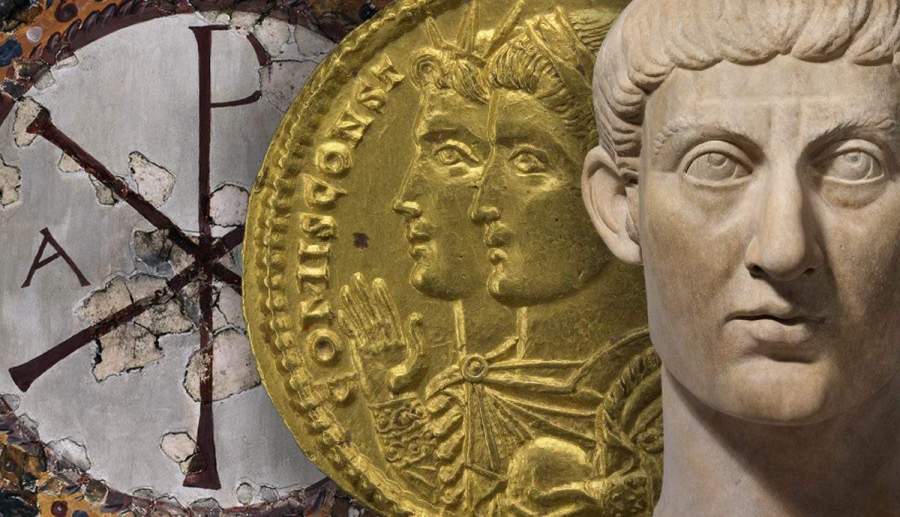
Constantine, although held by many to be the first “Christian” Roman Emperor, was actually a sun-worshiper who was only baptized on his deathbed…He was also vehemently anti-Semitic, referring in one of his edicts to “the detestable Jewish crowd” and “the customs of these most wicked men”—customs that were in fact rooted in the Bible and practiced by Jesus and the apostles.
As emperor in a period of great tumult within the Roman Empire, Constantine was challenged with keeping the empire unified. He recognized the value of religion in uniting his empire. This was, in fact, one of his primary motivations in accepting and sanctioning the “Christian” religion (which, by this time, had drifted far from the teachings of Jesus Christ and the apostles and was Christian in name only)…
Constantine convened the Council of Nicaea in the year 325 as much for political reasons—for unity in the empire—as religious ones. The primary issue at that time came to be known as the Arian controversy.
“In the hope of securing for his throne the support of the growing body of Christians he had shown them considerable favor and it was to his interest to have the church vigorous and united. The Arian controversy was threatening its unity and menacing its strength…
Arius, a priest from Alexandria, Egypt, taught that Christ, because He was the Son of God, must have had a beginning and therefore was a special creation of God. Further, if Jesus was the Son, the Father of necessity must be older.
Opposing the teachings of Arius was Athanasius, a deacon also from Alexandria. His view was an early form of Trinitarianism wherein the Father, Son and Holy Spirit were one but at the same time distinct from each other…
As emperor, Constantine was in the unusual position of deciding church doctrine even though he was not really a Christian. (The following year…he had both his wife and son murdered)…
Norbert Brox, a professor of church history, confirms that Constantine was never actually a converted Christian: “Constantine did not experience any conversion; there are no signs of a change of faith in him. He never said of himself that he had turned to another god . . . At the time when he turned to Christianity, for him this was Sol Invictus (the victorious sun god)” (A Concise History of the Early Church, 1996, p. 48).
When it came to the Nicene Council, The Encyclopaedia Britannica states: “Constantine himself presided, actively guiding the discussions, and personally proposed . . . the crucial formula expressing the relation of Christ to God in the creed issued by the council…
With the emperor’s approval, the Council rejected the minority view of Arius and, having nothing definitive with which to replace it, approved the view of Athanasius—also a minority view. The church was left in the odd position of officially supporting, from that point forward, the decision made at Nicaea to endorse a belief held by only a minority of those attending…more than three centuries after Jesus Christ’s death and resurrection…
Nicene decision didn’t end the debate
After the council, the bishops went on teaching as they had before…Arius and his followers fought back and managed to regain imperial favor. Athanasius was exiled no fewer than five times. It was very difficult to make his creed stick” (pp. 110-111).
The ongoing disagreements were at times violent and bloody. Of the aftermath of the Council of Nicaea, noted historian Will Durant writes, “Probably more Christians were slaughtered by Christians in these two years (342-3) than by all the persecutions of Christians by pagans in the history of Rome” (The Story of Civilization, Vol. 4: The Age of Faith, 1950, p. 8). Atrociously, while claiming to be Christian many believers fought and slaughtered one another over their differing views of God..
“During the middle decades of this century, from 340 to 380, the history of doctrine looks more like the history of court and church intrigues and social unrest . . . The central doctrines hammered out in this period often appear to have been put through by intrigue or mob violence rather than by the common consent of Christendom led by the Holy Spirit” (p. 119)…
“Be sober, be vigilant; because your adversary the devil, as a roaring lion, walketh about, seeking whom he may devour:” (I Peter 5:8)
Satan strengthened the worship of his frankly pagan Antichrist, AKA Sumerian Marduk / Greek Apollo with the veiled worship of the Persian Mithras.
-
The Mysteries of Mithra…were translated into Greek during the Alexandrian epoch…A scrupulous respect for the traditional practices of their sect characterized the Magi of Asia Minor, and continued…among their Latin successors. On the downfall of paganism, the latter still took pride in worshipping the gods according to the ancient Persian rites which Zoroaster was said to have instituted. These rites sharply distinguished their religion from all the others that were practised at the same time in Rome, and prevented its Persian origin from ever being forgotten.
In the Mazdean service, the celebrant consecrated the bread and the water which he mingled with the intoxicating juice of the Haoma prepared by him, and he consumed these foods during the performance of his sacrifice…for the Haoma, a plant unknown in the Occident / West, was substituted the juice of the vine. A loaf of bread and a goblet of water were placed before the mystic, over which the priest pronounced the sacred formula.

MITHRAIC COMMUNIONA curious bas-relief recently published shows us the spectacle of this sacred repast. Before two persons stretched upon a couch covered with pillows is placed a tripod bearing four tiny loaves of bread, each marked with a cross. Around them are grouped the initiates of the different orders, and one of them, the Persian, presents to the two a drinking-horn; whilst a second vessel is held in the hands of one of the Participants. These love feasts are evidently the ritual commemoration of the banquet which Mithra celebrated with the Sun before his ascension. From this mystical banquet, and especially from the imbibing of the sacred wine, supernatural effects were expected. The intoxicating liquor gave not only vigor of body and material prosperity, but wisdom of mind; it communicated to the neophyte the power to combat the malignant spirits, and what is more, conferred upon him as upon his god a glorious immortality.
Mithra appears suddenly in Roman archaeology in the last quarter of the 1st century AD…at the time of [the concurrent spread of acceptance] of Jesus. Mithraism was essentially a soldier’s religion: Mithra, its hero, was a divinity of fidelity, manliness, and bravery; the stress it laid on good fellowship and brotherliness, its exclusion of women…this deity was honored as the patron of loyalty to the emperor.
- In a Roman context, Mithras was…the savior of initiates of his cult…
By the Roman legionnaires, Mithra—or Mithras, as he began to be known in the Greco-Roman world—was called “the divine Sun, the Unconquered Sun.” He was said to be “Mighty in strength, mighty ruler, and greatest king of gods! O Sun, lord of heaven and earth, God of Gods!” Mithra was also deemed “the mediator” between heaven and earth.
Mithraism’s sudden emergence in the Roman world at that particular time has not been explained by historians, but I’m impressed with what the Encyclopaedia Britannica has to say. “The most plausible hypothesis seems to be that Roman Mithraism was practically a new creation, [Mari-Utu] wrought by a religious genius.“
That would be Satan. The Adversary imported Persian Mithraism through the many Roman soldiers returning from wars on the eastern boundary. Obviously nothing has changed there between East and West.
Mithraism took hold and flourished throughout the Roman Empire in the 2nd through 4th centuries AD as the most successful rival to Christianity.
The birthday of the unconquered sun was celebrated at the Roman festival of Dies Natalis Solis Invicti on December 25, and it is often theorized that Constantine had a hand in selecting this day as the celebration date of the birth of Christ as well…
Seemingly, Constantine…viewed Sol Invictus as very similar to the Christian god. His adoption of Christianity in the Roman Empire was more likely a matter of political strategy than religious conviction.
After the acceptance of Christianity by the emperor Constantine in the early 4th century, Mithraism rapidly declined.
I put it to you that this militaristic religion did not in fact decline. While the liturgies of all the religions of classic antiquity have almost totally disappeared – in marked contrast to the Bible it should be noted – the ancient Mithraic Liturgy survived into Christian times and provides an unimpeachable explanation for the process of merging the spirit of a god with a human.
As this study proceeds we will discover that Rome’s state religion is simply a cover, shall we say a shroud, for Rome’s militaristic, secretive, and preferentially, if no longer exclusively male, Mithraism.
The inevitable results of the early Church incorporating pagan beliefs and practices and distancing itself from Judaism was that Judaism likewise determinedly eliminated Jesus Christ-ian, i.e. Messia-nic, elements from its new orthodoxy.


 Kingdom Come