
The first hybrid producer Canaan had literally hundreds of years to grow fertile families of hybrid giants. Not all are specifically named in the Bible as giants, but in context they are certainly included.
“And Canaan begat [named as his heirs]
- Sidon his “first born” / ranked above the others – best known by their maritime rival Japhethite Greek name of Phoenicians.
- and Heth
- the Jebusite – who conquered the city of God
- the Amorite
- the Girgasite
- the Hivite
- the Arkite
- the Sinite
- the Arvadite
- the Zemarite
- the Hamathite.”
This is consistent with Canaan
- fathering multiple hybrids with his grandmother with varying giant traits determined by the shuffle of the genes during meiosis of sperm and egg,
- with the resulting fertile giant offspring generating diverse hybrids based which mix of giant genes they received
- with the differences entrenched by the incestuous breeding necessary to ensure maximum expression of gigantism.
The western leg of the fertile crescent, coastline of the Mediterranean maritime territory, was as much a geopolitical imperative then as it is in our day when Canaan had staked his claim and his name, like William Penn’s “Pennsylvania”. Canaan besieged Jerusalem, the city which is called by YHVH’s name. the gateway to YHVH’s heaven, and laid claim to Mount Hermon, landing strip of the fallen angels.
Canaan’s sons then used this home base to conquer and spread their father’s legacy all across the Mediterranean.
As Canaan’s scion and “begotten” i.e. heir, Sidon is the ultimate representative of a Canaanite.
The city that is called by his name, Sidon, is considered the seat of the seafaring Canaanite, i.e. Phoenician, civilization. Most of the trading ships which spread Phoenician cedarwood, goods, culture, and colonies were launched from this city’s port. An artist’s rendition from historic descriptions and archeological finds gives us a sense of what Sidon’s heyday was like. This, as well as the Phoenician port colony of Carthage on the northern coast of Africa is reminiscent of the description of Atlantis. This is likely a deliberate identification with their glorious Old World civilization, just as Washington D.C. was intentionally designed to recreate Roman heritage.

Artifacts manufactured at Sidon have been found throughout Mesopotamia, Egypt, Rome and even Britain. Through its trade, Sidon was the most powerful city-state of ancient Phoenicia. One of its primary trade goods came from mollusks in that part of the Mediterranean from which were manufactured the purple dye which was so rare and expensive that the color purple became synonymous with royalty.

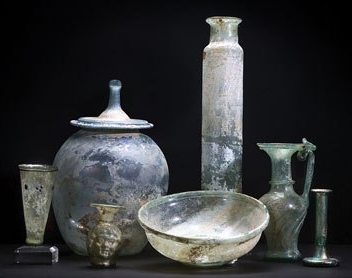
There is evidence that Sidon was inhabited as long ago as 4000 B.C., i.e. the dawn of biblical human history, with evidence of historical continuity from about the time of the flood. That the locations of these cities were known to the post-flood peoples is evidenced by ancient documents such as the following.
I captured the cities of Tarbaṣu and Yaballu…I destroyed those cities, together with cities in their environs, making them like the tells after the Deluge. –Assyrian King Tiglath-pileser III (745-727 BCE)
No doubt Sidon was guided by his antediluvian grandfather Ham to exploit a known source of self-empowerment by settling at a pre-flood site. This emerges as a pattern with the rest of Canaan’s sons as well as immigrants from other families.
The city flourished as part of a loose confederacy of city-states spread along the coast of the land of Canaan...with each city operating as a sovereign state ruled over by a king…This brought Sidon into competition with…the city of Tyre.
In the 10th century BCE, the balance of power shifted to Tyre primarily due to the leadership of…Hiram. Tyre forged trade agreements with the newly minted kingdom of Israel-Judah and her king David. This agreement made Tyre wealthy and Sidon, trying to compete, entered into their own pacts with the kingdom of Israel [which split from David’s clan Judah after Solomon] including the marriage of the Sidonian princess Jezebel, daughter of Ethbaal, to King Ahab.
The Sidonian Jezebel is a portrait of why God said to destroy the Canaanites and their culture from among his people.
“And [Israel’s king] Ahab the son of Omri did evil in the sight of the LORD above all that were before him…he took to wife Jezebel the daughter of Ethbaal king of the Zidonians, and went and served Baal, and worshipped him…in the house of Baal, which he had built in Samaria. And Ahab made a grove…there was none like unto Ahab, which did sell himself [ahh! that profit motive from trade with Sidon] to work wickedness in the sight of the LORD, whom Jezebel his wife stirred up. And he did very abominably in following idols, according to all things as did the Amorites, whom the LORD cast out before the children of Israel.” (I Kings 16:30-33, 21:24-26)
Sidon suffered the depredations of a succession of conquerors. By the beginning of the 19th Century, Sidon had sunk into obscurity.
Heth
Higher criticism of the Bible, which is grounded in denial of any supernatural input, treated the lack of archeological evidence of the Hittites as proof that the Bible was just a book of myths. This position was disproved when in 1876 when archeological discoveries uncovered the existence of powerful nation based in present-day Turkey. If you look at the map you’ll see that this nation had plenty of space to retreat back into the mountains into hiding.
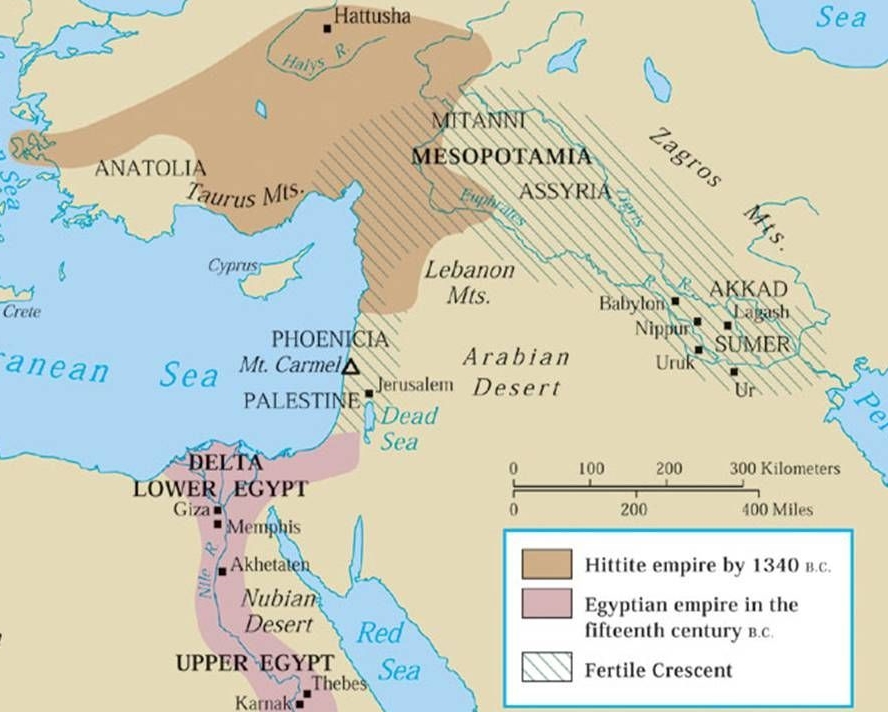
Like his brother Sidon, Heth is referenced as “begotten”, i.e. heir. He also re-occupied a notable pre-flood site. Hattusha was a vast fortress-city with soaring citadels and elaborate temples, originally founded by the Hatti before the flood ~ 2500 BCE.

Even more significant than
- the timing of Hattusha’s construction,
- its primarily defensive form and function and
- its remote location high in the almost inaccessible mountains of Turkey
are the similarities between Hattushan, Babylonian, Egyptian and even South American religious iconography found in Gobekli tepe, the most ancient and mysterious temple site so far discovered.
These unquestionably point to a recent and commonly shared antediluvian culture. Restoration of this massive antediluvian complex would have been high on Heth’s to-do list in order to seize international spiritual control.

When we recall that “sacred” celestial marriages produced genocidal hybrid angel-humans-animals capable of wiping out the entire human race, we understand that the Hittite were going for Alien Resurrection, returning the world to the pre-flood state of alien desecration and destruction.

The powerful Hittite Empire expanded south and challenged Egypt for world dominance.
Excavations at Hattusha have unearthed international treaties with neighboring city-states, among which are some indicating that the Hittites were likely involved in a very real Trojan War.
The clever strategy of getting through the walls via an idol of a horse makes perfect sense once awareness of the practice of horse worship is added our accumulating data. The Trojans couldn’t refuse to host one of their gods.
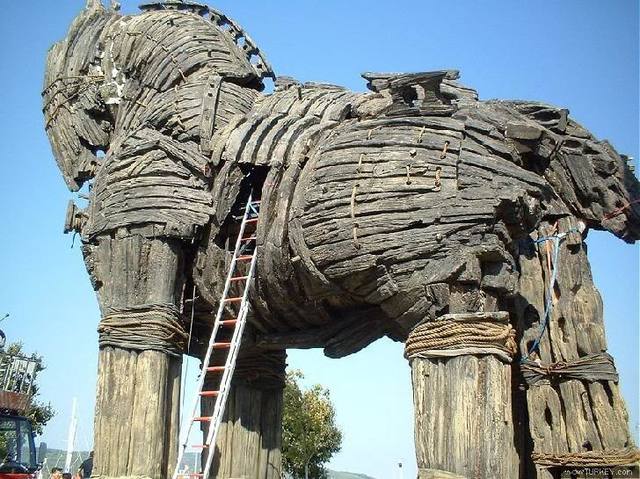
Horse worship is a pagan practice that existed in Europe in the Iron Age and perhaps the [earlier] Bronze Age. The horse was seen as divine, as a sacred animal associated with a particular deity, or as a totem animal impersonating the king or warrior.
Tacitus (Germania) mentions the use of white horses for divination by the Germanic tribes…
There is some reason to believe that Poseidon, like other water [outer space is a sea, remember] gods, was originally conceived under the form of a horse…
This seems related to the archaic myth by which Poseidon once pursued Demeter; She spurned his advances, turning herself into a mare so that she could hide in a herd of horses; he saw through the deception and became a stallion and captured her. Their child was a horse, Arion, which was capable of human speech.
Myth, or account of the pre-flood hybridization program including centaurs?
This bears some resemblance to the Norse mythology reference to the gender-changing Loki having turned himself into a mare and given birth to Sleipnir, “the greatest of all horses”.
A Hittite was among King David’s great men. proving that “God is not willing that any should perish, but that all should come to repentance. (II Peter 3:9)
The compound Hebrew name of “Amorite” indicates ranks of destroyers as tall as palm trees matches the description “whose height was like the height of the cedars, and he was strong as the oaks;” (Amos 2:9)
The Amorite giants are best known for establishing the kingdom of Babylonia under Nimrod, the first named megalomaniacal post-flood giant. God singles them out by name for destruction. for good reason. The Amorite leaders proudly carried on the tradition of arcane pre-flood knowledge brought to mankind by the fallen angels.
This is consistent with other indications that the Amorite nation consolidated in the area around Mount Hermon, documented in the Book of Enoch as Armon, the landing zone for the fallen angels.

The evidence strongly supports the conclusion that the Amorites possessed fallen angel DNA which was carefully bred in their descendants, like race horses or prize-winning dogs, to bring out the most desired traits.
The Amorites are identified from linguistics as Semitic, but this may reflect their early prominence during Sargon’s Semitic empire, before the scattering of the nations into language groups
Naram-Sin of Akkad, grandson of Sargon, recorded defeating the Canaanite Amorites c. 2240 BC.[11] in their territory termed MAR.TU, the western section of the “Four Quarters” of central Mesopotamia along with Subartu (north), Sumer (south), and Elam (east).
 Akkadian literature of this era viewed their nomadic and primitive way of life with disgust and contempt due to their nomadic way of life. Think the Huns. Artifacts from Amorite Kingdom of Mari, capitol city on the west bank of the Euphrates River, further indicate a rude civilization.
The Sumerian myth “Marriage of Martu”, written about this time, warns a goddess, i.e. hybrid female, considering marriage to the god, i.e. chief hybrid male, of the Amorites, against doing so. Think Daenerys and her Dothraki lord.
By the 21st Century BC, i.e. before Abram was born, the immigrating Amorites had become such a force that kings constructed a 270-kilometre (170 mi) wall from the Tigris to the Euphrates to hold them off.[13][14]
Several Amorite royal houses, including those of the old Babylonian kingdom, the old Assyrian kingdom, and the kings of Ugarit, traced their ancestry from Dedan, whose descendants were called the Didanu, Tidanum, and variations thereof from which the Greeks derived the word titanes—the Titans – the old gods who planned their rebellion against God at Mount Hermon causing Noah’s cataclysmic flood.
 Maybe Dedan’s characterization in a new video game has some actual basis in fact?


 Kingdom Come