“they have built the high places of Tophet…to burn their sons and their daughters in the fire.” (Jeremiah 7:30-32)
GOT once again does a fabulous job of depicting this ancient practice when a priestess convinces a claimant to a throne currently up for grabs to burn his young daughter alive to ensure victory in battle.
While humanism-lauding archaeologists deny the biblical record, and define “tophets” as the unusually large number and size of children’s cemeteries in the Canaanite colony of Carthage, the true meaning of this word is in its etymology, still found in the Aramaic word taphyā meaning “hearth”, “fireplace”, or “roaster”, and in the many quotations in the Bible as “pass through the fire to Molech.”
While human sacrifice is a common feature of all pagan religions, the Canaanites were unique in slaughtering their own children, and by the worst of all deaths – burning alive.
The best explanation for this is the predominance of Canaanite peoples in the reproduction of hybrid offspring, many of whom would have been deformed or severely impaired in some way due to genetic aberrations. These would be “given back” to the gods by sacrifice. Just as in modern abortion laws, in time this practice would extend to even healthy unwanted children for economic or romantic relationship reasons.
The Canaanite colony of Carthage was founded in the 9th century BC to facilitate its trade economy, identified as Phoenicians by the Latin word Punica, and almost beating out the Romans for dominion of the Mediterranean in the Punic wars.
In 1921, French archeologists excavating some of ancient Carthage identified many children-specific cemeteries. The largest contained the remains of approximately 20,000 infants in urns.
The Phoenician settlement of Sulci was part of the Carthaginian sphere of influence from the 8th century B.C.E until its conquest by Rome in the 1st century B.C.E., when child sacrifice was prohibited.
An exhibit in the Sant’Antioco archaeological museum reconstructs the layers of Sulci’s Punic “tophet,” with offering bowls to hold the baby’s bodies and dedicatory stelae.

Writing in the 4th century B.C.E, the Greek historian Cleitarchus said of the Carthaginian practice, “There stands in their midst a bronze statue of Kronos (Greek name for Lucifer, Canaanite god Baal Hammon, the chief of Carthage’s gods) its hands extended over a bronze brazier, the flames of which engulf the child. When the flames fall upon the body, the limbs contract and the open mouth seems almost to be laughing until the contracted body slips quietly into the brazier.
 Some inscriptions on the urns record that vows to Tanit / Ashtoreth and Baal Hammon had been met. Many other inscriptions record dedications from the children’s parents ending with the explanation that the god concerned had “heard my voice and blessed me”.
The final line of evidence came from analysis of bones and teeth found in the urns. In the last few years, experts from a number of Academic institutions examined the contents of over 340 burial urns. The finding that 67% of the infants were between 1 and 2 months old strongly suggests that a particular age group was deliberately selected and that these did not die of natural causes.
A second logical explanation is the shift in the balance of power after the flood when fallen angel gods no longer took human women at will to produce hybrids mighty men, and men were dependent solely on hybrid women’s reproductive apparatus to reproduce hybrids.
The dependence on a female goddess mother as the essential carrier of the energy-producing mitochondria, expressed as physical and psychological nurturing of her wishes, was dramatically increased. This is the plot of the mesmerizing book turned into a movie, Gone Girl, and, in the common Arab idiom “the mother of” as meaning any extreme example.
This philosophical consideration is validated by the striking similarities between the Canaanite goddess Astarte and the equally ancient Hindu goddess Kaali, whose culturally variant names for the same goddess are recited in an energy chant sometimes used in Wicca: “Isis, Astarte, Diana, Hecate, Demeter, Kali, Inanna.”
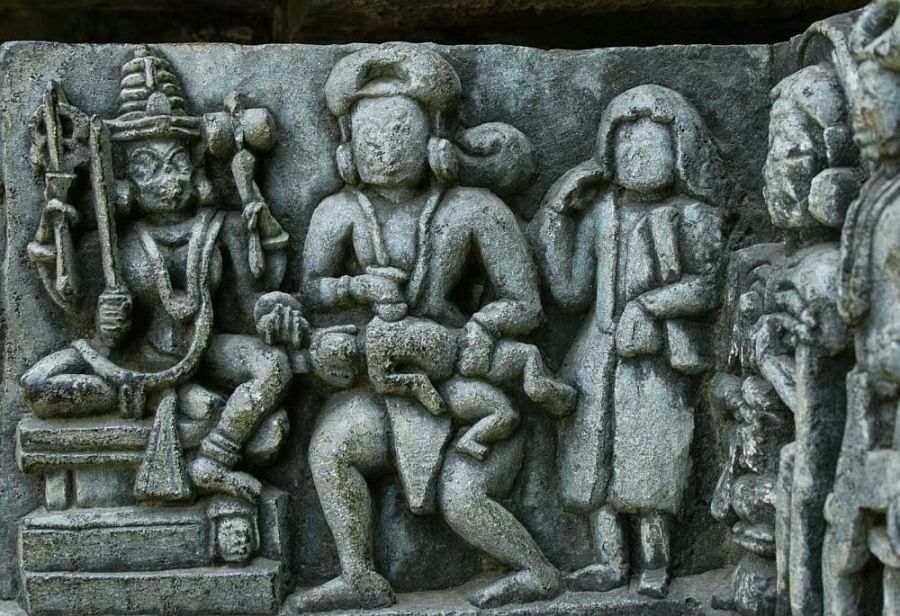
Canaanite goddess Astarte, holding snakes above horse symbols of power and skulls.

Many-armed / Powerful Killer Kali

Clearchus of Soli who wrote extensively around 320 BCE on eastern cultures, wrote that much of Canaanite religion is connected to the ancient Hindu writings.
The Hindu Divine Mother, and Embodiment of Power
Kali first appears in a foundational Shakta text that celebrates the power of the Divine Feminine. Though Kali is often called the “goddess of destruction,” this label oversimplifies her role. In Hindu philosophy, destruction is not inherently negative—it’s a necessary prelude to renewal.
Renewal of the demons’ power, that is.
Two hundred years ago a boy was killed every day at a Kali temple in Calcutta,
Kali’s image has evolved over time, not only in India but globally. She has become a symbol of: Feminine empowerment, Resistance against oppression, Spiritual transformation, Liberation from societal and psychological constraints. Kali has been embraced by some New Age and feminist spiritual circles.
Additional information about the cruel practices of ancient pagans who were ruled by tyrants under the ubiquitous snake chief god and hybrid anthropomorphic animals can be induced from the Mesoamerican practices discovered by the conquering Spaniards in the middle of the first millennium AD.

According to some Spanish records, 80,400 people were slaughtered at the dedication of just one building, the Templo Mayor.
What is truly shocking is the justification for these practices given by self-styled judges of culture.
“The religion of the Aztec civilization which flourished in ancient Mesoamerica (1345-1521 CE) has gained an infamous reputation for bloodthirsty human sacrifice with lurid tales of the beating heart being ripped from the still-conscious victim, decapitation, skinning and dismemberment. All of these things did happen but it is important to remember that for the Aztecs the act of sacrifice – of which human sacrifice was only a part – was a strictly ritualised process which gave the highest possible honour to the gods.”
Seriously?
What is often glossed over in anthropological accounts bemoaning the destruction of grand buildings, works of art and elaborate societies of pagan cultures of every era is the destruction of the victims of those cultures . It is a simple matter of Income Statement. The cost of those grand buildings and lifestyle of the elite at the top of the social pyramid were paid in pitiless taxes, sweat and blood of the masses of people.
The conquering Catholic Spaniards were no different from the locals in enslaving masses of people with uniquely appalling death rates by Spaniards caused by infection.
If the Conquistadores are responsible for unwittingly introducing epidemics to infection-naïve peoples, then so should homosexuals be blamed for causing the deaths of AIDS victims.and that the key stakeholders in each group allowed to mass slaughter to continue in pursuit of their selfish agendas.
My point is not to relieve the Conquistadors of responsibility or demonize astoundingly promiscuous gays who individually may have upwards of 1,000 sexual partners, kindling AIDS into an epidemic. My point is to justly spread the responsibility to all involved parties.
Cortes and his four hundred Spaniards could not have destroyed the magnificent Aztec empire with all its infrastructure if it wasn’t thoroughly rotten from within, based on the worship of deceitful, lying gods who abandoned their faithful subjects at the first sign of defeat. Keep that in mind as we face our own 21st century corruption-induced empire collapse.
It stands to reason that the only thing worse than murder is murder on an industrial scale. The pathological compulsion that serial killers have to repeatedly extinguish life is what sets them apart from other murderers with a financial or legal motive.
As Colombian Luis Garavito, aka ‘La Bestia’ (‘The Beast’) serves 1,853 years for murdering well over 300 children in one devastating seven-year blitzkrieg of death (1992-1999), he continues to confess to more and more murders of vulnerable runaway boys he would lure, tie-up, rape, torture, kill and dismember.
When Santa Isabel-born Pedro López, who preyed on young girls from 1969, confessed to over 300 slayings, police were skeptical until a flash flood uncovered some of his burial sites.
Let’s make an effort to apply the same standards to the biblical account of eliminating the Canaanites from the land of Israel as we do to contemporary justice systems. We do believe that does need to happen sometimes, right?


 Kingdom Come