“stablish you according to my gospel, and the preaching of Jesus Christ” (Romans 16:25)
Paul’s gospel was not a new gospel.
Nothing changed in Yeshua’s message about himself before Pentecost and the apostle’s doctrine of the New Testament Church after Pentecost.
The apostolic leaders of the congregation of believers – including Paul – validate everything they preach by referencing back to the Old Testament promises to Israel.
“Now therefore so shalt thou say unto my servant David, Thus saith the LORD of hosts, I took thee from the sheepcote, from following the sheep, to be ruler over my people, over Israel…Also the LORD telleth thee that he will make thee an house [dynasty].And when thy days be fulfilled, and thou shalt sleep with thy fathers, I will set up thy seed after thee, which shall proceed out of thy bowels, and I will establish his kingdom. He shall build an household / family for my name, and I will stablish the throne of his kingdom for ever.” (II Samuel 7:8-17)
“…they came to Antioch in Pisidia, and went into the synagogue on the sabbath day, and sat down. And after the reading of the law and the prophets the rulers of the synagogue sent unto them, saying, Ye men and brethren, if ye have any word of exhortation for the people, say on. Then Paul stood up, and beckoning with his hand said, Men of Israel, and ye that fear God, give audience.
- The God of this people of Israel chose our fathers, and exalted the people when they dwelt as strangers in the land of Egypt…
- he raised up unto them David to be their king; to whom also he gave their testimony, and said, I have found David the son of Jesse, a man after mine own heart, which shall fulfil all my will. Of this man’s seed hath God according to his promise raised unto Israel a Saviour, Jesus…
- children of the stock of Abraham, AND whosoever among you feareth God, to you is the word of this salvation sent…
- we declare unto you glad tidings, how that the promise which was made unto the fathers, God hath fulfilled the same unto us their children, in that he hath raised up Jesus…from the dead, now no more to return to corruption, he said on this wise, I will give you the sure mercies of David. Wherefore he saith also in another psalm, Thou shalt not suffer thine Holy One to see corruption…
Be it known unto you therefore, men and brethren, that through this man is preached unto you the forgiveness of sins: And by him all that believe are justified from all things...Now when the congregation was broken up, many of the Jews and religious proselytes followed Paul and Barnabas: who, speaking to them, persuaded them to continue in the grace of God.” (Acts 13:14-43)
A meaningful pattern of the development of the organization and doctrine of the New Testament Church becomes apparent if we organize the books in the order and the context in which they were written. The dates the books of the New Testament were written can’t be known with absolute certainty, but for our purpose, the order and historical context in which books were written is what matters, and can be determined for the most part by internal evidence.
Chronological New Testament
| ~Date | Historical Event | |
| 15-34 | Acts 22:3 | Paul, a Pharisee, studies the Law under Gamaliel, opposes Jesus & denounces His sect |
| 29 | Acts 2-8:1 | Crucifixion, Holy Spirit given at Pentecost, apostles and Jewish believers continue meeting in the temple |
| 32 | Acts 6-8 | Stephen stoned, persecution of Messianic Jewish sect by Jewish religious rulers including the Pharisee Saul / Paul |
| 32-42 | Acts 8, 11:19 | Persecution in Jerusalem scatter believers in this Jewish sect who at first continue to witness to Jews only |
| 34-37 | Acts 9 | A leading Pharisee, Saul, joins Messianic sect, smuggled out of Judea when his previous colleagues target him for death, indicating how great a threat he poses to their authority |
| 37-47 | Galatians 1:17-21 | Paul spends 14 years in isolation from Messianic headquarters at Jerusalem, restudying Law and matching to Jesus’ teaching |
| 40 | Acts 10-11 | Cornelius first uncircumcised Gentile accepted into fellowship with Jewish believers, by Peter |
| 43 | Acts 11:20-26 | Gentiles converted in numbers & called Christians at Antioch in Syria prior to Paul’s involvement |
| 43 | Acts 12 | Herod Agrippa I (d. 44) kills James son of Zebedee at Jerusalem, James bro of Jesus assumes leadership |
| 45 – 62 | James 1:1-3 | Epistle of James written by brother of Jesus, to encourage “the twelve tribes” under tribulation |
| 47 | Acts 11:26 | Barnabas brings Paul from Tarsus (Turkey) to Antioch (Syria) to help in existing ministry to Gentiles |
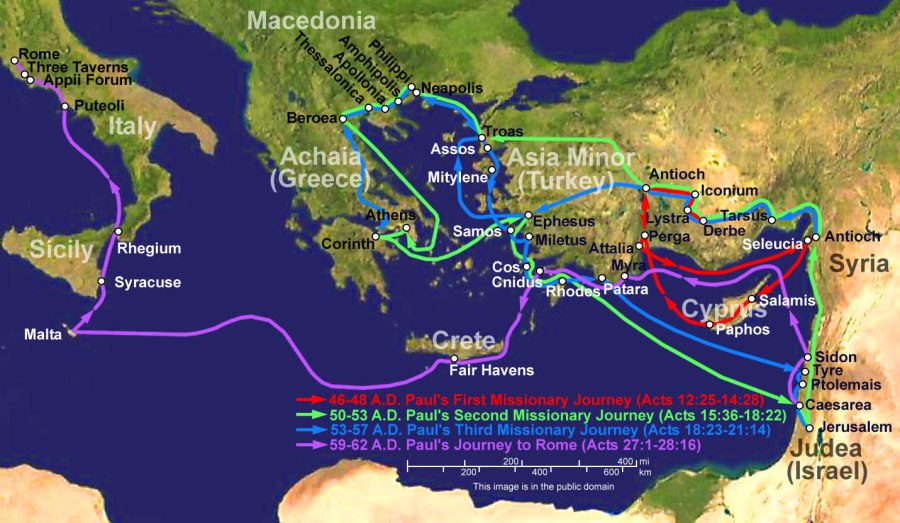
| 47-48 | Acts 13-14 | Paul’s 1st missionary journey thru cities in Galatia (Turkey), meets at synagogues, evangelizes Jews & Gentiles |
| 49 | Acts 15 | Enough Gentiles have joined the Jewish sect in Antioch that a Church Council meets to settle question of requirement of Gentile believers to follow Mosaic Law, Paul opposes this. |
| 49-53 | Acts 16-18 | Paul’s 2nd journey delivers decrees to existing churches in Galatia, crosses over to Europe at Macedonia & Greece |
| 52 | Acts 18:4-8 | Paul leaves Corinth synagogue when they blaspheme, meets in the first house church mentioned in the Bible, with Jewish and Gentile believers |
| 52-53 | Acts 18:1-18 | Letter to Galatians to strongly counter persistent Judaizers, 1st & 2nd letters to Thessalonians to encourage during tribulation, written by Paul from Corinth |
| 54-59 | Acts 18:23-21 | Paul’s 3rd missionary journey |
| 50-55 | I Peter 5:13 | Mark’s biography of Jesus written from Rome in collaboration with Peter to present Jesus as Messiah |
| 55-56 | Acts 19:1-10 | Paul leaves Ephesus (Turkey) synagogue, meets daily in schoolhouse, great church growth |
| 56 | Acts 20:1-2 | 1st letter to Corinthians written from Macedonia by founder Paul in response to church problems |
| 58 | Acts 20:2 | Romans is written from Corinth |
| 58 | Acts 20:3-4 | 2nd letter to Corinthians followup on previous instructions, references great tribulation, Paul meets personally with Ephesus elders |
| 58 | I Peter 5:13 | 1st letter from Peter backs up Paul’s ministry to his Gentile churches, and supports them in their fiery trial of tribulation |
| 58 | Acts 21 | Paul at Jerusalem denies the charge that he teaches Jews to forsake Mosaic Law |
| 58-60 | Acts 22-24 | Paul imprisoned at Caesarea by Romans to protect from illegal Jewish plot against his life, witnesses to Roman governors Felix and Festus, Jewish King Herod Agrippa II, appeals to Caesar |
| 55-60 | Mathew 1:1 | Matthew writes biography of Jesus to prove to the Jews that Jesus is the Messiah. Such biographies were “a genre of Greco-Roman literature interested in describing the goals, achievements, failures, and character of ancient historical persons and whether or not they should be imitated.” |
| 60-63 | Acts 28:16-31 | Paul imprisoned at Rome, reaches out first to Jewish leadership and only to Gentiles after Jews unaccepting |
| 60 | Luke 1:1-4 | Luke’s biography of Jesus is written in collaboration with Paul, possibly for evidence in trial before Caesar |
| 62-63 | Philippians, Colossians, Philemon written by Paul from prison in Rome. | |
| 62-63 | Act 1:1 | Acts by Luke at this time or later. James stoned to death by High Priest at Jerusalem as Jewish nationalistic aspirations heighten. |
| 63 | Letter to Ephesian Gentiles is written by Paul from Rome to encourage picking up their qualified leadership roles after his outreach to Jewish leadership is repulsed. Paul is aware of gathering storm in Judea from insight into current events as fulfillment of Jesus’ warning to “this generation”, predicting Jerusalem doomsday by 70 AD. | |
| 63 | Hebrews written to Jewish and Gentile believers in Jesus as Messiah explaining overrriding identity, and leadership rights, as Hebrew priests under High Priest Melchizedek, in preparation for transition of leadership from Jews to Gentiles. | |
| 63 | Paul is acquitted and released, leaves Rome | |
| 64 | I Timothy 1:3 | 1st letter to Timothy, Titus is Written from Macedonia |
| 64 | The Great Fire of Rome triggers a seven year great tribulation by the Roman Empire of followers of Jewish Messiah | |
| 64 | II Peter 1:1, 2:1-3 | 2nd letter by Peter written from Rome prior to Paul’s death, supporting Paul’s transfer of leadership from Jews to Gentiles. |
| 64-67 | Peter is martyred under Nero, | |
| 65 | II Timothy 4:6 | 2nd letter to Timothy written when Paul is imprisoned for 2nd and last time, mourning that the response to his letter to the Ephesians, the leading church of Asia was that “All in Asia be turned away from me“. Now who will pick up church leadership? |
| 66 | Paul martyred at Rome under Nero as the anticipated revolt by Judean Jews explodes, Messianic Jew flee across the Jordan river to Pella, Jerusalem church and Jewish leadership in shambles. | |
| 70 | Jerusalem besieged, temple destroyed and Jews are deported | |
| ~80 | Jude | Jude, brother of Jesus, exhorts believers to “earnestly contend for the faith which was once delivered unto the saints” which he references as pre-Judaism believers. |
| ~80 | John, I, II, III John | John’s biography of Jesus written to Gentiles unfamiliar with Jewish customs, and three letters. |
| ~89 | Revelation is Written by last surviving apostle, John, to Paul’s Gentile churches in Turkey |
When we track the New Testament documentary timeline, we discover that initially all believers in YHVH’s Savior were exclusively Jewish.
They had to be. The church of YHVH’s Savior was the one sect of Judaism true to scripture in a medley of heretic self-important Jewish sects.
“What advantage then hath the Jew?…Much every way: chiefly, because that unto them were committed the oracles of God.” (Romans 3:1-2)
For ye have heard of my [Paul’s] conversation in time past in the Jews’ religion, how that beyond measure I…profited in the Jews’ religion above many my equals in mine own nation, being more exceedingly zealous of the traditions of my fathers.” (Galatians 1:13-14)
- Pharisaical Conservatives obsessively creating increasingly detailed laws to achieve salvation by works.
- the Pharisees sit in Moses’ seat…do not ye after their works…For they bind heavy burdens and grievous to be borne, and lay them on men’s shoulders; but they themselves will not move them with one of their fingers.” (Matthew 23:1-4)
- “the Pharisees said unto them, Why do ye that which is not lawful to do on the sabbath days?…And the scribes and Pharisees watched him, whether he would heal on the sabbath day; that they might find an accusation against him. But he knew their thoughts…unto them, I will ask you one thing; Is it lawful on the sabbath days to do good, or to do evil? to save life, or to destroy it? And looking round about upon them all, he said unto the man, Stretch forth thy hand. And he did so: and his hand was restored whole as the other. And they were filled with madness; and communed one with another what they might do to Jesus.” (Luke 6:2-11)
- they have a zeal of God, but not according to knowledge. For…going about to establish their own righteousness, have not submitted themselves unto the righteousness of God.”(Romans 10:1-3)
- Herodians, whose religious affiliation was with, and for, political power.
- the Herodians, to catch him in his words…say unto him, Master, we know that thou art true, and carest for no man: for thou regardest not the person of men, but teachest the way of God in truth: Is it lawful to give tribute to Caesar, or not? Shall we give, or shall we not give? But he, knowing their hypocrisy, said unto them, Why tempt ye me? bring me a penny, that I may see it. And they brought it. And he saith unto them, Whose is this image and superscription? And they said unto him, Caesar’s. And Jesus answering said unto them, Render to Caesar the things that are Caesar’s, and to God the things that are God’s. And they marvelled at him.” Mark 12:13-17)
- the Sadducees / Social Liberals, who had become too broad-minded to believe in sin and resurrection.
- “the Sadducees, which say there is no resurrection…asked him, saying, Master, Moses wrote unto us, If a man’s brother die, and leave his wife behind him, and leave no children, that his brother should take his wife, and raise up seed unto his brother. Now there were seven brethren…And the seven had her, and left no seed…In the resurrection therefore, when they shall rise, whose wife shall she be of them?…And Jesus answering said unto them, Do ye not therefore err, because ye know not the scriptures, neither the power of God? For when they shall rise from the dead, they neither marry, nor are given in marriage; but are as the angels which are in heaven. And as touching the dead, that they rise: have ye not read in the book of Moses, how in the bush God spake unto him, saying, I am the God of Abraham, and the God of Isaac, and the God of Jacob? He is not the God of the dead, but the God of the living: ye therefore do greatly err.” (Mark 12:18-27)
- “The Zealots were…founded by Judas of Galilee (also called Judas of Gamala) in the year 6 CE…shortly after the Roman Empire declared what had most recently been the tetrarchy of Herod Archelaus to be a Roman province. According to Josephus, they “agree in all other things with the Pharisaic notions; but they have an inviolable attachment to liberty, and say that God is to be their only Ruler and Lord.” (18.1.6)”
- he called unto him his disciples: and of them he chose twelve, whom also he named apostles; Simon, (whom he also named Peter,)…and Simon called Zelotes…” (Luke 6:13-15)
When Paul is arrested and brought before a judge to determine if he has violated Jewish religious law, he denies these charges.
“My manner of life from my youth, which was at the first among mine own nation at Jerusalem, know all the Jews; Which knew me from the beginning, if they would testify, that after the most straitest sect of our religion I lived a Pharisee…saying none other things than those which the prophets and Moses did say should come: That the Anointed One should suffer, and that he should be the first that should rise from the dead, and should shew light unto the people, and to the Gentiles.” (Acts 26)
When it pleased God…that I might preach him among the heathen; I came into the regions of Syria [Antioch, first Gentile congregation] and Cilicia [first missionary journey]; And was unknown by face unto the [exclusively Jewish] churches of Judaea which were in Christ.” (Galatians 3:15-23)
The text clearly connects the significant Gentile teaching ministry at Antioch to Paul’s missionary work to the Gentiles.
“Now there were in the church / assembly which included many Gentiles] that was at Antioch certain prophets and teachers…the Holy Ghost said, Separate me Barnabas and Saul for the work whereunto I have called them.” (Acts 13:1-3)
The Pentacostal Jerusalem church was so grounded in the Old Testament prophets that its members could immediately accept in the same day the Jewish religion of YHVH’s Savior’s redemptive death and proof by resurrection as related by his righteous witnesses, and were saved by the thousands.
Gentiles? Not so. They needed to start with the Old Testament background leading up to Jesus’ death and resurrection. This is obviously why God chose a Pharisaical Jew obsessed with details of scripture to lead the conversion of Gentiles.
Paul also spearheaded all his new Gentile mission fields at the synagogues because this is where he would find Old Testament literate Jews and Gentile proselytes prepped to accept Jesus as the prophesied Savior.
“So they, being sent forth by the Holy Ghost, departed
- And when they were at Salamis, they preached the word of God in the synagogues of the Jews:
- they came to Antioch in Pisidia, and went into the synagogue on the sabbath day…many of the Jews and religious proselytes followed Paul and Barnabas…the word of the Lord was published throughout all the region.” (Acts 13)
- in Iconium, that they went both together into the synagogue of the Jews, and so spake, that a great multitude both of the Jews and also of the Greeks believed….Long time therefore abode they. (Acts 14)
What is called Christian doctrine is found in Paul’s epistles, and they did not become available until after his first missionary journey, when he follows up with his first Gentile converts to reinforce his preaching and teaching. Those who know the Old Testament recognize that Paul is pervasively citing Old Testament scripture to prove his arguments. We can certainly conclude that Paul was preaching from the Old Testament.
“And Paul, as his manner was, went in unto them, and three sabbath days reasoned with them out of the scriptures, Opening and alleging, that Christ must needs have suffered, and risen again from the dead; and that this Jesus, whom I preach unto you, is Christ.” (Acts 17:2-3)
Sound familiar? This is exactly what Jesus preached to all the apostles.
“These are the words which I [Jesus] spake unto you, while I was yet with you, that all things must be fulfilled, which were written in the law of Moses, and in the prophets, and in the psalms, concerning me. Then opened he their understanding, that they might understand the scriptures, And said unto them, Thus it is written, and thus it behooved Christ to suffer, and to rise from the dead the third day: And that repentance and remission of sins should be preached in his name among all nations, beginning at Jerusalem. And ye are witnesses of these things.” (Luke 24:44-48)
Notice how Paul’s exhortation to his Jewish pastoral student Timothy unquestionably references the Old Testament. The New Testament hadn’t been written when Timothy was a child.
“from a child thou hast known the holy scriptures, which are able to make thee wise unto salvation through faith which is in Christ Jesus. All scripture is given by inspiration of God, and is profitable for doctrine, for reproof, for correction, for instruction in righteousness: That the man of God may be perfect, thoroughly furnished unto all good works.” (II Timothy 3:15-17)


 Kingdom Come