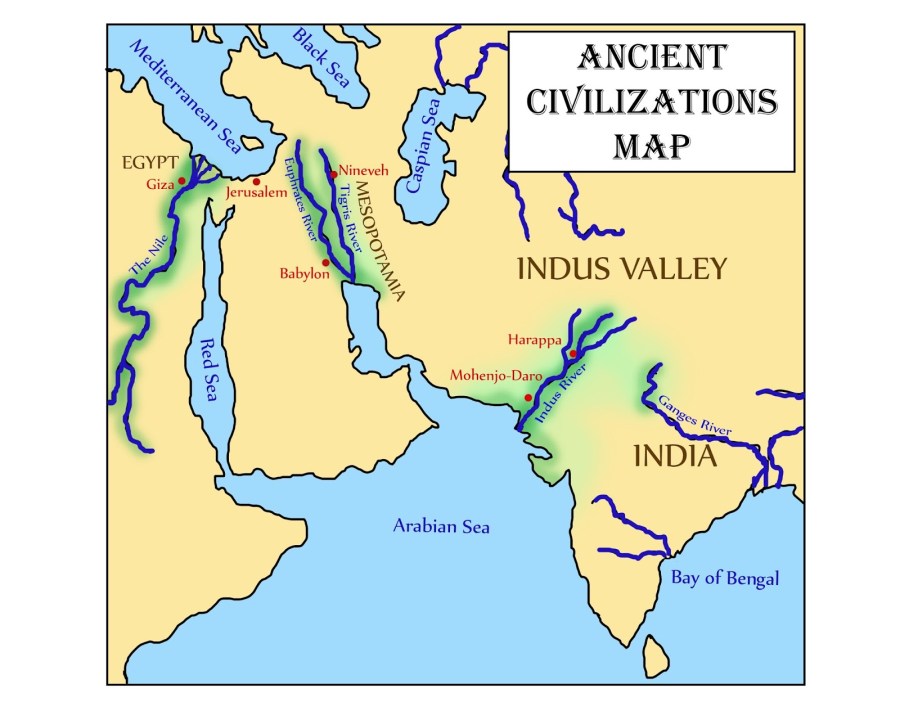
Civilization is defined as society with
- political organization,
- social stratification between elite and workers,
- urbanization with building projects,
- religion
- and record-keeping for perpetuation of the civilization.
Dates of births, deaths & events from Genesis 4 and the apocryphal Jasher, Enoch & Jubilees. Archeological dates from Wikipedia ancient history timeline. Unless otherwise referenced, interpretation of names from Bible codes.
~4000 – ~3700 BC: Adam lives 930 years, faithfully providing eyewitness testimony of the God of Creation to every founder of a rebel ungodly civilization. And we feel frustrated by the lack of results in our testimony.
~3900 -~3000 BC: Cain, whose lifespan is not recorded in the Bible but can be extrapolated from data of his peers in Genesis 5, lives for about 900 years.

~3800 BC: Exiled from Edenic agricultural society, Cain “went out from the presence of the Lord, and dwelt in the land of Nod, on the east of Eden, and he builded a city.” (Genesis 4:16-17)
And when Cain had traveled over many countries, he, with his wife, built a city Nod [meaning wanderer, homelessness] which is a place so called [obviously in defiance] and there he settled his abode; where he only aimed to procure every thing that was for his own bodily pleasure, though it obliged him to be injurious to his neighbors.
The posterity of Cain became exceeding wicked, intolerable in war, and vehement in robberies, bold in his profligate behavior, in acting unjustly, and doing injuries for gain.
~ 3700 BC-~2300 BC: The Ubaid period defined by archeologists as the first historic civilization, evidenced by the congregating of farmers into towns, can only be Cain’s civilization. Initially illiterate and using flint and obsidian tools later replaced by copper, corresponding to the time and region east of Eden settled by Cain, and ending at the date of Noah’s flood, validated by Sumerian records documenting that that their predecessor civilization was wiped out by a world-wide flood.
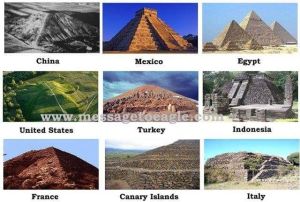
World-wide civilizations’ technology and religion reflect their shared Cainite / Ubaid culture, most obviously in the building of megalithic temples for their fallen gods.
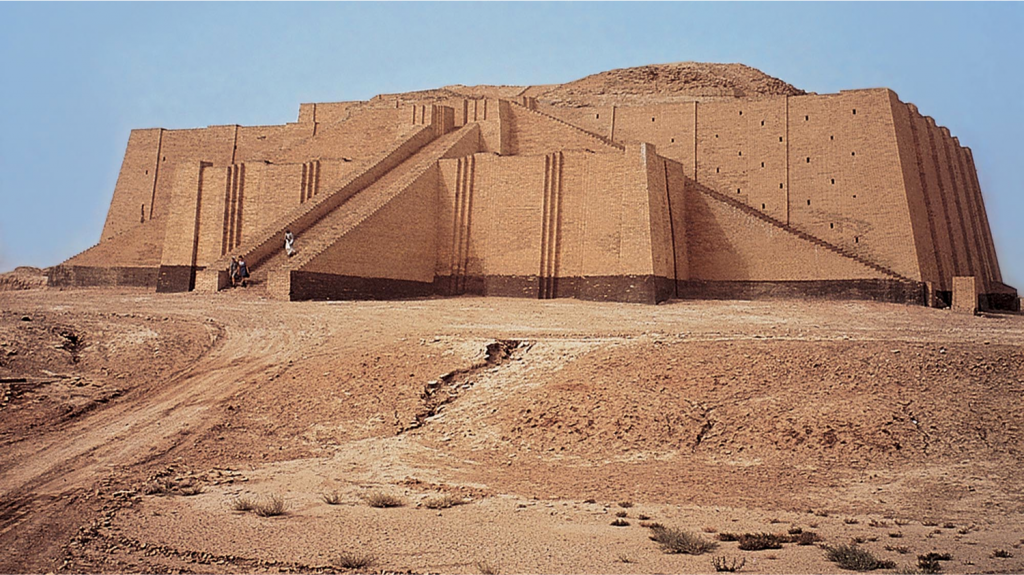
The Great Ziggurat of Ur
~3500 BC: oldest known civilization in the Americas established in the Norte Chico region of coastal Peru, expanding by 3200 BC to 30 major population centers. This is an indication of rapid appearance of “push factors” driving migrations such as invasions, religious persecution, poverty from paying tribute to tyrants, etc. And on Pangea, this was just a short walk across North Africa, no cross-Atlantic ships needed.

~ 3440 BC: Irad means “City of Witness or Fugitive” i.e. protection from vengeance in an era noted for violence? Numbers 35:11-12
~ 3360 BC: Mehujael means “Destroyed of God.“
~3300 BC: The Indus Valley civilization, extending from eastern Pakistan into northwest India for a thousand miles, exhibits highly advanced urban planning unable to be explained by known historical conditions. Its capitol city, Mohenjo-Daro was built on a planned layout street grid lined with buildings built of fired and mortared brick, with indoor plumbing and toilets.

Its infrastructure supported a population of over 5 million people, comparable to New York City, the largest city in the United States, with a population of 8 million people.
And keep panning out – bearing in mind that the earth was one landmass for hundreds of years after the Flood, until the time of Peleg, so travel was much easier and distances far shorter to spread the Cainite civilization.


~ 3260: Methusael means “Man of God” or “The Man We Wanted” a claim to be the promised deliverer. His title is indicative of the violence of this age.
 ~3200 BC: Cycladic culture uncovered by archeologists on Greek islands, the remnants of Eden The Garden Of God, most of which was submerged when the Flood created the Medi-terranean Sea. Most of the remains of this culture are submerged so unaccounted for, but what little is known is that it was a settled and organized community growing wheat and barley, raising sheep, goats, and pigs, and fishing. It is best known for flat female idols carved from marble worshipping the Mother of All Living.
~ 3160 BC: Lamech means “Those in Despair“. From Cain’s line but marries Adah & Zillah, daughters of righteous Cainan (Jasher 2:17,36). Possibly a believer, since he lives during righteous Enoch’s reign during a great revival, but more likely as commonly practiced, he abducted Adah & Zillah like Hamor abducted Dinah, daughter of Jacob.
~ 3100 BC The Uruk period named after the most prominent city at this time, acknowledged by all the leading biblical experts to be the City of Cain’s son Enoch, grew to an estimated population of 50-80,000 despite constant warfare during Cain’s almost thousand year reign / reich.

Uruk was notorious at this time for its extraordinary intellectual output.
- The greatest of the many cultural contributions by the Sumerians is the development of cuneiform writing at Uruk. Proto-cuneiform was pictorial, developed in response to the need for long-distance communication regarding battles and trade, needing only some basic numbers and nouns and verbs to communicate the obvious like “I sent 20 sheep did you get them all?” or “Losing the battle! Send more soldiers!” However, as noted in deciphering the compound names of the rulers, you really have to be familiar with the context and have a certain expectation to understand these messages. “A record of ‘Two Sheep Temple God Inanna‘ tells us nothing about whether the sheep are being delivered to, or received from, the temple, whether they are carcasses, beasts on the hoof, or anything else about them such as payment on a debt or to be paid for by the priests for a festival. This system increased in complexity by changing
- from pictograms – for example, a stick figure lying prone with eyes and mouth open representing “dead body”
- with phonograms where the same stick figure now represents the “uhh” sound of the last breath exhaled from a dying body. A stick figure of a cow could phonetically represent “mmm” from “mooo”. Put together, the two stick figures spell “uhm”, Arabic for “mother”. Add the stick figure of a face with a finger held up before pursed lips and you’ve got “sh”, building the next world “mush” for the daily food of boiled grain. Since there are far fewer sounds than places, people and things and actions this greatly simplifies communication both in writing and interpreting.
- The Sumerian metrology dating back to ~2700 BC is the first known development of a complex place value numerical system with the first appearance of the abacus. Its sexagesimal (60-base) system is used to this day used in astronomy (as viewed from a flattened face of the earth) and time-keeping, with related division of the circle into 360 degrees, as well as developing arithmetic, geometry and algebra and – essentially – linking the daily activities of the individuals in a society by
- scientifically defined units of measurement
- applying these units of measurement society-wide in commerce and industry
- legally upholding the accuracy of measurements made in practice to the reference standards
~3060 BC: And [Cain’s daughters-in-law] Adah bare Jabal…Jubal…And Zillah…bare Tubalcain.” (Genesis 4:19-22) Significantly unlike the genealogical record up to this point – these sons are NOT said to have been begotten by their father, but only that his two wives bare them. This parallels “Joseph the husband of Mary, of whom was born Jesus…that which is conceived in her is of the Holy Ghost.” (Matthew 1:16) Only in the case of J, J & T the conception could not be holy. We can deduce that their fathers were fallen angels and they were demigods.
- Jabal…was the father / authority / teacher of such as dwell in tents, and of such as have cattle…
- Jubal…was the father of all such as handle the harp and organ…
- Tubalcain, an instructer of every artificer in brass and iron…
We know from the biblical record that none of the offspring of these three men survived the flood, so their “fatherhood” is in terms of “authorities” at the same time that a unique Sumerian civilization is recorded to have taken shape, beginning about 2800 BC, as the final stage in the development of writing.
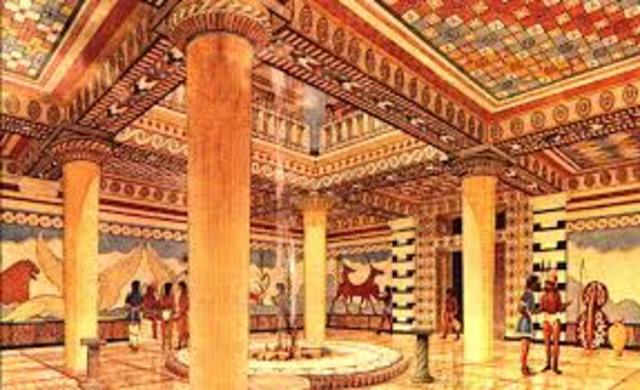
3000 BC: Minoan civilization begins on what is now the island of Crete. Flourishing through trade between the nearby cities, it grows rapidly to become the first major European civilization with palaces and a hierarchy of classes with artisans producing magnificent pottery, jewelry, statues, carvings, frescoes and other works of art, with highly suggestive indications of cultural ties to Atlantis.
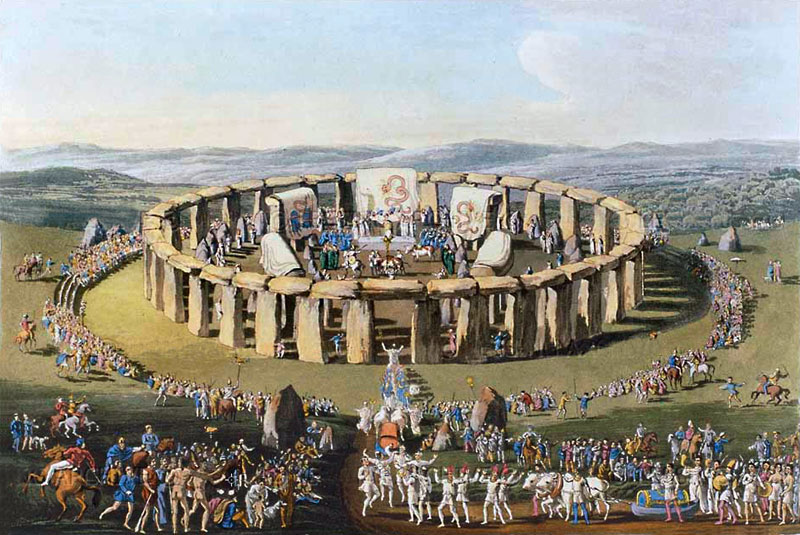
3000 BC: Stonehenge begun in England, along with other mysterious megaliths throughout Europe.
2900 – 2334 BCE – the Early Dynastic Period in Mesopotamia paralleling the Early Dynastic Period in Egypt, both ended by the Flood. The Sumerian Kings List indicates this was an era of perpetual warfare for dominance between kings.
2830 BC: Adam dies, proving that all men, in fact, must die and can only be offset by serving the Most High God. This is acknowledged by commemorating Adam’s death annually by the worshippers of his God.
2800 BC: Mesopotamian civilization expands and flourishes in what is now Iran, with the plough, sailing boats, and copper metal working. Texts in an undeciphered script dated to this period are labeled Proto-(primitive) Elamite.

2800 BC: first Chinese dynasty. Consistent with the biblical account of this era, Five Founding Emperors are portrayed having lived to a great age, introduced the use of fire, taught people how to build houses, invented farming including cultivation of silk, discovered medicine, devised the calendar and Chinese script.
2600-2500 BC The Giza pyramid complex in Egypt is home to the Great Pyramid, the Pyramid of Khafre, and the Pyramid of Menkaure,
2600 B.C. Archaic Olmec Civilization , precursor to later Mesoamerican civilizations such as Mayan and Aztec. Similarities in pyramids world wide can’t be logically explained in any other way than shared culture.


 Kingdom Come